


Perplexity recorded 240M monthly website visits in 2025.
These numbers show how much users rely on LLMs for quick search instead of search engines.
When Google launched AI Overviews and AI-native search engines like Perplexity, it gained mainstream adoption. It comes with a new question that has emerged for publishers, marketers, and SEO professionals:
How do AI search engines decide which sources to trust and cite?
Traditional SEO was simple; marketers just had to focus on ranking web pages in search engine results pages (SERPs) by integrating high volume keywords.
But AI search has introduced a different challenge. Instead of simply displaying links, platforms like Perplexity now analyze information from multiple sources, synthesize answers, and attach citations directly within the generated response.
This shift has transformed how brands ensure visibility. Today, appearing in a citation within an AI-generated answer can be more valuable than ranking on the first page of Google.
Understanding this process is becoming essential for brands investing in SEO, content marketing, or Generative Engine Optimization (GEO).
Curious about how to get cited by Claude? Read more to get 500 prompts today.
What Happens When a User Enters a Query in Perplexity?
Most users assume that Perplexity works like a smarter version of Google. In reality, its workflow is completely different.
When someone asks:
“How does Perplexity choose sources?”
The answer is never simple. This LLM model doesn’t immediately generate an answer from memory. Instead, it follows a multi-stage Retrieval-Augmented Generation (RAG) pipeline designed to gather, evaluate, and synthesize information from external sources.
At a high level, the process looks like this:
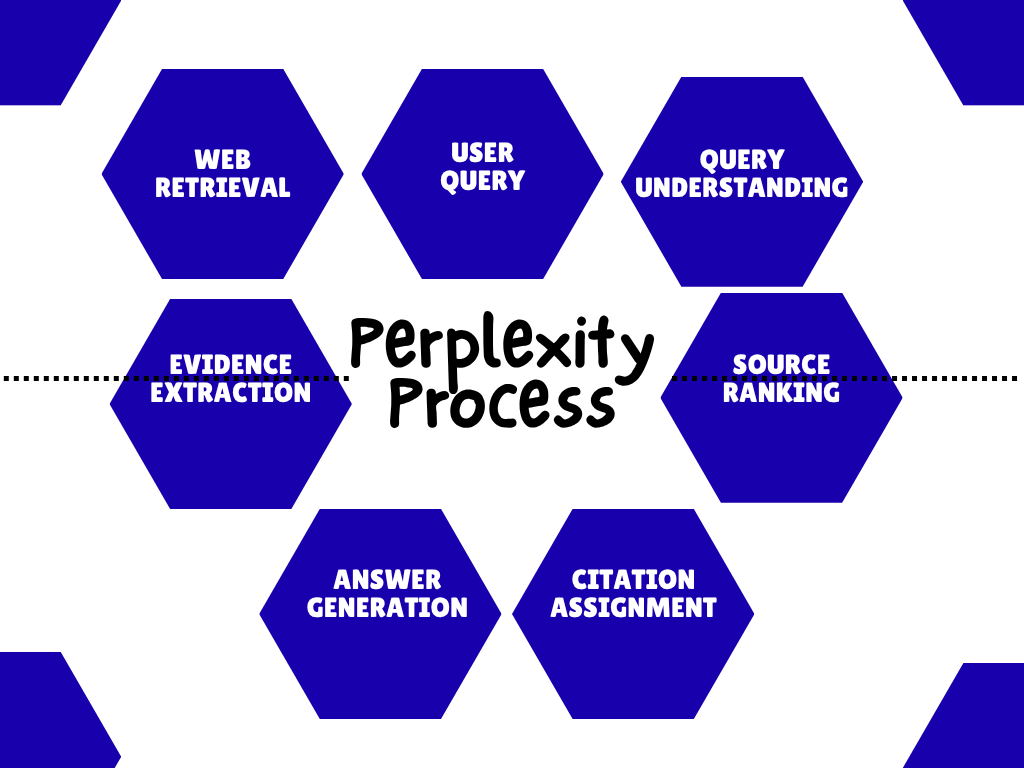
Each step plays a critical role in determining which websites ultimately get cited by Perplexity.
Stage 1: Query Understanding
Before Perplexity retrieves information, it must understand what the user is asking.
For example:
- How does Perplexity choose sources?
- How does Perplexity cite websites?
- What determines AI citations?
These queries use different wording but share a similar intent.
The system analyzes:
Search Intent
Perplexity identifies whether the query is:
- Informational
- Comparative
- Commercial
- Research-oriented
Intent helps determine what type of answer should be generated and which sources should be retrieved.
Query Expansion
Perplexity may expand a query by adding related concepts to the output.
For example:
Original Query
One of the biggest misconceptions about AI search is that retrieval automatically leads to citations.
It doesn’t.
A webpage may be:
- Retrieved by the system
- Evaluated for relevance
- Used as supporting evidence
Yet still never gets cited. Understanding why this happens is one of the keys to succeeding in AI search optimization.
Let’s search for “How does Perplexity cite websites?”
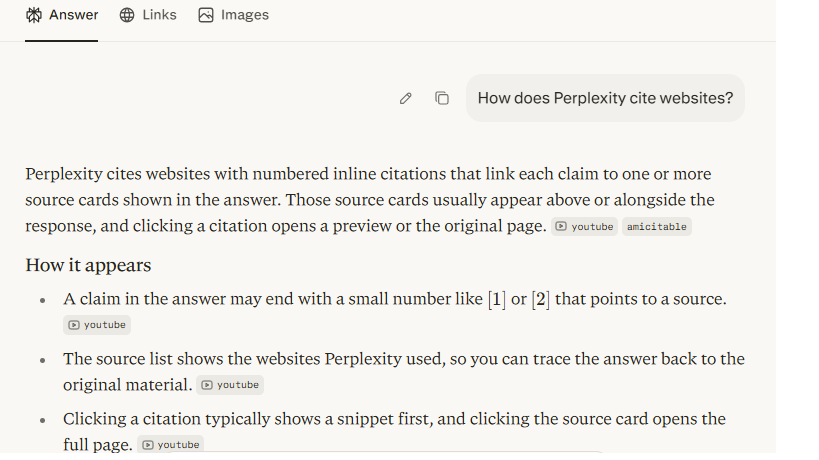
This is what Perplexity cited as a response.
It potentially expanded concepts for:
- AI citations
- Source attribution
- Retrieval systems
- Evidence ranking
- Citation mechanisms
- RAG pipelines
This allows the system to discover highly relevant content even when it doesn’t contain the exact phrase used by the users.
This is one of the reasons why pages optimized only for exact-match keywords often struggle to gain visibility in an AI search environment.
Entity Recognition
The perplexity model recognizes different identities, making the citation more relevant and accurate for the user query. Some of the most common entities it focuses on:
- Companies
- Technologies
- Products
- Concepts
Rather than matching words alone, Perplexity understands relationships between topics and context to provide more accurate results for the user.
Why It Matters
AI search increasingly rewards topical coverage over keyword density. Content that comprehensively explains a topic often performs better than content optimized just for a single word.
Stage 2: Source Retrieval
Once Perplexity understands the query, it begins retrieving multiple sources. This stage is known as retrieval.
The goal isn’t to find one perfect page but to gather a pool of potentially useful documents that answer the exact query.
What Is Retrieval-Augmented Generation (RAG)?
-
Retrieval
When you enter a query, Perplexity first searches for relevant information.
It includes multiple sources and analyzes:
- News articles
- Official websites
- Research papers
- Documentation
- Public web pages
For example, if you ask:
“What are the latest developments in quantum computing?”
Perplexity will:
- Search the web.
- Rank relevant documents.
- Select the most useful passages to provide accurate information.
The goal is to gather evidence before answering the query to make the user’s intent clear and relevant.
-
Augmentation
After retrieval, Perplexity doesn’t immediately answer; instead, it builds a prompt for its underlying LLM that looks conceptual.
When a user enters a query, it retrieves content and injects it into the model’s context window so the model can reason over it.
Think of augmentation as: LLM Knowledge + Retrieved Documents = Enhanced Context
Without augmentation, the model would only rely on what it learned during the training.
-
Generation
The augmented prompt is then sent to the underlying language model.
The model:
- Reads the retrieved passages.
- Identifies key facts.
- Combines information from multiple sources.
- Produces a coherent answer.
For example:
Based on recent announcements, IBM introduced …
Google reported …
Researchers demonstrated …
Perplexity then attaches citations to show which retrieved sources support each claim.
In a Nutshell, RAG stands for:
- Retrieval = search the web and gather evidence.
- Augmentation = placing the evidence into the model’s context.
- Generation = have the LLM write the final answer based on that evidence.
End-to-End Flow in Perplexity
User Question
↓
Web Search
(Retrieval)
↓
Relevant Sources
↓
Context Building
(Augmentation)
↓
LLM
(Generation)
↓
Answer + Citations
Hybrid Search: The Foundation of Retrieval
Perplexity likely combines two retrieval methods: lexical and semantic search.
Lexical Search
Lexical retrieval is also known as keyword search; it’s a traditional method that finds information by exactly matching the keywords.
For example:
A search for “Perplexity source ranking” may prioritize documents containing those specific terms.
Advantages:
- Precise matching
- Strong keyword relevance
Limitations:
- May miss semantically related content
Semantic Search
Semantic retrieval on data searching is a technique that focuses on understanding the contextual meaning and intent behind the user’s query.
It uses embeddings to understand that:
- “How Perplexity selects sources”
- “How AI answer engines choose citations”
These are closely related concepts that make the semantic search more relevant.
Advantages:
- Better understanding of context
- Finds conceptually relevant content
Limitations:
- Can retrieve broader results
Why Perplexity Uses Both
Hybrid retrieval combines the strengths of keyword matching and semantic understanding.
| Retrieval Method | Strength |
| Lexical Search | Exact matches |
| Semantic Search | Meaning-based relevance |
| Hybrid Search | Precision + Context |
This approach increases the chances of finding high-quality information.
Stage 3: Source Ranking
Retrieving documents is only the beginning. The next challenge is determining which sources deserve attention.
This is where ranking comes in. Perplexity may retrieve dozens of pages, but only a handful will influence the final answer.
Key Ranking Signals
-
Relevance
The most important signal is relevance.
A highly relevant source that directly answers the query will typically outperform a less relevant but more authoritative page.
-
Authority
Authority helps Perplexity evaluate trustworthiness.
Indicators may include:
- Expertise
- Reputation
- Consistent accuracy
- Strong topical coverage
-
Freshness
For rapidly changing topics, recent information becomes important. Queries about AI tools, software updates, regulations, or news often benefit from fresh sources.
-
Evidence Density
Pages containing:
- Statistics
- Research
- Data
- Examples
often provide stronger evidence than opinion-heavy content.
-
Extractability
One of the most overlooked ranking signals is extractability.
AI systems prefer content that is easy to understand and extract.
Examples include:
- Clear headings
- Definitions
- Bullet points
- Tables
- FAQs
Well-structured content often performs better because it reduces the effort required to identify useful information.
Stage 4: Evidence Extraction
After ranking, Perplexity doesn’t treat every webpage equally.
Instead, it extracts specific passages that appear most relevant to the query.
This process is often called chunking or passage retrieval.
Rather than using an entire article, Perplexity may only use:
- A definition
- A statistic
- A key explanation
- A comparison
This is why individual sections can become highly valuable.
What Makes Content Easy to Extract?
The most extractable content typically includes:
- Clear definitions
- Short explanatory paragraphs
- Data points
- Tables
- Step-by-step frameworks
- FAQ answers
Content organized in this format is more likely to contribute evidence to AI-generated responses.
Stage 5: Answer Generation
Once evidence is gathered, Perplexity synthesizes information into a single answer.
This differs significantly from traditional search.
Instead of showing users multiple webpages, the system combines information from several sources into one response.
How Answer Synthesis Works
Perplexity may:
- Merge information from multiple sources
- Compare viewpoints
- Remove redundant information
- Resolve contradictions
The objective is to generate a concise and useful answer rather than reproduce source material verbatim. This synthesis process is one reason AI search feels different from traditional search engines.
Users receive conclusions rather than a collection of links.
Read more about how to rank in ChatGPT.
Stage 6: Citation Assignment
Citation assignment is the final stage of the pipeline.
After generating an answer, Perplexity determines which sources should receive attribution. This is where many websites drop out of the process.
A source may:
- Be retrieved
- Be ranked
- Contribute evidence
Yet still do not receive a visible citation. Sources are more likely to be cited when they:
- Provide unique information
- Contribute key evidence
- Directly support important claims
- Demonstrate trustworthiness
Sources may be excluded because:
- Similar information exists elsewhere
- Their contribution was minimal
- Higher-quality alternatives were available
This explains why citation visibility is often much more competitive than retrieval visibility.
How Perplexity Differs From Google Search
| Factor | Google Search | Perplexity |
| Goal | Rank webpages | Generate answers |
| Output | List of links | Synthesized response |
| Ranking Unit | Entire page | Evidence and sources |
| Citations | Optional | Core feature |
| User Experience | Discovery | Direct answers |
LLMs are providing more accurate and quick answers. Therefore, models like Perplexity focus on delivering answers that are direct and brief.
The 7 Signals Most Likely to Influence Perplexity Citations
While Perplexity doesn’t publicly disclose its ranking algorithm, content that consistently earns citations tends to share several characteristics.
1. Topical Relevance
Staying relevant to the topic signals to LLMs that a business has authority. When you directly answer the query, it instantly gets cited.
2. Authority
To build a business authority, it’s important to cover every aspect of the topic. Demonstrates expertise and trustworthiness to build credibility and authority.
3. Freshness
Creating fresh and relevant content can help get cited in LLMs. It signals that your business is constantly providing fresh and relevant information.
4. Evidence Density
Adding relevant data, examples, and research makes the content more authentic and credible.
5. Content Structure
Structuring the content can help get it cited. Break down text by using headings, lists, and clear organization. This instantly makes content scanable and easy to cite.
6. Original Insights
Provides information backed by original insights, making the content more credible and citable.
7. Extractability
Adding key points to the content makes it easy for AI systems to extract and cite.
How to Optimize Content for Perplexity and AI Search
If your goal is earning citations from AI search engines, focus on creating content that serves both humans and retrieval systems.
Best Practices
- Answer questions directly
- Use descriptive headings
- Include concise definitions
- Add original data and research
- Cover topics comprehensively
- Use tables and comparison frameworks
- Structure content with FAQs
- Update content regularly
Most importantly, optimize for usefulness rather than keywords alone. AI systems increasingly reward information quality over keyword repetition.
Sum Up
Perplexity’s source selection process is built around a Retrieval-Augmented Generation pipeline that combines query understanding, retrieval, ranking, evidence extraction, answer generation, and citation assignment.
The system doesn’t simply find webpages; it evaluates information, extracts evidence, synthesizes insights, and attributes sources that contribute meaningful value to the final response.
For publishers, the implication is clear: success in AI search depends less on ranking for individual keywords and more on creating trustworthy, well-structured, evidence-rich content that AI systems can easily retrieve, understand, and cite.
As AI search continues to evolve, the websites are most likely to earn visibility. At Rankhive, we believe prioritizing relevance, clarity, authority, and extractability is both helpful for humans and AI systems to find trustworthy answers.


