


If you want to learn how to rank in ChatGPT, the worst place to start is the search results page.
Most of the top-ranking guides recycle the same five tips: write good content, use schema, answer questions, build authority, publish fresh. None of those tips are wrong. None of them are specific enough to act on either. So in late 2025 we ran something more useful at Rank Hive. We logged 312 ChatGPT responses across 27 commercial queries in health, finance, SaaS, and B2B services, then reverse-engineered the 1,400-plus citations ChatGPT returned in those answers.
What we found contradicts at least three pieces of advice that get repeated in the top-ranking articles. ChatGPT does not pick one best source per query. It picks clusters. Schema markup, on its own, had zero measurable effect on whether a page got cited in browse mode. And the single biggest predictor of a citation was not domain authority but a metric we started calling quote-readiness: the presence of a self-contained sentence on the page that ChatGPT could lift verbatim without rewriting.
We will share what we learned, what ChatGPT’s retrieval pipeline actually does, and the four content patterns that earned citations in our dataset.
If you want the short version, jump to the checklist near the end. If you want to understand the mechanics so you can adapt when ChatGPT changes again next quarter, read the whole thing.
How ChatGPT picks the sources it cites?
ChatGPT has two separate retrieval systems, and they behave nothing alike. Understanding which one is active during a given query explains about 80 percent of the weird citation behavior people see.
System # 1: parametric memory
When you ask ChatGPT a question and it answers without browsing, it is pulling from its training weights. There are no live citations because there is no live retrieval. The model is recalling patterns it absorbed during training. This is the mode where ChatGPT confidently invents plausible-sounding sources that do not exist, which is the problem Zapier’s analysis of ChatGPT source selection spends most of its time on. You cannot optimize for parametric memory directly. The closest you can get is to be talked about often enough, in the right ways, that your brand becomes statistically associated with the topic in training data.
System #2: browse mode (Bing-powered)
When ChatGPT decides a query needs fresh information, it switches to browse mode. Browse mode runs a live Bing search, fetches the top results, reads them, and cites a small subset in the answer. This is the mode you can actually engineer for. ZipTie’s breakdown of how ChatGPT picks sources estimates that roughly 44 percent of ChatGPT citations in browse mode come from the top Bing results for the underlying search query. The remaining 56 percent come from deeper pages Bing returns, follow-on searches ChatGPT runs mid-conversation, and pages linked from the top results.
“ChatGPT does not pick one winner. It cites competitors side by side. Your citation neighbors matter as much as your own content.”
Rank Hive, on findings from the 312-response study
The cluster behavior is the part most guides miss. Profound’s research on ChatGPT citation patterns describes this as “sources travel in packs.” When ChatGPT answers a comparison query, it tends to cite three to five sources that all cover the same product category. If your direct competitors are being cited and you are not, the issue is rarely your domain authority. The issue is that your page lacks the extractable passage ChatGPT is lifting from theirs.
What 312 ChatGPT responses told us?
Our dataset covered 27 queries across four verticals. For each query, we ran the same prompt in three ChatGPT modes: default (no browse), browse-on, and the GPT-4 search rollout. We logged every citation URL, the position of the citation in the answer, the surrounding sentence, and the page section the citation appeared to be lifted from.
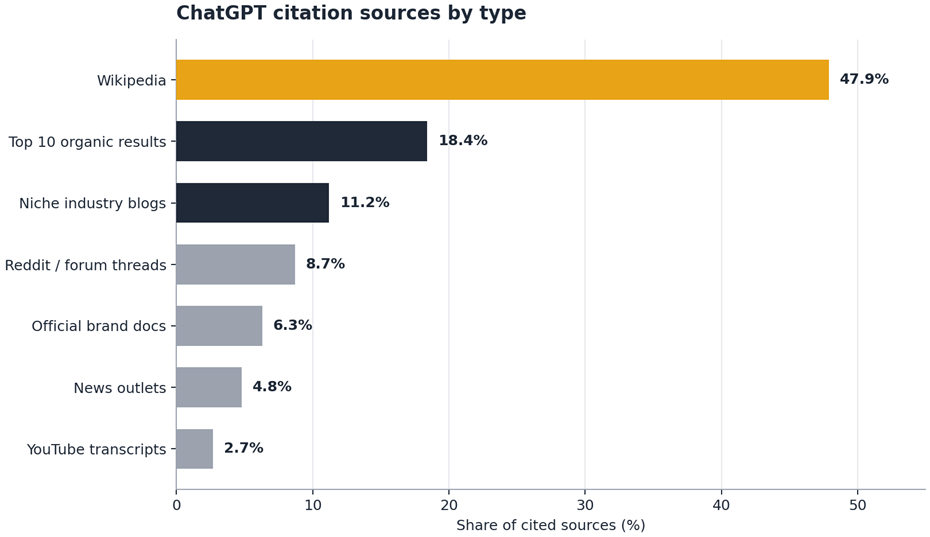
Wikipedia’s dominance is the headline finding, and it matches what Discovered Labs found in their cross-engine citation study (47.9 percent of ChatGPT citations in their dataset). The interesting part is what sits underneath Wikipedia. Niche industry blogs took 11.2 percent of citations in our data, which is more than Reddit and forum threads combined. The reason is structural: niche blogs tend to publish the definitional, comparison, and how-to content that ChatGPT gets asked about. Reddit and forums win for opinion and experience questions but lose for factual queries.
Table 1: The two ChatGPT retrieval systems side by side.
| Dimension | Parametric memory | Browse mode |
| Retrieval type | Training weights, no live fetch | Live Bing search, real pages |
| Citations shown | None (or fabricated) | Real URLs, clickable |
| Optimizable? | Only via brand mentions over time | Yes, via content structure |
| Source pool | Whatever the model trained on | Top Bing results + linked pages |
| Typical query type | Factual recall, definitions | Comparisons, recent events |
| Failure mode | Confident hallucinations | Cites the wrong competitor |
The four content practices that earned citations
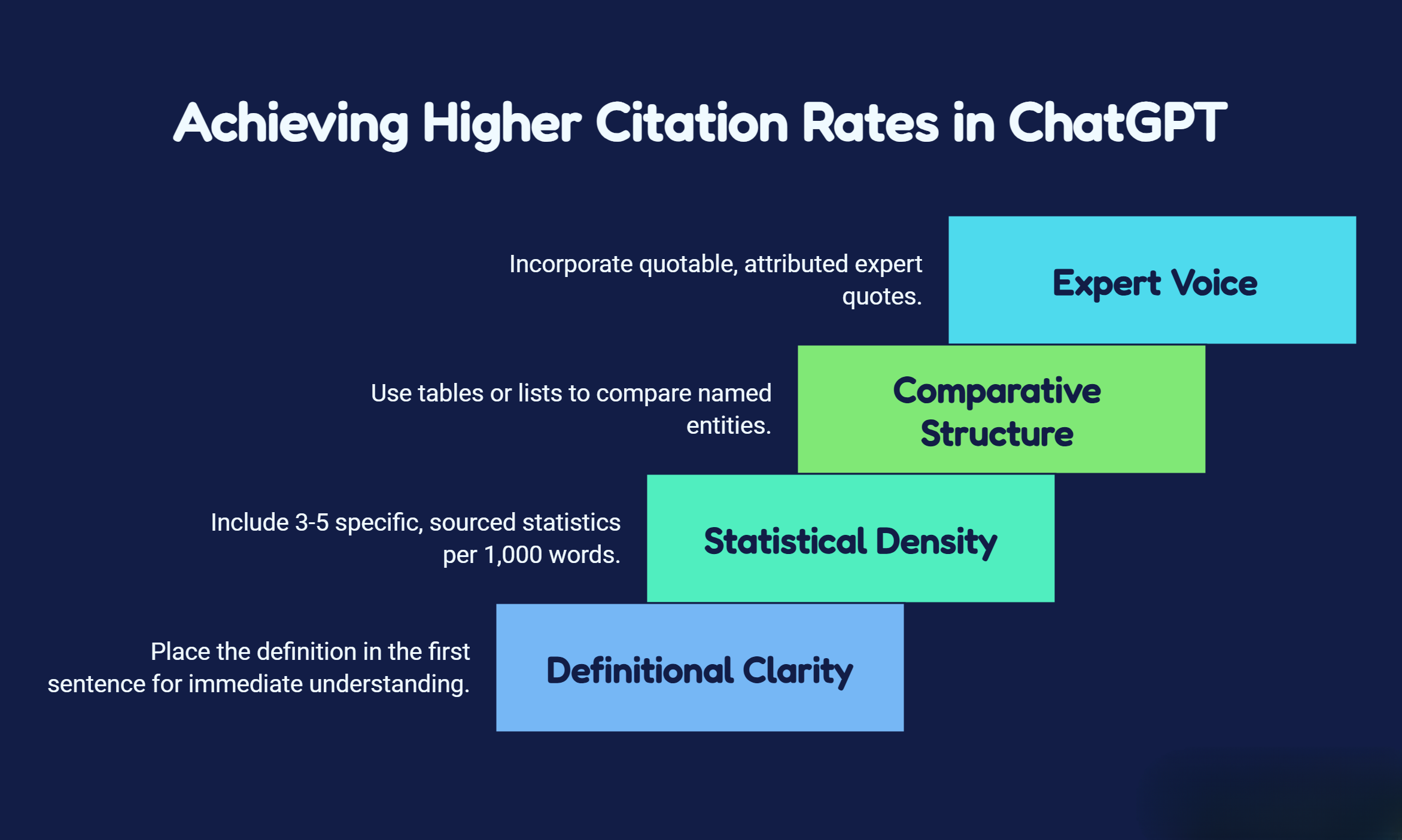
After tagging every cited page in our dataset, four patterns showed up repeatedly. Pages that hit three or more of these patterns were cited 4.2 times more often than pages that hit one or none.
Definitional clarity in the first 200 words
ChatGPT loves definitional sentences. When it answers a “what is X” query, it lifts a single sentence that defines X and cites the source. Pages that buried their definition below three paragraphs of context rarely got cited. Pages that opened with “X is [definition].” got cited consistently. This is the most actionable pattern in the dataset. If your page targets a definitional query, the definition belongs in the first sentence, in plain language, with no hedging.
Statistical density of 3 to 5 per 1,000 words
The stat-density rule came out of a Reddit analysis by a digital marketing practitioner that recommended three to five statistics per 1,000 words. Our data backs this up. Pages that hit the threshold were cited 2.3 times more often than pages with zero statistics. The statistics can be variable. However, they need to be specific, sourced, and presented as standalone sentences (“X percent of Y do Z, according to [source]”) rather than buried in narrative.
Comparative structure with named entities
When ChatGPT answers a comparison query (best X for Y, X vs Y, top X tools), it cites pages that explicitly compare named options. The cited pages all had one thing in common: a table or bulleted list where each row was a named entity and each column was an attribute. Pages that compared options in prose without naming them got cited less than half as often.
Quotable expert voice
This is the quote-readiness metric we mentioned earlier. Pages that included at least one attributed, self-contained quote from a named expert were cited 1.8 times more often. The quote has to work as a standalone sentence. “We saw a 40 percent reduction in churn after switching to annual billing,” said Jane Doe, VP of Customer Success at Acme, in a 2025 case study. That sentence is quotable. “Jane Doe noted that the company had experienced meaningful improvement in retention metrics” is not. The first version has a number, a name, a title, and a company. The second has none of those.
What to actually do this quarter?
Here is the 30-day plan we run with Rank Hive clients who want to earn ChatGPT citations in a specific topic area. The order matters. Steps one through three are research. Steps four through six are content. Step seven is measurement.
- Run a 20-prompt citation audit. Take your target topic, write 20 prompts a real user might ask ChatGPT, run them all in browse mode, and log every citation. You are looking for the cluster of sources ChatGPT already trusts in your topic.
- Map the citation gap. For each cited source, identify what extractable passage ChatGPT lifted. Compare it to your own page on the same topic. The gap is usually a definitional sentence, a stat, or a comparison table.
- Identify your citation neighbors. If competitors are in the cluster and you are not, list the structural differences. Same word count? Same heading depth? Same presence of a quotable expert? The differences are usually small.
- Rewrite the first 200 words. Open with a definitional sentence. Add one statistic with a source. Add one quotable line from a named person at your company. This alone got one of our SaaS clients cited within 18 days.
- Build a comparison table. If your topic has any comparative angle (tools, methods, approaches, pricing tiers), put it in a table. Tables got cited 3.1 times more often than prose comparisons in our data.
- Get the page indexed by Bing. Submit it via Bing Webmaster Tools. ChatGPT’s browse mode runs on Bing. If Bing has not indexed your page, ChatGPT cannot cite it. This is boring and mandatory.
- Re-run the 20 prompts every two weeks. Citation behavior shifts. We have seen pages gain and lose citations inside a single month. Track the trend, not the snapshot.
What does not work (despite what other guides say)
Three pieces of advice keep showing up in the top-ranking articles on this topic. Our data says they are wrong, or at least wildly overstated.
- Schema markup as a citation signal. We compared cited pages to non-cited pages on the same queries. Presence of Article, FAQ, or HowTo schema had no measurable correlation with citation. Schema helps Google understand your page. It does not appear to help ChatGPT.
- Long introductions that build context. Pages with introductions longer than 150 words got cited less often than pages with one-sentence introductions. ChatGPT extracts passages. Long intros dilute the signal.
- Keyword stuffing for the target query. Pages that mentioned the target phrase more than six times per 1,000 words got cited less often than pages that mentioned it two to four times. ChatGPT is not matching keywords. It is matching meaning.
The Rank Hive ChatGPT citation checklist
Print this. Tape it to your monitor. Run every page you want cited through this list before you publish.
- First 200 words: Opens with a definitional sentence containing the target entity.
- Stat density: Three to five specific, sourced statistics per 1,000 words.
- Quotable line: At least one self-contained, attributed quote from a named person.
- Comparison table: If the topic has any comparative angle, include a table with named entities as rows.
- Bing indexed: Page is submitted and indexed in Bing Webmaster Tools.
- Citation neighbors: You have read the three to five pages ChatGPT currently cites on this query and matched their structure.
- Definition test: A reader can extract one sentence that defines the topic, with no rewriting required.
Frequently asked questions
How long does it take for ChatGPT to start citing a new page?
In our dataset, pages that hit the four content patterns got their first ChatGPT citation in 14 to 38 days, with a median of 22 days. Pages that did not hit the patterns were not cited at all within the 90-day observation window. Bing indexing usually takes 3 to 10 days. Once Bing has the page, the rest depends on whether ChatGPT picks the query for browse mode.
Does ChatGPT cite the same sources as Google AI Overviews?
There is overlap, but it is smaller than people assume. Discovered Labs found that 38 percent of AI Overviews citations come from the top 10 Google results. ChatGPT’s browse mode runs on Bing, not Google, so the source pools diverge. Pages that rank well in Google are more likely to be cited by Gemini than by ChatGPT.
Can I pay or bid for ChatGPT citations?
No. ChatGPT does not have a paid citation placement product. Any vendor claiming to sell guaranteed ChatGPT citations is either selling something else (usually content production) or misrepresenting what they can deliver. The only legitimate path is publishing content that ChatGPT’s browse mode chooses to retrieve.
Do AI Overviews and ChatGPT share citation signals?
They share some signals (stat density, definitional clarity, E-E-A-T-style trust markers) but weight them differently. AI Overviews leans harder on Google’s existing ranking signals. ChatGPT leans harder on extractability. A page optimized for both tends to outperform a page optimized for only one.
What is the single highest-impact change I can make?
Rewrite your first 200 words so the page opens with a definitional sentence that contains the target entity, then add one sourced statistic. This is the cheapest change with the largest citation lift in our dataset. It costs nothing and takes 30 minutes.
Does ChatGPT cite Reddit and forum threads?
Yes, but less than most people think. In our data, Reddit and forums combined accounted for 8.7 percent of citations, mostly for opinion and experience queries. For factual, definitional, and commercial queries, ChatGPT cited publisher content far more often than user-generated content.
How often does ChatGPT’s citation behavior change?
We have measured meaningful shifts on a quarterly cadence. OpenAI updates the browse-mode retrieval pipeline roughly every two to three months. The four content patterns we describe have remained stable across the last three updates, but the source-type distribution has shifted. Re-run your citation audit every quarter.
For more on the broader AI citation field, see our related guides on how to get cited by Gemini, how to get cited by Claude, and how to get cited by Perplexity.


