


AI overviews have reduced clicks by 42%.
The click search era is almost over, and so is the need for adding high volume keywords.
For years, the equation between Google and content creators was straightforward: create valuable content, rank in search results, and earn traffic.
However, that era is over!
As Google AI Overviews took over traditional search, users are increasingly getting answers directly on the search results page without needing to visit a website.
While this improves convenience for searchers, it has created a new challenge for publishers, marketers, and businesses that rely on organic search traffic.
This shift isn’t simply another search algorithm update. It reflects the fundamental change in how people consume information today. Rather than clicking on the link, users now prefer getting answer via AI overview.
What Are Google AI Overviews?
Google AI Overviews are automatically generated summaries that appear at the top of search results for many informational queries.
Let’s consider an example:
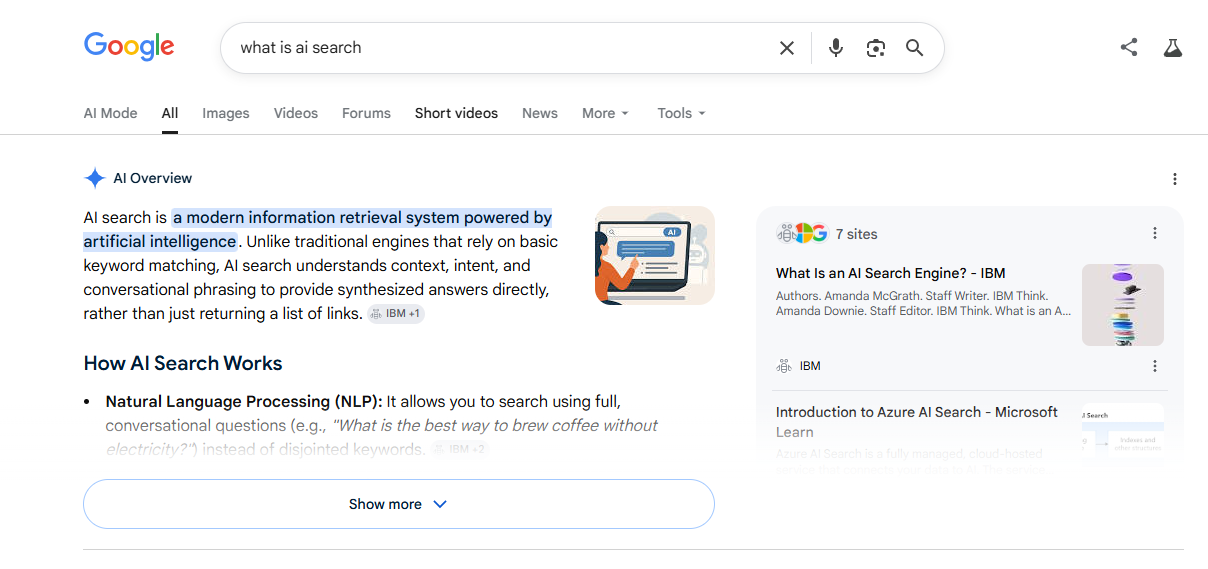
When we searched for “What is AI search” AI overview it provided a concise information that answers the query directly. Also, it cites the source that answers the query.
Instead of showing users a list of links, Google compiles information from various sources and presents a concise answer directly within the search page.
For users, the experience feels faster and more efficient. For websites, user experience is what makes a website hit or miss. Not getting enough traffic through click rate can impact the overall performance of the brand.
When a user receives the answer they need immediately, there’s less incentive to click on the sources that contributed to that answer.
This is one reason why many publishers are reporting a decline in organic click-through rates (CTR) despite maintaining or even improving their ranking.
The Rise of Zero-Click Searches
The concept of zero-click searches isn’t new. Google has been changing its algorithm for years through the following:
- Featured snippets
- Knowledge panels
- Local packs
- People Also Ask sections
- Instant answers
AI Overviews simply take this trend further.
About 360 out of every 1,000 Google searches click to the open web. The majority either end on Google’s search page or lead users to other sources.
This means businesses are now competing for a smaller share of available clicks than ever before. It makes the search even more competitive and challenging. It’s convincing users to leave the page and go for short AI overviews.
Why AI Overviews Are Reducing Organic Traffic
1. Users Get Answers Without Switching Tabs
The primary reason for declining organic clicks is simple: users no longer need to visit websites for the information.
Consider a search such as:
“How does compound interest work?”
Before AI overviews, users would click an article, read the explanation, and explore additional resources.
Today, Google can provide a detailed overview directly in the search results, satisfying the user’s intent immediately.
The result? The website may receive an impression but not a click.
2. Organic Results Are Pushed Further Down
Visibility matters.
When AI Overviews take over the most prominent position on a search results page, traditional organic listings are pushed even lower.
On mobile devices, users may need to scroll significantly before reaching the first organic result.
Even websites ranking in position #1 are seeing major declines ever since AI Overviews took over. That space is now occupied by AI-generated summaries.
3. Click-Through Rates Are Declining
Multiple industry studies indicate that AI Overviews are impacting their CTR, and rightly so.
An Ahrefs analysis shows that when AI Overview appears, the click-through rate of the top-ranking organic result can decline to 34.5%.
Adding informational content with certain websites citation reduces the traffic by 50% or more, affecting the CTR of every brand.
The impact of AI overviews is affecting every industry. However, the results are the same for every industry: AI-generated answers are absorbing clicks that were previously in favor of publishers.
Which Websites Are Most Affected?
Not every website is experiencing the same impact. There are certain categories that are being highly affected.
Highly Affected Categories
Educational Content
Websites answering common questions or information based are getting more effective.
Some of the examples include:
- Definitions
- Tutorials
- Beginner guides
- Historical information
- General knowledge content
Publishers and Media Sites
News organizations increasingly compete with search summaries that condense their reporting into a few sentences. This creates a situation where users gain key information without visiting the original source.
Affiliate Websites
Many affiliate sites rely on articles and informational buying guides. When Google summarizes these insights directly, fewer users click through to complete the research process.
The Data Behind the Shift
Several statistics highlight how dramatically search behavior is evolving:
- 58.5% of Google searches in the U.S. now end without a click to an external website.
- 59.7% of searches in Europe produce zero clicks.
- Only about 36% of Google searches result in a visit to the open web.
- Studies suggest AI-generated answers now appear for a growing share of informational searches, particularly question-based queries.
These numbers show that the future of visibility alone is no longer enough. Brands need to adapt to the era of search and optimize to get better visibility.
The traditional SEO metric of ranking highly is becoming less valuable if users never click through.
What This Means for SEO
The era of traditional SEO is over. Brands are no longer getting ranked for high volume keywords. The traffic is fading, and so is the need for generic content.
Businesses need a different approach for better visibility. This is what it means for traditional SEO.
Create Content Based on Experience
Google summarizes information that already exists everywhere. Creating content that is hard to summarize in one paragraph can give you an edge in winning visibility.
Some of the key examples are:
- Original research
- Industry surveys
- Case studies
- First-hand experiences
- Proprietary data
When your content offers unique insights, users find it hard to leave. This will help you improve your brand ranking.
Build Topical Authority
Rather than publishing hundreds of loosely related articles, focus on becoming the best resource in a specific niche. Search engines instantly reward expertise and insightful content.
Comprehensive content clusters can improve visibility while strengthening brand recognition. Building a topical authority can improve AI search and overall ranking. Learn more about how you can build topical authority and improve ranking.
Focus on High-Intent Keywords
Informational searches are getting most affected by AI Overviews. Commercial and transactional keywords often remain more click-driven and get more visibility.
Here are some keyword examples that focus on high intent:
- Best CRM software for startups
- SEO agency pricing
- Project management tools comparison
These high intent keywords typically require more detailed information than a search summary. Therefore, your audience is more likely to engage with this kind of content.
Optimize for Citations
Even if clicks decline, being cited in AI Overviews still adds value to the brand presence.
To improve AI visibility, you need to add:
- Use clear headings
- Answer questions directly
- Include original statistics
- Add expert insights
- Structure content logically
Content that is easy to understand is also easier for search systems to reference. To optimize content for AI citation, it’s important to leverage AI SEO tools.
The Hidden Opportunity
Although many brands believe that organic clicks are over, there is still light at the end of the tunnel.
The users who still click often demonstrate stronger intent.
Instead of attracting large volumes of casual visitors, businesses search for a greater proportion of highly engaged users.
In many cases, quality matters more than quantity.
A visitor is most likely to spend 5 minutes evaluating your product. However, there might be 10 or more visitors who immediately leave.
This makes conversion optimization, brand building, and audience loyalty increasingly important. Getting visibility in the Google AI overview helps brands get organic leads.
The Future of Organic Search
Google AI Overviews are unlikely to disappear.
If anything, search results will continue moving toward direct answers and summarized information.
For website owners, the goal should not be to fight this trend. The goal is to adapt, evolve, and change the strategy to stand out. Just like AI overviews, brands are now also striving to rank in ChatGPT answers. Nonetheless, to rank in ChatGPT, brands need to adapt a different strategy.
The websites that thrive in the coming years will be those that provide something search summaries cannot easily replicate:
- Original expertise
- Proprietary research
- Real-world experience
- Interactive tools
- Strong brands
- Community engagement
As search evolves, traffic may become harder to earn, but valuable content will remain essential.
Final Word
Google AI Overviews are reducing organic clicks because they satisfy user intent directly within search results. Combined with the growing rise of zero-click searches, this shift is changing how websites attract visitors.
However, declining click-through rates do not mean SEO is dead.
They mean SEO is evolving.
Success today depends less on publishing generic information and more on creating content that offers unique value, demonstrates expertise, and gives users a reason to go beyond the search results page.
The future belongs to websites that don’t just answer questions but provide insights, experiences, and resources that can’t be summarized in a few lines.


