


If you’re writing content and unsure why it’s not appearing in the searches, then you’re missing out on topical authority.
Today, we are going to discuss essential steps on how you can build a topic cluster to achieve topical authority and boost online traffic.
After all, you don’t want your content to be missed by Google crawlers or LLMs scrapers.
Topic clusters (also known as content clusters) remain one of the most effective strategies to build your website authority game.
You will learn how to choose a core topic, perform keyword research, map your cluster, create content, and measure results.
We will also learn why topic clusters matter more than ever in this very age of AI and search visibility.
So without further ado, let’s delve in.
What is a Topic Cluster?
The most simplest of definitions I have read about topic clusters is from AHREFs which says:
“Topic clusters are interlinked pages about a particular subject.”
In my opinion, a topic cluster is a collection of related blog posts or other online content which help visitors and search engines to identify you as an authoritative source of knowledge. It helps search engines to understand what your website content is about. For example, if you are writing about SEO marketing, then a search engine will most likely search for signals crawl budget, Google Rankings, robots.txt, XML sitemap, canonical tags, ranking factors, search algorithm, Core Web Vitals, page speed, schema markup, index vs noindex, topic clusters, pillar page, internal linking, anchor text, meta tags, heading structure, semantic SEO, and many other related but relevant terms. These terms will help the crawlers and scrapers to rank you higher on search rankings and build AI citations.
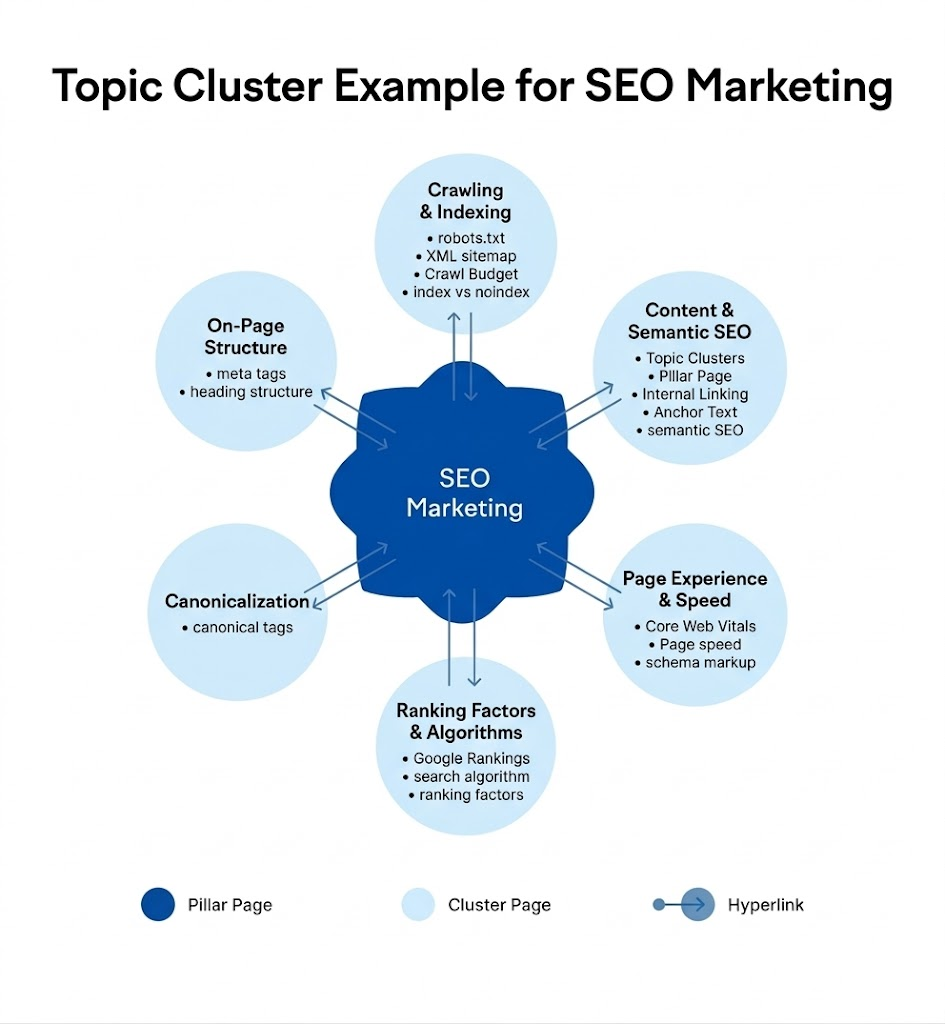
Why Topic Clusters Win SEO & AI Search?
The advantage of having a topic cluster strategy is to build topical authority for SEO and GEO.
As Kevin Indig keeps it:
“Topical authority is built by consistently publishing high-quality content around a core theme.”
Building topical authority increases your chance of ranking more keywords in search engines and getting cited by AI. For instance, you have a pillar topic on Generative Engine Optimization, and you create clusters of high quality content on AI search visibility, AI agents for SEO and similar themes; you will send a signal to Google Search crawlers and AI scrapers your website is an authority on GEO themes.
Why is it important? It’s because Google and tools like ChatGPT, Gemini and Perplexity want to show content that follows the EEAT principle of Experience, Expertise, Authoritativeness, and Trustworthiness.
As Marie Haynes confirms:
“E-E-A-T is about demonstrating that your content can be trusted.”
Besides, having a decent topic cluster contributes positively in building an organized site structure.
When you cross-reference website links between cluster blogs, and pillar pages or vice versa, your site becomes more visible to Google Search and LLMs at the same time.
It’s the same as you visit Netflix and find different categories grouped together in specific sections.
There’s one for Horror, one for Fiction, one for Supernatural, one for K-Dramas, one for Action/Adventure, and so on. You watch a top trending show and automatically it suggests you other similar shows.
It’s the same with pillar/cluster strategy, the more you write, the stronger you create a reputation of your business as a subject matter expert. This way, you can attract more audience and convert them.
How to Create a Topic Cluster for Your Website?
Developing topic clusters for your website is the first step you take to drive organic traffic. If you follow these steps correctly, you will ultimately improve your site’s credibility and upscale your rankings.
Start with a Core Theme
First things first, you need to find a core theme around which you will create your topic clusters.
Because “The best content strategy starts with understanding what your audience actually cares about and building around that.” says Rand Fishkin, it’s important to ask yourself these questions:
- Which topics are the most trending in the industry around your business?
- Which topics have you previously worked around in the past?
- What type of content is appealing for your audiences?
- Does your topic discuss their pain points, or provide them with solutions?
- Who are your competitors and what are they doing?
The theme you choose should be sound so that you can build multiple clusters around it. You want to diversify, but not so much that your cluster becomes confusing or messed up.
Pro Tip: You can always follow industry experts and check their tweets. Many industry experts have a theme which they are following week-by-week educating the masses on its respective values.
In my case, I follow SEO influencers like Nathan Gotch, Brian Dean, Larry Kim, Neil Patel, Rand Fishkin, Anne Handley, and many others. In their posts, I often find themes which I can source for content inspirations. Based on what they are talking about, I choose my topics for my pillar/clusters.
Perform Keyword Research
Once you have the core theme and you know what clusters you want to weave around it, it’s time to find queries people are actually searching for around your pillar topic and clusters.
This is important because you want to make them appear in search engines and LLMs for target keywords & prompts. Your research will help you find the best opportunities & prioritize clusters.
To do keyword research, you can always start with Google’s Keyword Planner.
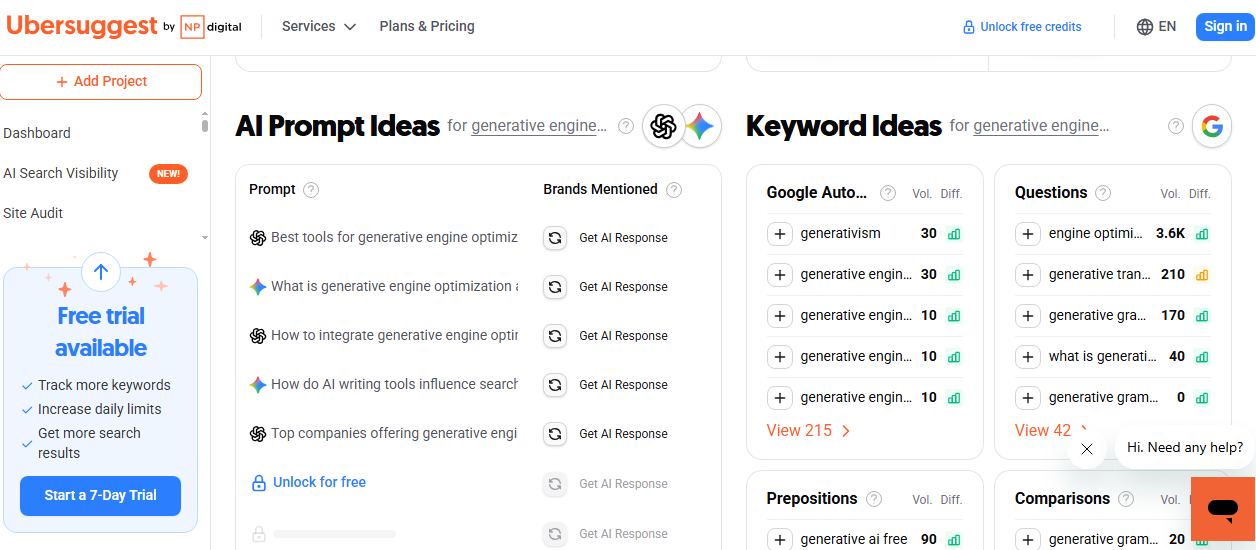
For me, it’s UberSuggest because it provides me beyond just keyword search volume.
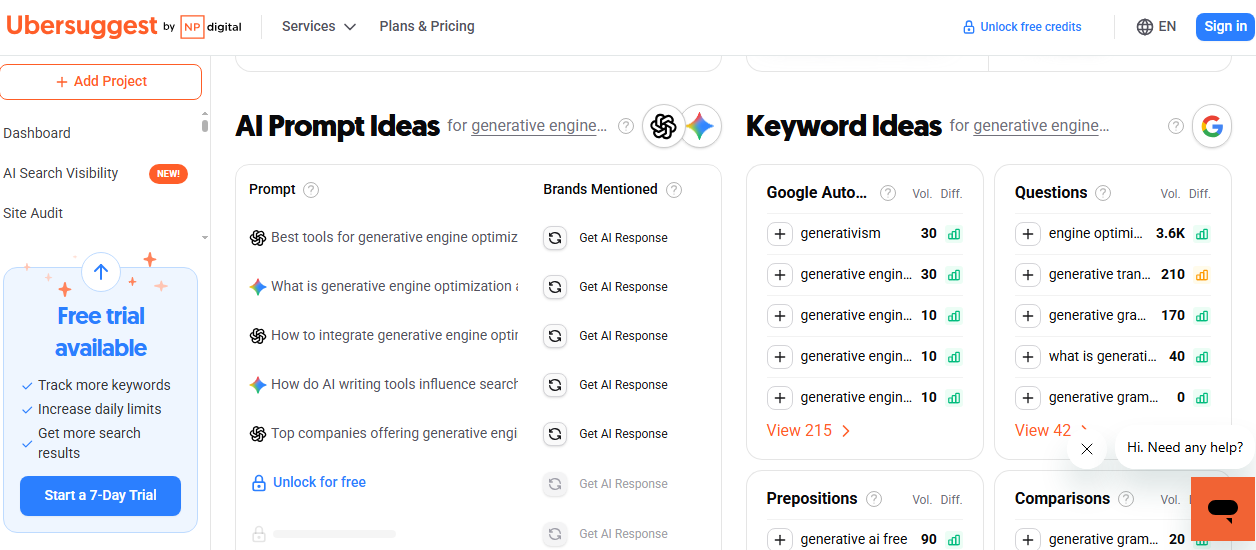
Ubersuggest gives me AI prompt ideas, keyword ideas, questions, comparisons, and much more.
It also provides me with reference sources of brands which are already performing in AI overview.
If you’re searching for keywords on Google Keyword Planner or tools like SEMRush or Ahrefs, then there are following metrics you need to look at the following metrics:
Intent – It will tell you whether your keyword is navigational, information, commercial or transactional. You will often have to pick informational/commercial as these keyword types are best for content clusters.
Volume – The keyword volume is where you will get the monthly searches of your targeted keywords. The higher the number, the greater is the monthly search volume making it more competitive to rank.
Keyword Difficulty (KD%) – is a score which shows how difficult it will be to rank your content on the specific keyword in the top 10 of Google Search results. Higher means difficulty in the redzone.
Find Pillar & Cluster Topics Around Your Keyword
Now, there are two ways I follow to do my pillar & cluster topic research around my seed keywords.
The first one is called Google SERP Mining.
It’s a powerful yet overlooked way to build clusters around your topic. In Google SERP Mining, you’re basically pulling direct signals from Google itself. There are no third-party tools involved.
You can simply start with your core keyword, for example: “Generative Engine Optimization”
By simply entering the keyword in your Google Search Bar, it will provide you with multiple cluster ideas.
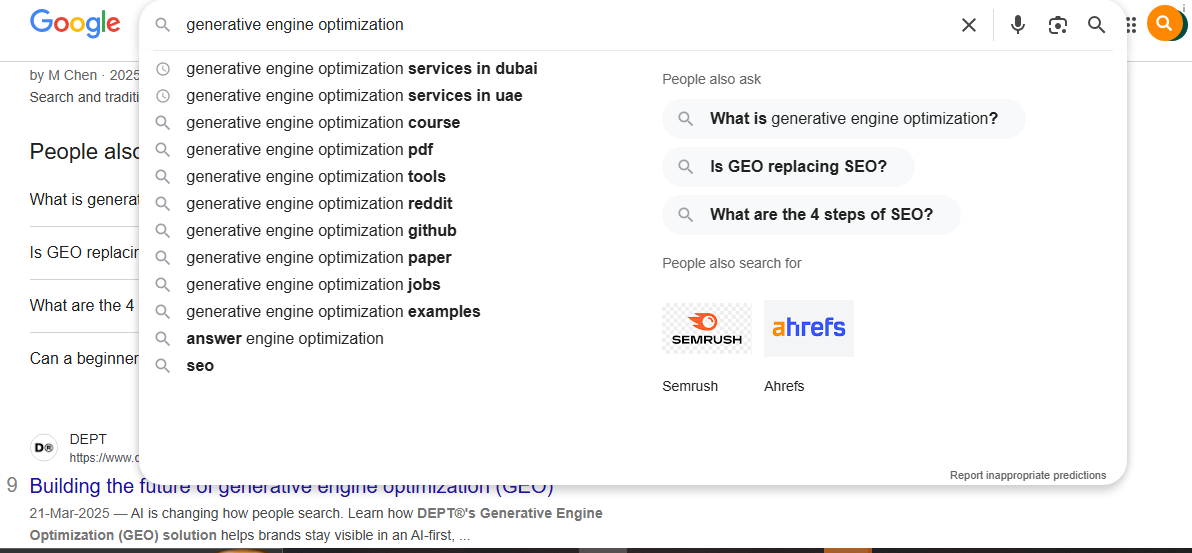
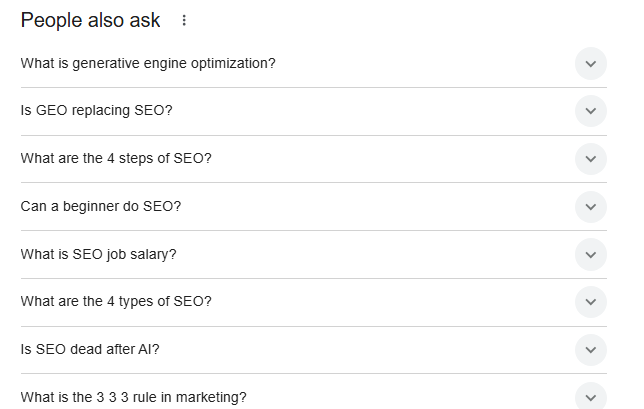
You can further check the People Also Ask section for relevant cluster ideas.
Each section you expand will open up more cluster opportunities within the theme for you.
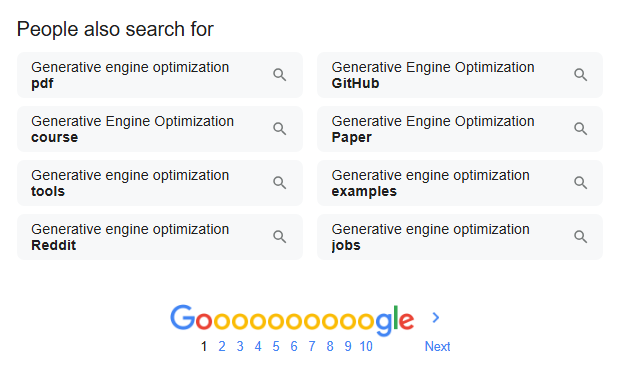
Last but not the least, you can scroll down to the bottom and check the “People Also Search” option.
Just in case, if Google isn’t satisfactory to complete my research, I refer to AnswerThePublic.
This search listening tool helps me pull up more cluster ideas.
The only caveat is I get 3 free searches per day.
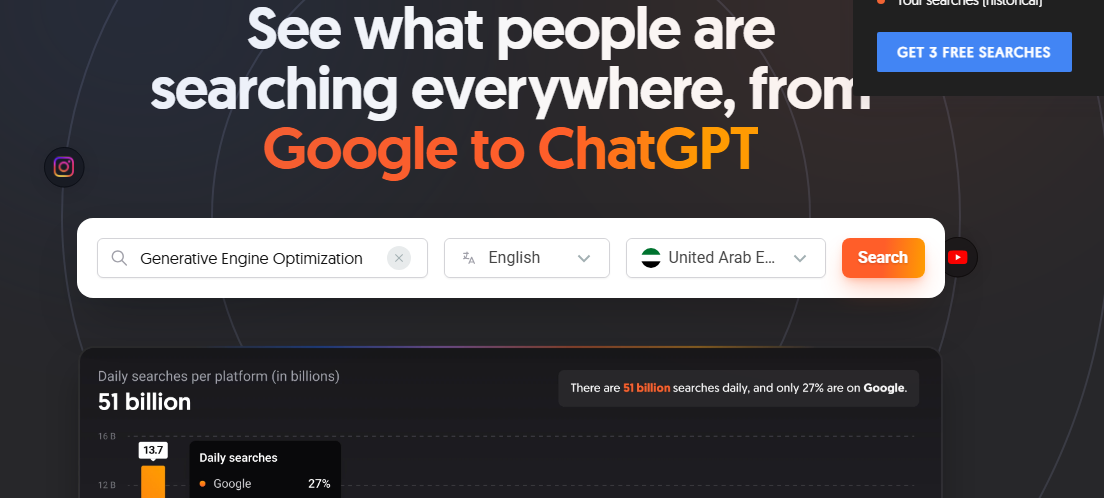
Once I click “Search” it gives me an entire wheel of long-tail keyword ideas around my search term.
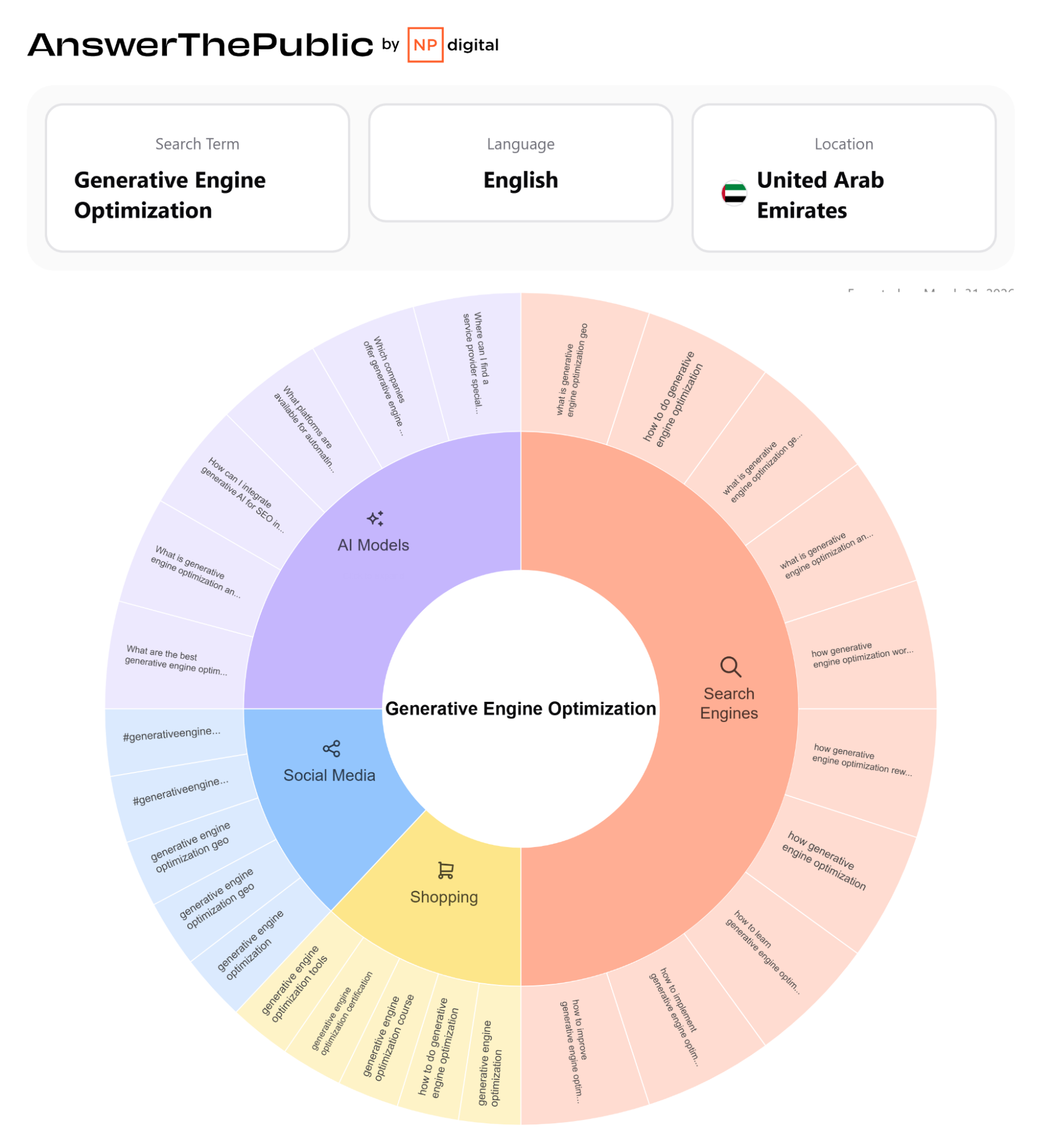
AnswerThePublic also provides me with AI prompts around which I can create more long tail clusters.
And if that’s not enough…
The second approach I follow is Reddit & Community Mining which is a Real Intent Goldmine.
In this strategy, all you have to do is visit Reddit, Quora and niche forums of your specific topic.
Search for your topic there and find relevant questions, reader pain points and other related content. You can source these queries and build your powerful pillar/cluster strategy around them.
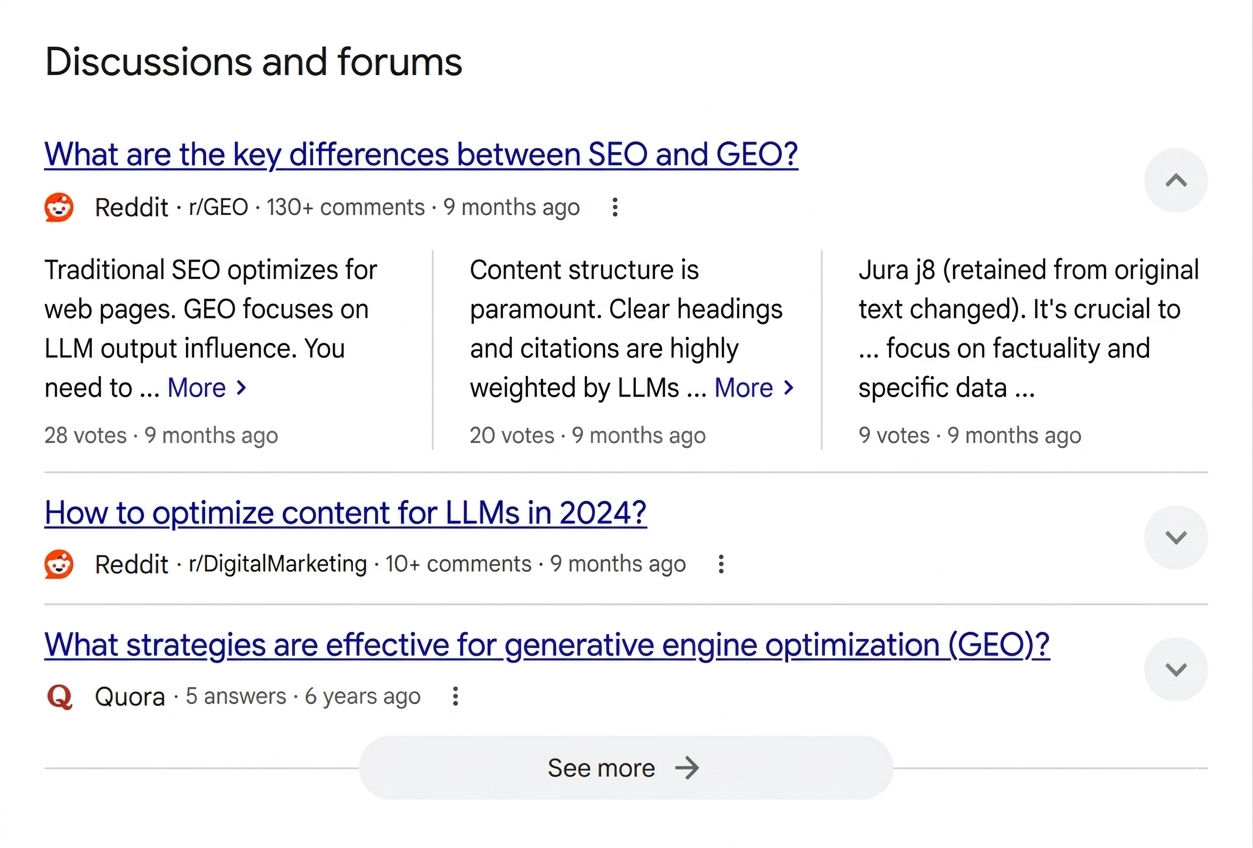
You can create your own blog angles, use them in your FAQs which are great for AI citations, etc.
Group these titles that you have come across in an organized Pillar Content/Cluster content strategy. You can always take help from ChatGPT by importing your keyword & topic research file.
Ask ChatGPT to help you come up with your Pillar/Cluster content strategy.
Here’s a prompt which I use:
Prompt:
“Act as an SEO strategist and topical authority expert. Using the data provided, create a pillar and topic cluster strategy designed to rank on Google and get cited by AI search engines.
Identify:
- 1 primary pillar topic (based on strongest opportunity)
- Supporting cluster topics grouped by search intent
- Recommended page structure (pillar + clusters)
- Internal linking strategy (how pages should connect)
- Key gaps or opportunities competitors are missing
Ensure the strategy builds strong topical authority, aligns with EEAT, and maximizes visibility across both traditional search and AI-generated results.”
Write Quality Content
As soon as you have planned out your first topic cluster, it’s time to create and publish quality content.
Start with the pillar page content as this will be the cornerstone of your strategy. Write a good 3000-4000 word long form article with a wholesome viewpoint.
While writing content, be certain that you’re writing strong content to complete the content.
- Answer the main question (your pillar topic).
- Leave trails for all sub sections within the article (your clusters).
- Write in a way that the user doesn’t jump back to Google.
If a user has to go back to Google, your content is incomplete.
Don’t Blend While Writing
We often make the mistake of blending when writing, so when you’re writing content for your pillar page, make sure you do not blend concepts. Every page should target one clear intent:
- Pillar → broad, informational
- Cluster → specific, focused
For example, your pillar page content can be around “Generative Engine Optimization” but your cluster can be “GEO vs SEO” which is a comparison intent. Cover them separately in different pages.
Mixing intents can often confuse Google & AI.
Clear Structuring
A blog is only as good as the structure it follows.
AI models are more fine-tuned to prefer a clean heading structure.
It means your blog should have clear H2s and H3s, short scannable paragraphs, and bullet points for clarity. Make sure that you cover all the essential definitions early in the content.
It will automatically increase your chance of being quoted or cited by AI in relevant searches.
Build Internal Linking
When you write content to get cited by AI, you need to ensure your content feels like a connected system.
Don’t cover your blogs as isolated or it will decrease your chances of getting AI citations.
Always Link Pillar to clusters, and clusters to pillars and vice versa.
Make cross-references and link related clusters with each other as well where necessary.
It’s always great to add descriptive anchor text, instead of “click here”
This will reinforce topical authority of your website greatly.
Measure Cluster’s Performance
Last but not the least, monitor how your pillar and cluster strategy performs.
It will help you learn what’s working and what isn’t. This way, you’re better able to decide whether you want to expand top-performing clusters with additional content or not.
You may also review and improve low-performing content, when required. Adapt your topic cluster strategy based on meaningful data which you have collected over time.
When it comes to pillar/cluster strategy, there are many content marketing metrics you can track. However, the topic clusters focus on developing content for organic rankings.
The best one so far is SemRush. It comes with a Keyword Strategy Builder which finds pillar topics & supporting subpages, automatically grouping keywords and tracking cluster rankings.
Another one which you can use is AHrefs which provides excellent “Parent Topic” clustering. It allows you to see which subtopics (wheel spokes) should connect back to your main page.
You can use any of these tools to perform your research.
Real Use Cases for Building Topic Clusters for Google Rankings & AI Search
The “AI SEO Strategy” Cluster
If you are running a digital marketing blog, you can’t just write a single post about AI and expect to rank. You need a “hub and spoke” system. Here is how that looks using the pillar/cluster strategy:
Start with a Core Theme (The Pillar)
Let’s say, your core theme is “AI SEO Strategy,” then you need to begin with a core pillar topic title.
Select “The Ultimate Guide to AI SEO Strategy in 2026”
This page will work as the main source for everything AI-related in search. It will cover the broad “what, why, and how” of AI in marketing, covering 3,500+ words.
Perform Keyword Research (The Data)
Using tools like Ubersuggest, you’d identify high-intent queries.
Instead of just targeting “AI SEO,” you look for:
- Informational: “How does Google Search Generative Experience work?”
- Commercial: “Best AI SEO tools for content automation.”
- Comparison: “Human-written vs. AI-optimized content performance.”
3. Finding Clusters (SERP & Reddit Mining)
By mining the “People Also Ask” section and Reddit threads, you find pain points that a keyword tool might miss, such as: “Will AI content get my site penalized in 2026?”
This becomes a dedicated cluster post.
4. The Map: Pillar & Cluster Structure
To build topical authority, your map would look something like this:
- Cluster 1: Top 10 AI SEO Tools for Technical Audits. (Commercial Intent)
- Cluster 2: How to Optimize for AI Overviews & Citations. (Educational Intent)
- Cluster 3: GEO vs. SEO: Why Your Strategy Needs Both. (Comparison Intent)
- Cluster 4: A Guide to Using AI Agents for Keyword Research. (Transactional Intent)
5. Writing Quality Content (The “No-Blend” Rule)
When writing the cluster “AI SEO Tools,” you stay strictly on tools. You don’t veer off into a 1,000-word explanation of what SEO is, you save that for the Pillar Page.
It will keep the “intent” clean for Google’s crawlers and LLM scrapers.
6. Internal Linking (The “Connected System”)
This is the “glue.”
- Every cluster post (like the “AI SEO Tools” post) must link back to the Pillar Page using the anchor text “AI SEO Strategy.”
- The Pillar Page links out to each cluster post as a “Deep Dive” or “Recommended Reading” section.
- This tells AI models: “This website isn’t just mentioning AI; it owns the entire topic.”
7. Measuring Results
After 3 months, you check SemRush’s Keyword Strategy Builder. You notice that while the Pillar Page is ranking for 50 keywords, the “AI SEO Tools” cluster is driving 40% of the conversions.
If data tells you to create more clusters focused specifically on AI software reviews.
Build Your Topic Clusters with Us
Building effective topic clusters takes deep research and a clear strategy.
It requires thoughtful planning, smart keyword selection, and a strong understanding of how to structure your pillar and cluster content.
Struggling to rank on Google or get cited in AI Overviews?
At Rank Hive, we build data-driven content strategies that improve visibility and drive results.
Let’s create content that ranks and gets chosen.


