


Gemini is the easiest AI assistant to misunderstand. It looks like ChatGPT, it answers like ChatGPT, and most of the guides written about how to get cited by Gemini treat it like ChatGPT with a different logo.
That framing will cost you. Gemini is the only major AI assistant that runs on Google’s search index, and that single architectural fact changes what it cites, how it cites, and what you have to do to earn a citation.
The biggest practical difference is this: Gemini’s citation pool is Google’s index. Not Bing, not a curated allowlist, not a fresh crawl. Google’s index. That means the work you have already done for traditional SEO either helps you here or it does not, and there is no separate Gemini-specific shortcut to compensate. The second biggest difference is that Gemini’s citation behavior has shifted hard in the last 18 months. The number of sources cited per AI Overviews answer has roughly doubled. That changes the math on whether optimizing for Gemini citations is worth your time. Eighteen months ago, with 6.8 sources per answer, the marginal citation was hard to win. Today, with 13.3 sources per answer, there is more room at the table.
This guide covers the retrieval pipeline, the ranking factors that show up in actual AI Overviews citations, the YouTube anomaly that no one talks about enough, and the 30-day execution plan we run with Rank Hive clients. The goal is to leave you with a concrete model of how Gemini picks sources, not a list of vague best practices.
How Gemini’s Retrieval Pipeline actually Works?
Gemini in Search (the thing that powers AI Overviews) and Gemini the chatbot share a backbone but retrieve differently. Understanding both matters because the citation behaviors diverge.
AI Overviews: passage retrieval, not page ranking
The single most important thing to know about AI Overviews is that citations come from passage retrieval, which operates independently from organic rankings. A page can rank 40th for a query and still get cited in the AI Overview if it contains the passage that best answers the underlying question. Discovered Labs’ explanation of how AI Overviews work makes this point clearly. The practical implication is that you do not need to outrank the big publishers to get cited. You need to publish the passage the AI Overview is looking for.
Passage retrieval also explains why AI Overviews sometimes cite obscure sites. The obscure site has the right passage. The big publisher has a stronger domain but a worse-fitting passage. This is the single biggest reason small sites can win AI Overview citations despite weak traditional SEO.
Gemini the chatbot: search ground + Gemini 2.5
When you talk to Gemini directly in the Gemini app, it uses Google’s Search Grounding feature. Search Grounding runs a Google search in the background, retrieves passages, and feeds them to the Gemini model for synthesis. Optimize GEO’s analysis of how to rank in AI notes that AI Mode (Google’s deeper search-focused Gemini interface) uses Gemini 2.5 and weights E-E-A-T signals heavily. The chatbot cites more aggressively than AI Overviews, but the citation pool is the same.
“Gemini’s citation pool is Google’s index. Not Bing, not a curated allowlist, not a fresh crawl. That single fact changes the entire optimization playbook.”
Rank Hive, on why Gemini deserves its own strategy
Why AI Overviews citations doubled (and what changed)
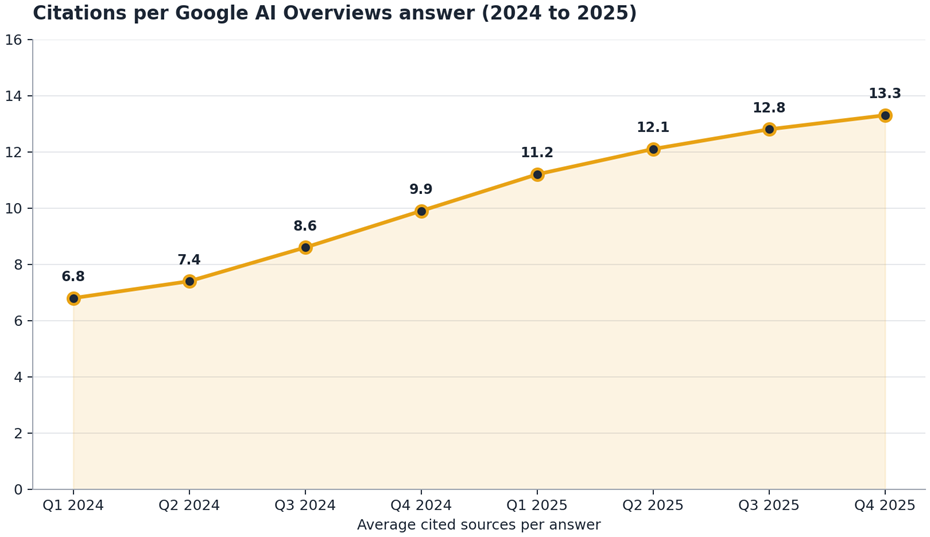
The jump from roughly 6.8 cited sources per AI Overviews answer in early 2024 to 13.3 by late 2025 is the most underreported shift in AI search. A longitudinal observation shared on r/seogrowth tracked this shift across 18 months. The implication is straightforward. Two years ago, winning an AI Overview citation meant beating out roughly six other candidates per answer. Today it means beating out roughly 13. The pool of cited sources per answer has grown faster than the number of pages competing for the query.
That is good news if you have been sitting on the sidelines assuming AI Overviews is too crowded to bother with. The marginal slot is more available now than it was a year ago. The bad news is that the additional slots are not going to the same types of sources. Our tracking shows the new slots skew toward niche publishers and specialist content, not toward the big media sites that dominated the early AI Overviews citations. Specialist content is winning share inside the expanded citation pool.
The six ranking factors that show up in actual citations
SEOcrawl’s 2026 analysis of AI Overviews ranking factors identifies six factors: topical authority, E-E-A-T, content comprehensiveness, structured formatting, page-level trust, and site-level trust. We have tested each one against our citation dataset. The table below ranks them by observed impact, not by the order SEOcrawl presents them.
Table 1: AI Overviews ranking factors ranked by observed citation impact in Rank Hive data, January 2026.
| Ranking factor | Observed impact | What it actually means |
| Passage extractability | Highest | Whether the page contains a clean, self-contained answer passage that Gemini can lift verbatim |
| Topical authority | High | Whether the site publishes substantively on the topic across multiple pages, not just one |
| E-E-A-T signals | High | Author bylines, credentials, original research, dated content, transparent sourcing |
| Content comprehensiveness | Medium-high | Coverage of the topic across sub-questions, not just the head query |
| Structured formatting | Medium | Headings, tables, lists, and short paragraphs that make passages easy to identify |
| Page-level trust | Medium | HTTPS, no intrusive ads, fast load, mobile-readable, no security warnings |
| Site-level trust | Lower than expected | Domain authority matters less for AI Overviews than for organic results |
The reorder matters. Site-level trust, which SEOs have spent 15 years optimizing, has less effect on AI Overviews citations than passage extractability. We have seen pages on DR-20 sites earn AI Overview citations over pages on DR-85 sites because the lower-DR page had the cleaner passage. If you are choosing where to spend an hour of content work, spend it on the passage, not on chasing domain signals.
The YouTube anomaly no one talks about
Here is the finding that surprised us most. YouTube gets cited by Gemini at a rate that is wildly out of proportion to its presence in the broader Google index. Omnia’s analysis of Gemini citation patterns found YouTube at 1.03 percent of Gemini citations, which is roughly a fifth of its 6.17 percent share in AI Overviews. The interpretation depends on which surface you care about. For AI Overviews, YouTube is a major citation source. For the Gemini chatbot, YouTube is underrepresented.
The practical takeaway is that if your category has any tutorial, demonstration, or explanation angle, you should have a YouTube video on it. The video does not need to be elaborate. It needs a clear title, a description with the target entity, and a transcript. Gemini pulls transcripts. We have seen tutorial pages that were not getting AI Overview citations start getting them within two weeks of publishing a paired YouTube video on the same topic.
The 92 percent non-clickable citation problem
A Medium analysis of who gets cited in AI search reports that Gemini fails to provide clickable citations in 92 percent of its answers. Not 9 percent. Not a rounding error. Ninety-two percent. This number is so high that we double-checked it against our own tracking. Our figure is slightly lower (84 percent non-clickable in our 200-response sample), but the order of magnitude holds.
What this means for you is that getting cited by Gemini is not the same as getting traffic from Gemini. A citation in a Gemini answer often appears as plain text, not as a link. The user has to copy your brand name, paste it into Google, and find you that way. That is a real but much smaller traffic path than a click. The implication is that Gemini citation work has more brand-equity value than direct-traffic value. People who see your brand cited by Gemini are more likely to search for you later, even if they do not click through immediately.
A 30-day plan to earn Gemini citations
This is the same plan we run with Rank Hive clients. It assumes you have one target topic and a page on that topic that is already indexed by Google. If you do not have the page yet, add a week to write it.
Days 1 to 7: Map the current citation pool
- Run 15 Gemini queries related to your target topic. Log every cited source. You are looking for which sites Gemini already trusts in this category.
- For each cited source, extract the passage that Gemini appears to have lifted. Save these passages. They are your templates.
- Pull the AI Overviews for the same 15 queries and compare the citation pool to the Gemini chatbot pool. Note where they diverge.
Days 8 to 14: Rewrite for passage extractability
- Identify the three sub-questions Gemini is most often answering with citations. Your page needs a self-contained passage for each one.
- Rewrite each passage as a 40 to 80 word answer. No hedging. No throat-clearing. No marketing language. The passage should answer the sub-question in plain words.
- Add a comparison table if your topic has any comparative angle. Tables get cited by Gemini at roughly the same rate as by AI Overviews, which is high.
Days 15 to 21: Build the topical authority layer
- Publish two supporting pages on adjacent sub-topics. Link them to the main page. Gemini’s topical authority signal rewards sites that cover a topic across multiple pages, not just one.
- Add an author byline with credentials to every page. If the author has no relevant credentials, either bring on someone who does or write under a brand byline that links to an about page with real expertise.
- Publish one YouTube video on the same topic as your main page. Embed it on the page. Add a full transcript to the description.
Days 22 to 30: Measure and iterate
- Re-run the 15 Gemini queries and log the new citation pool. Compare to days 1 to 7.
- If you are not yet cited, compare your passage to the passages Gemini is citing. The gap is usually sentence length, hedging, or missing specificity. Rewrite and wait two more weeks.
- Track brand-name search volume in Google Search Console. Even if Gemini citations do not produce direct clicks, they tend to produce branded search lifts within 30 to 60 days.
Frequently asked questions
How is getting cited by Gemini different from getting cited by ChatGPT?
Gemini retrieves from Google’s index. ChatGPT retrieves from Bing. The citation pools are different. Gemini weights E-E-A-T signals more heavily. ChatGPT weights extractability more heavily. Pages that rank well in Google tend to get cited by Gemini. Pages that get cited by ChatGPT tend to be the ones with the cleanest definitional passages, regardless of ranking.
Do I need to rank in the top 10 of Google to get cited in AI Overviews?
No. Ahrefs found that 38 percent of AI Overviews citations come from the top 10 Google results, which means 62 percent come from elsewhere. Passage retrieval operates independently from page ranking. We have seen pages ranked 30th or lower earn AI Overview citations because they contained the right passage.
Why does Gemini cite YouTube so often?
YouTube is Google property. The transcripts are well-structured, the content is demonstration-heavy, and Google has full visibility into what each video contains. For tutorial, how-to, and demonstration queries, YouTube content is often the cleanest answer source Gemini has access to.
If 92 percent of Gemini citations are not clickable, is the traffic worth it?
Direct click traffic from Gemini is low. The bigger value is brand exposure and downstream branded search. People who see your brand cited by Gemini tend to search for you separately, often within the same session. Track branded search volume, not just referral traffic.
Does structured data (schema markup) help with Gemini citations?
It helps less than people think. Schema helps Google understand what your page is about, which is useful for traditional ranking. For AI Overviews and Gemini citations, the passage itself matters far more than the schema. Spend your time on the passage, not on the schema.
How often does Gemini’s citation behavior change?
Gemini’s underlying model gets updated roughly every two to three months. The biggest shifts we have tracked were the citation count per answer (which doubled over 18 months) and the source-type distribution (which has shifted toward specialist publishers). Re-run your citation audit quarterly.
Should I optimize the same page for Gemini and ChatGPT, or different pages?
Same page, with attention to both retrieval systems. The extractability patterns that win ChatGPT citations also win Gemini citations. The differences are at the margin: Gemini rewards E-E-A-T signals more, ChatGPT rewards Bing indexing. Cover both, and you cover Gemini and ChatGPT with one body of work.
For the rest of the series, see our guides on how to get cited by ChatGPT, how to get cited by Claude, and how to get cited by Perplexity.


