


The era of blue links is now fading.
The Google I/O conference unveiled an AI-powered overhaul taking over traditional searches. This makes room for an intelligent search box. Users now, instead of getting ten blue links, get an AI overview, which is impacting the click through rate.
For more than two decades, the internet operated on a simple system.
Users searched. Google ranked websites. Websites fought for clicks.
This whole system consists of:
- SEO
- affiliate marketing
- publishing
- content marketing
- digital advertising
- ecommerce discovery
But that model is now fundamentally changing. Google Search, as we used to know it, is ending.
Not disappearing. Not dying. But evolving into something completely different.
With AI Overviews, Gemini-powered search experiences, conversational interfaces, and autonomous AI agents, Google is moving away from the traditional “10 blue links” model toward direct AI-generated answers.
This shift changes everything.
Because the internet’s business model was built on clicks, AI search reduces the need for clicks.
And that means businesses, publishers, marketers, and SEO agencies now face a massive strategic shift. This is not just another Google update.
This is the beginning of the post-search internet.
The “10 Blue Links” Era Is Ending
For years, traditional searches used to work like this:
- A user typed a keyword.
- Google displayed ranked links.
- Websites competed for clicks.
- Traffic flowed from Google to publishers.
The entire SEO industry evolved around this model. Rankings mattered. Clicks mattered. Traffic mattered.
But AI search changes the interaction completely.
Here’s what happened when we searched for “best CRM in UAE” on Google:
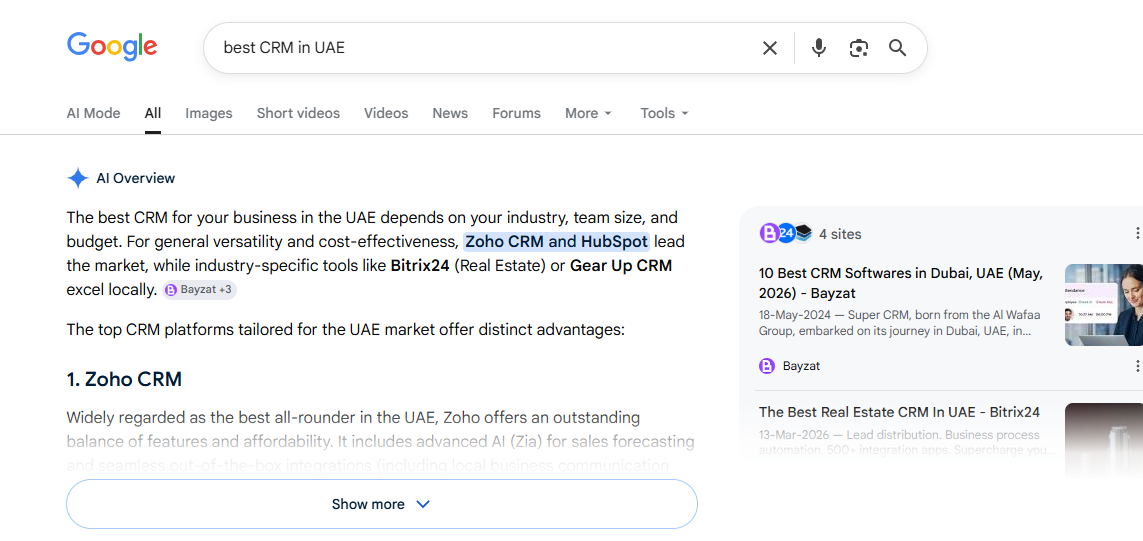
Image credits: Google
The AI system now:
- interprets intent
- understands context
- compares options,
- synthesizes information
- and generates a direct answer
Users easily get what they need without clicking a single link. This is a critical shift that is changing the dynamics of search engines.
Old Search vs AI Search: What Has Changed?
Before we dig into how to compete and gain search visibility, it’s important to understand the difference.
| Old Google (2000–2022) | AI Search (2023–Present) |
| Return Links | Deliver Answers |
| Keyword matching | Intent understanding |
| Ranking determine visiblity | Citations determine visibility |
| Search results | Recommendations |
| Clicks drive traffic | Zero-click experiences |
| Search engine | Decision engine |
This is one of the biggest changes in the history of the internet. Google no longer wants to simply organize information. It wants the user to make the decision.
Google Is No Longer Just a Search Engine
The biggest mistake businesses can make right now is thinking AI search is just another Google feature.
It’s not.
Google is rebuilding search around AI assistance.
That means search is becoming:
- conversational
- predictive
- personalized
- multimodal
- and increasingly autonomous.
Instead of users manually researching information across multiple websites, AI systems now increasingly perform the research for them.
This is delegated discovery. And eventually, delegated decision-making.
Search is Becoming Agentic
There is a profound shift in search engines. Google’s agentic search experiences, research assistants, and personalized AI workflows. It’s an autonomous search. AI agents that research, compare, book, and transact.
One of the most important developments announced by Google is the rise of AI agents.
Under this new system, it’s now easy to:
- monitor information
- compare products
- conduct ongoing research
- automate workflows
This is far beyond traditional search.
Instead of searching manually for:
- flights
- software
- services
- or products
Users are now increasingly asking AI systems to evaluate options and make recommendations. That means businesses are no longer only competing for rankings.
They are competing to become: trusted AI-recommended sources.
This distinction is critical.
The Difference Between Ranking and Retrieval
When it comes to visibility, it’s important to understand the difference between ranking and retrieval. The important concept in AI search is understanding the difference between:
- ranking
- retrieval
Traditional SEO focused on ranking pages. But the AEO search engine focuses on retrieving trusted information fragments.
That means:
- semantic demands for more clarity
- concise answers are the new win
- Builds authority
- Proper structure matters more
A page can rank well traditionally can still fail to become AI-citable. This is where many businesses will struggle.
In AI search, visibility does not equal clicks. Ranking does not equal recommendation. A brand can rank #1 on Google and be completely invisible to an AI that never cites it, and vice versa. These are now separate metrics.
With an active AI system, it is now easy to summarize the entire topic, reduce the number of website clicks, and show only credible and trusted sources. Authority now compounds faster than ever before.
What AI Search Engines Actually Reward
This is where the biggest strategic opportunities emerge. AI search systems increasingly prioritize content that is:
- trustworthy
- structured
- semantically clear
- original
- easy to retrieve data
AI search engines are now getting smart and only show what appears relevant to the user’s intent. Let’s dig deeper to understand what an AI search engine actually rewards.
1. Entity Authority
Creating authority means having complete control over what you’re sharing. AI systems today increasingly evaluate content before presenting it to the user. They look for:
- brands
- authors
- organizations
- reputation networks
Not just individual pages. This means businesses need to evaluate their content and incorporate:
- strong author profiles
- consistent topical positioning
- expert thought leadership
- recognizable brand authority
Becoming a trusted entity has to be one of the strongest competitive advantages in AI searches.
2. Structured Content
AI systems prefer content that is easy to extract, readable, and summarizes the whole context. That means formatting your content matters more than ever.
High-performing AI search content often includes:
- concise definitions
- bullet summaries
- FAQs
- tables
- frameworks
- comparison sections
- clear headings
This improves machine readability, as well as human readability. Creating structured content can easily make your brand more visible on AI overviews.
3. Topical Depth
One of the biggest mistakes businesses still make is publishing disconnected blog posts. AI systems only detect and present topics that have context and cover every aspect.
- topical ecosystems
- semantic depth
- contextual authority
Let’s consider an example:
When we asked Gemini, “Compare SEO and GEO for a UAE ecommerce brand” this is how it responded.
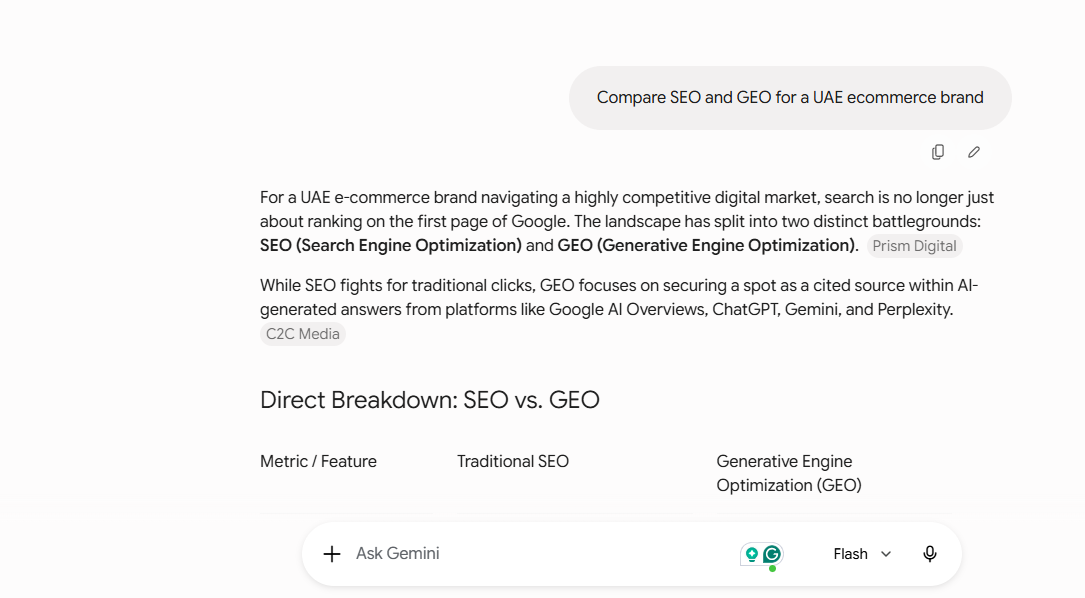
Instead of sharing:
100 random articles completely break down the topic with inline brand citation. Brands that grasp the topic well win.
Here’s what you need to do. Instead of sharing an article about SEO, businesses should build interconnected content around:
- GEO
- AI search
- AI Overviews
- semantic SEO
- local SEO
- entity optimization
- AI retrieval systems
Topical authority compounds. Learn more about how to create a topic cluster for Google ranking and AI search.
4. Original Information
Originality is perhaps the most important shift in AI visibility. This is the most important point in this entire article. Original information becomes exponentially more valuable in the AI era.
AI can summarize generic information. It cannot replace research, data, experiments, or firsthand expertise. A proprietary study. A survey of 500 real buyers. A benchmark with actual screenshots. A case study with real numbers.
These are irreplaceable, and they become the citations AI systems reach for precisely because no amount of synthesis can replicate them.
5. Machine Readability
Schema markup, semantic HTML structure, clear heading hierarchies,
retrieval-optimised chunking, and crawlability. These aren’t optional extras; they’re the infrastructure that determines whether an AI can even access and extract your content correctly in the first place.
The 5 Layers Of AI Search Visibility
- Technical Access: Crawlability, schema, and site structure
- Semantic Clarity: Structured answers, definitions, FAQs
- Entity Authority: Brand recognition and reputation networks
- Citation-Worthiness: Original research and unique data
- Brand Trust: Consistent identity across the web
To better understand the I/O Google Search update, let’s take a look at what was actually discussed.
Action Framework for Businesses Looking For AI Visibility
For businesses looking for an action plan to boost AI visibility, there are some key pointers to consider. Here’s how you can get started.
-
Build Topic Ecosystems, Not Isolated Blogs
Pick two or three subjects where your brand can credibly own the conversation. Build comprehensive, interlinked content clusters around each. Remember, depth and coherence signal authority to AI systems far more effectively than scattered publishing on unrelated topics.
-
Create Citation-Ready Content
Structure your content so AI can extract clean answers from it. Use FAQs. Use comparison tables, concise definitions, and include statistics with sources. Make your insights extractable, because if AI can’t pull a clear, attributable claim from your content, it will pull it from a competitor who made it easier.
-
Invest in Brand Authority
AI trusts recognised entities. That means real press coverage, not sponsored content. LinkedIn thought leadership from named experts. Author bios with speaking credits, publications, and expertise signals. Brand mentions across
authoritative publications. Entity-building is no longer optional; it is foundational.
-
Publish Original Data
Commit to at least one original research piece per quarter, an industry survey, a benchmark study, or a documented experiment. These become your most-cited assets and create exactly the kind of content no AI system can synthesize away.
-
Optimise for Retrieval, Not Just Rankings
Audit your content architecture for machine readability. Implement schema markup. Improve heading structures. Chunk long-form content into clearly labeled, AI-extractable sections. Think about how a retrieval system reads your page, not only how a human does.
To boost the visibility and ranking of your brand, it’s important to learn more about how businesses can show up in ChatGPT, Gemini and Perplexity.
Bottom Line
Clicks continue to decline. Zero-click answers become the default for most
informational and commercial queries. At Rankhive, we understand that you need beyond traditional SEO, generic publishing, content farms, thin affiliate pages, blogs with no original insight, and collapses further. Traffic consolidates around a small number of trusted source ecosystems per topic.
The web effectively splits into two tiers: commodity content that AI reads but never cites, and trusted source ecosystems that AI references repeatedly, compounding their authority over time. The middle ground disappears, and there will be no gradual warning when it does.
“The future of visibility is not about being ranked. It’s about being trusted enough to be referenced.”
Search is not disappearing; people will keep asking questions. It’s all about how brands answer, rank, and gain visibility.
FAQs
What does “Google Search is over” actually mean?
It does not mean Google is disappearing.
It means the traditional search model is evolving. You now get to see less:
- blue links
- keyword rankings
- website clicks
As search is becoming more AI-driven, the answer and recommendation system.
Google increasingly wants users to get answers directly inside AI-powered search experiences instead of browsing multiple websites.
Why are AI Overviews changing SEO?
AI Overviews reduce the need for users to click external websites for informational queries.
Instead of sending traffic outward, Google increasingly:
- summarizes answers,
- compares information,
- and surfaces trusted sources directly in search results.
This changes how visibility and traffic work.
What is the biggest difference between traditional SEO and AI search?
Traditional SEO focused on:
- rankings
- keywords
- clicks
AI search focuses more on:
- retrieval
- semantic relevance
- authority
- citations
In AI search, visibility increasingly depends on whether AI systems trust and reference your content.
What is the “citation economy” in AI search?
The citation economy refers to the growing importance of being referenced by AI systems.
In the past, websites competed mainly for clicks.
Now businesses increasingly compete to become
- trusted sources
- cited in references
- AI-recommended brands
Why is generic content becoming less effective?
AI systems can summarize repetitive information instantly.
If hundreds of websites publish nearly identical articles, AI has little reason to prioritize any single source.
That means:
- original insights
- firsthand experience
- proprietary information
they are becoming far more valuable.
What kind of content will perform best in AI search?
The strongest AI-search content usually includes:
- original research
- case studies
- expert commentary
- frameworks
- comparisons
- deep topic authority.
AI systems increasingly reward:
- usefulness
- structure
- clarity
- originality


