


Data shows at the beginning of 2025, there were more than 5.17 billion social media users globally. This shows almost 65% of the global population is on social media.
It shows social media marketing has moved beyond being a platform where one posts pretty pictures, adds comments and shares them on their live feeds.
It’s turned into a dynamic platform where people are actually living their lives.
But what exactly is social media marketing? We have heard this term quite a many times getting thrown around but seldom do we understand what it truly meant?
Does it mean putting your products online and waiting for people to show up on your page and engage with your business? Does it mean having a digital presence that shows your brand value to your customers? Or does it mean running meta ads to convert visitors into customers?
To be honest, it could mean any of those things, and that’s why we are going to help you understand what social media marketing is all about. We hope at the end of this article, you will be well-informed.
What is Social Media Marketing (SMM)?
Social media marketing (SMM) is the process of using platforms such as Facebook, Instagram and TikTok to promote products, services or your brand online. SMM is all about creating & sharing content, engaging audiences, running paid ads, and analyzing results to conduct business.
In SMM, your end goals are more specific; you market on social media because:
- You want to increase brand awareness.
- You want to drive website traffic.
- You want to boost sales.
SMM vs Traditional Marketing
SMM or Social Media Marketing is a more interactive and data-driven approach to marketing.
It’s often cost-saving and a budget-friendly way to reach a targeted audience.
While, traditional marketing is a more one-way broadcast to a broader, less-defined audience. Social Media Marketing is more focused for a specifically designed audience. The key factor which differentiates SMM from traditional advertising is how it establishes a two-way communication.
Based on real-time feedback, and precise targeting methodologies, SMM can bring results which are far better than traditional methods like TV/Radio advertisements, billboards or print media.
If you’re curious how search behavior itself plays into modern marketing, check out our comparison of Google vs Bing — Which Search Engine Wins?
What Are the Key Characteristics of SMM?
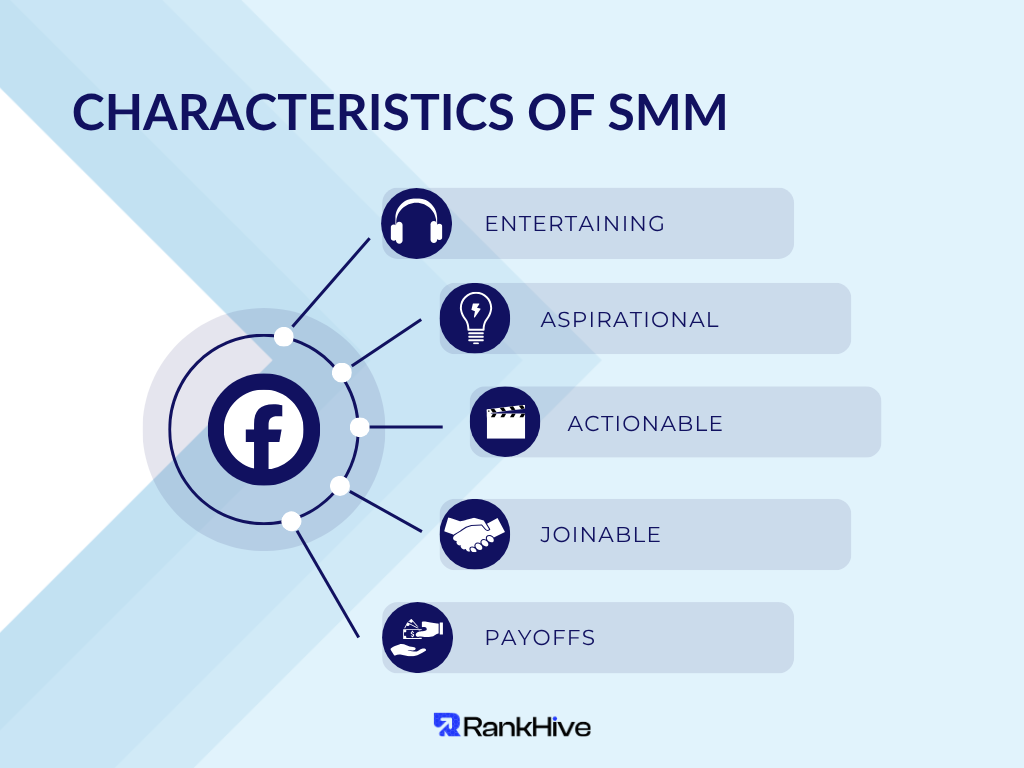
There are five characteristics of a winning social media presence. These characteristics are applicable to any brand or industry who want to create effective social media content.
Entertaining – Your social media content must be entertaining or it will fail to grasp user-attention. You can capitalize on beautiful content, add humor, make it vulnerable or beautify it using a great design, one way or the other make information entertaining.
Aspirational – If you want to engage your community, you have to go beyond inspiration. Long-term aspirations will ensure your audience will feel inspired to follow your goals & meet your objectives by contributing to something bigger and better overall.
Actionable – When people decide to follow you, they want actionable content, one that benefits them too. For most brands, it means updating products, adding sales, set maintenance recommendations and curated accessory suggestions.
Joinable – People want to belong to something; especially when they are interacting with a brand or making a purchase. Brand loyalty doesn’t come cheap, and on social media, you can make online presence joinable through a shared mission, events, causes or simply hashtags.
Pay Offs – Consumers want to be rewarded; it’s something they don’t get from traditional advertisements. They want promotions, giveaways, freebies or any form of incentives which makes them feel special; such payoffs often make them loyal to your business.
What Are the Pillars of SMM?
There are five major pillars of social media marketing which compliments its framework.
These pillars help brands define their goals, create and share content that resonates and interact with the audience more effectively. To explore the complete strategic roadmap for successful social presence, check out The Ultimate Social Media Guide.
Strategy: The first foundational pillar is strategy where the SMM manager sets clear objectives, identifies the target audience and establishes the brand’s voice and sets up its identity.
Content Creation: The second pillar focuses on developing and scheduling valuable & relevant content, one that aligns and properly compliments the overall SMM strategy.
Engagement: The third is about actively listening to the audience requirements, responding to their comments and building the perfect community around the brand.
Analytics: The fourth pillar is analytics. Without proper insights on how social media posts are performing, you cannot refine your strategy for improved future campaigns.
Advertising: The fifth pillar is using paid social media promotions to reach broader & more specific audiences, boost visibility and drive specific actions for results.
If you’re ready to master the paid side of marketing, explore our guide on How to Become a PPC Expert — A Complete Guide for optimizing paid campaigns and ad performance.
Why Do Businesses Use SMM?
In simple terms, SMM lets businesses connect with a wider audience and engage customers directly. It lets them collect valuable customer insights and use social media as a cost-effective tool for growing their brand. At the same time, it helps them deliver better customer service.
The key reasons why most businesses utilize SMM are:
Brand Visibility: Social media platforms have billions of users bringing massive audiences to reach. It becomes a global stage for businesses to show their products, sell services and values.
Drive Website Traffic: If you’ve web presence, social media can bring a lot of online traffic to drive more business through targeted ads. A single post can turn followers into confirmed leads.
Build Relationships: SMM gives users a platform for direct, personal interaction giving businesses an opportunity to provide lasting customer service and build meaningful connections.
Get Customer Insight: Social media analytics introduce valuable data on audience demographics, interests and behavior to refine their marketing strategies for the better.
Boost Search Engine Rankings: When you post consistently on social media, it improves company’s visibility in search engine results and promotes positive brand mentions.
Cost-Effective Marketing: Businesses can use SMM as an affordable strategy to reach a specific audience, especially for small businesses or those on a budget.
What Are the Major SMM Platforms?
Meta (Facebook & Instagram): Branding, E-commerce, and Community Building
Meta’s platform (Facebook and Instagram) forms a powerful marketing ecosystem.
Instagram stands as a top-tier platform for branding. The platform capitalizes on high-quality visual content published in the form of photos, stories and reels. Instagram alone has over 2 billion monthly active users and 91% of them watch videos almost everyday.
Besides, Instagram shopping adds another layer to why this platform is favored among users. It gives users a chance to discover and buy products directly from their respective feeds.
Do you know almost 44% of users shop on Instagram weekly? The products they purchase often come from inspirations they collect from creators and visual storytellers.
And when you think Instagram takes the lead, along comes Facebook. It’s built around a much larger community of up to 3 billion monthly active users. The community around Facebook is a more mature audience and are more prone to target advertising opportunities. But that’s not the only good thing about Facebook; Facebook comes with its unique feature called “Groups.” It’s among the core strengths allowing members to form tight-knit communities.
These communities are far more rewarding compared to the rest of the pages. Almost 70% of users on Facebook belong to at least one active group showing how alive is its community. Together, Facebook and Instagram deliver a full-funnel marketing experience — from brand discovery all the way to final sale. Meta’s ad ecosystem now reaches nearly 60% of the global internet population.
LinkedIn: Professional Networking and B2B (Business-to-Business) Marketing
LinkedIn is one of the world’s largest professional networks. It has approximately 1 billion members belonging to more than 200 countries from around the world.
The platform serves as the hub of b2b marketing. You can find many decision makers on LinkedIn. Almost 89% of the b2b marketing space use LinkedIn for lead generation. And almost 80% of complete b2b leads from social media come from LinkedIn.
And the best part about LinkedIn is, you can segment people based on job title, industry, company size and other such factors. It’s what makes Linkedin a goldmine for lead generation.
For marketers, it’s a place for thought-leadership. 3 of 4 b2b buyers say thought-leadership content is what helped them decide which vendor they are supposed to shortlist.
Beyond B2B marketing, LinkedIn is also a powerhouse for recruitment. Brands and recruiters leverage thought-leadership and professional content to attract top talent.
You can explore practical tactics in 6 Content Magnets to Make Your Recruitment Strategy Shine — a deep dive into how content can drive your hiring success on platforms like LinkedIn.
It’s what makes LinkedIn’s professional environment perfect for credibility.
Marketers often bring commendable industry knowledge and proven case studies to LinkedIn for reliability and results. LinkedIn doesn’t capitalize on virality, it builds upon professional networking & educational content powered by real-time data and real-life experiences of leaders.
YouTube & TikTok: Video Marketing, Entertainment, and Driving Mass Engagement
YouTube and TikTok are the two popular platforms which dominate the video marketing space.
You can find both short and long-form videos on these platforms.
For now, we all know how YouTube is a long-established leader for publishing long-form video content in the form of tutorials, product reviews and long-form evergreen content. It’s one of the reasons why many classify YouTube as the second-largest search engine. In fact, YouTube reaches around 2.53 billion monthly active users globally, almost half of all social media users.
And when it comes to brand engagement, nearly 47% of YouTube users interact with brands at least once a week, highlighting its power for marketers.
Meanwhile, the short-form side of video is booming too: TikTok boasts over 1.6 billion monthly active users, with users spending an average of around 58 minutes per day on the app. On TikTok, engagement isn’t passive, around 92% of global users take some action (like sharing, liking, clicking) after watching a video.
So while YouTube remains the go-to for deep dives and staying in search, the short-form platforms are winning for immediacy and high engagement.
Social Media Marketing in the Age of Artificial Intelligence
AI has flipped social media marketing (SMM) from being just “create and post” to a full-blown, data-driven engine. Today, we have AI tools which can now generate captions, graphics, and videos in minutes. We have platforms like ChatGPT, Jasper and Synthesia help brands create personalized, on-trend content that feels native to each platform. It takes the guesswork out of the game, letting marketers predict what kind of posts will perform down to the tone, emoji use, or even video length.
AI further offers hyper personalization to the next level. Imagine your own social media platform now works on deep-learning algorithms which can predict user interests, behaviors and user intent. What does it mean? It means your ads reach people before they even realize they are interested. Many marketers can now build micro-segments instead of broad audiences, ultimately increasing ad ROI & engagement rates dramatically.
For instance, Spotify Wrapped, TikTok’s “For You” feed or Instagram Reels recommendation are all great examples of AI personalization in full action.
In fact, AI chatbots like ChatGPT-powered assistants and Meta’s AI-driven customer tools now handle DMs, comments, and FAQs at scale — in brand voice. It means some chatbot is always ready with instant replies and ready to offer human-like interactions to build community and trust without burning out your team.
So you see, AI isn’t replacing marketers, it’s actually reprogramming SMM teams to make marketing better.
To explore this shift in detail, read AI SEO Tools 2025 — Everything You Need to Know — it dives into how some AI tools are reshaping digital strategy and content performance across platforms.
At Rank Hive, we believe great brands don’t just exist on social media, they lead the conversation. Talk to our social media marketing team to establish a brand that inspires & converts.


