


You plan & post.
You even follow trends.
But the numbers? They just don’t move.
It’s the same story for thousands of brands, they show up on social media every day, yet conversions barely trickle in. The issue isn’t effort; it’s strategy.
According to Hubspot marketing, over 68% of marketers say converting followers into customers is their biggest social media challenge.
It’s no secret that social media has outgrown its “just post and hope” era.
It’s no longer about being seen — it’s about being remembered and acted upon.
And, that’s what separates brands that trend for a day from those that build communities and drive real revenue.
So here’s the thing, you’re scrolling Instagram and you come across two similar posts from different brands. One is all random product shots with generic captions like “Grab Discounts” or “Year End Sale” etc.
The other actually tells a story where a real customer purchased your product! The post is sharing a real-life experience of a customer who walked away truly satisfied mentioning how it solved problems.
What will you choose? Definitely, the one sharing an experience.
In a world where most brands are simply existing, you need a social media strategy that lets you own your position. It’s what motivated us to put together this wonderful guide.
We will tell you how you can build a social media strategy that actually converts.
Introducing a detailed step-by-step process from researching your audience to designing content pillars and how you can effectively track your performance.
So without further ado, let’s begin.
Why Your Social Media Strategy Isn’t Converting Yet?
So before we tell you how to fix it, let’s find out why it’s broken.
If your posts look good, your hashtags are on point, and your follower count is growing — but your conversions aren’t — you’re not alone.
You’re not the only one creating content without backing a proven strategy.
You post because you want to stay “active” rather than to stay relevant.
It’s the gap that kills conversion.
How we know this, because Hootsuite’s 2025 Social Trends Report tells us how 64% of marketers admit they don’t have a documented social media strategy, even though 80% of them post multiple times a week. It means a majority are operating in what we call content chaos. They are chasing trends for short-term virality and avoiding long-term measurable goals.
So what’s really not working?
You’re Focusing More on Visibility
Posting often isn’t the same as posting with purpose.
Your audience doesn’t just want to see your brand — they want to feel something from it. When every post screams “Buy Now” or “Check This Out,” you’re not building trust, you’re burning it.
“People don’t convert from content that interrupts. They convert from content that aligns.”
Your Content isn’t Aligned with the Funnel
You might be pushing sales content to people who don’t even know your brand yet. A good social media strategy maps content to the buyer’s journey:
- Awareness (introduce + educate)
- Consideration (solve + engage)
- Decision (convert + reassure)
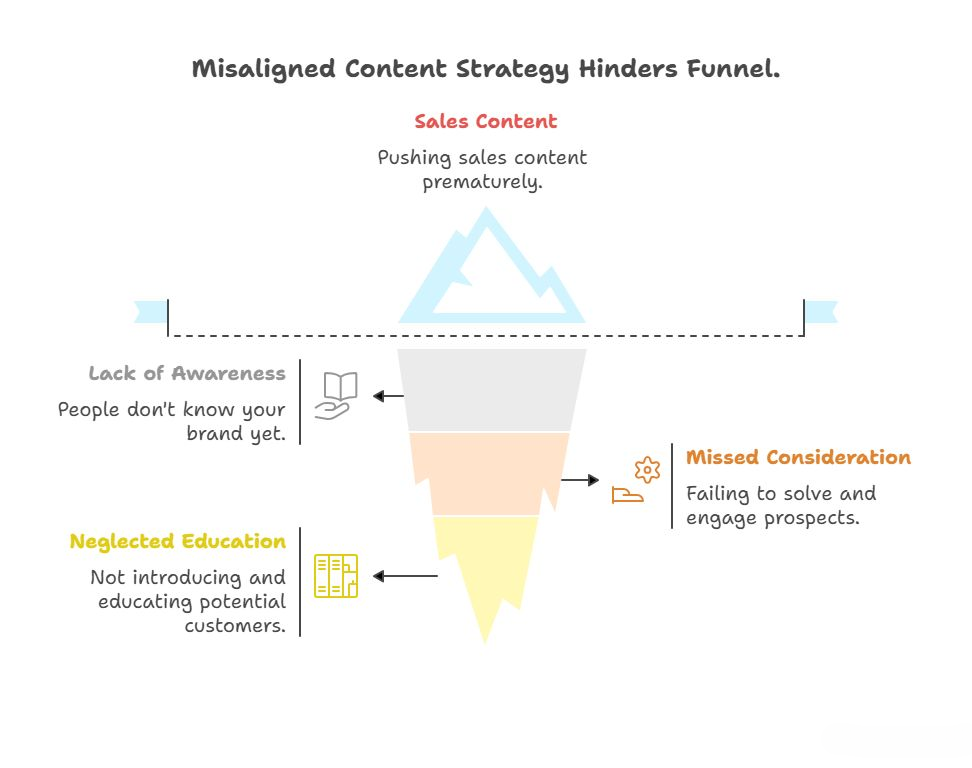
If all your posts sit in one stage (usually “decision”) you’re losing the rest of your funnel.
You’re Ignoring Platform Psychology
Each platform plays by its own rules.
What performs on LinkedIn might flop on TikTok, and vice versa.
Yet most brands recycle the same post across platforms.
If you’re following a one-size-fits-all strategy for your social media marketing, it’s like wearing formal shoes to the beach.
It doesn’t matter how nice it looks when it doesn’t fit the context.
You’re Measuring the Wrong Metrics
Likes never mean conversions.
You can have a virality factor yet you may end up bringing zero sales. A post with 20 comments does not mean it will convert into 10 DMs with 3 actual clients.
To achieve conversions, you need a real strategy… one that is all about tracking what drives business, not just what looks good on a dashboard.
You’re Not Leveraging Data Insights & AI
Social media has changed.
We are living in a fast-paced environment that seldom relies on gut instincts.
Many brands are now using AI for content ideation, creation, strategy building and data-driven insights. They are not working on guesswork or instinctual marketing any more.
Step 1: Research the Landscape Like a Pro
Before you create a single post, you need to know the playground you’re stepping into.
Social media is like a massive city, every platform working in a different neighborhood where every brand is a neighbor. Your audience are people outside planning to decide which door to knock.
If you’re not sure what’s happening in the city, who’s the most popular neighbor, what’s trending & which place your people hang out, you will end up shouting loud but attracting nobody.
It’s why research is the first and foremost step to designing a winning social media strategy.
Study Your Competitors
Start with something really simple. Find out who’s already winning in the neighborhood…
Pick 3 to 5 competitors or similar brands within your niche.
They can be your direct rivals or just basic accounts which your audience follows. Now go deeper into researching them, reverse engineer their strategy and find out what’s working.
Learn:
- Content type: What kind of posts perform best — Reels, carousels, threads, or stories?
- Engagement style: How do they talk to their audience? Formal, casual, funny, aspirational?
- Frequency: How often do they post — daily, weekly, campaign-based?
- Performance clues: Which posts get the most likes, shares, or comments?
Just remember, you’re not doing this practice to copy them. You’re doing this to understand & spot patterns; your end goal is to understand what resonates, what flops and how to fill the gaps.
You can use ChatGPT. Paste a few competitor captions and ask:
“Analyze the tone, style, and emotional triggers of these captions. What kind of audience would respond to this tone?”
It will readily provide you insights on how to effectively position your brand voice differently.
Decode Platform Algorithm
Each platform plays by its own rules.
Instagram pushes short-form Reels, LinkedIn boosts thought leadership posts, and X (Twitter) rewards conversations and replies.
So you don’t want to treat them all the same way:
- Follow official creator blogs: Instagram for Creators, YouTube Creator Insider, etc.
- Watch engagement trends: Did your carousel flop but your Reel blew up? That’s algorithm feedback in action.
- Note platform priorities: LinkedIn prioritizes saves and dwell time. TikTok values watch completion.
When it comes to algorithmic science, you don’t want to blame the system. You want to find a way to use it to your advantage so you can make your social media marketing overall better.
Map Out What’s Trending
Chasing every trend will not always cut it. You need to understand what your audience currently cares about. You can use different tools to spot what’s hot in your specific niche.
- Exploding Topics: Find emerging topics before they go mainstream.
- AnswerThePublic: See what questions people are asking around your keywords.
- Notion AI: Summarize and cluster insights into trend categories — e.g., “Sustainable beauty” or “AI in marketing.”
For example, if you’re in the fitness industry and you find “desk workout routines” are just something that’s trending, you can build a lot of content around it.
This can be educational posts, short reels, carousel guides…
Step 2: Define Your Audience (and Micro-Audiences)
Looks like we are leveling up now :)!
You have done the research, you’ve spotted trends, and studied the algorithm.
Now, it’s time to zoom in on real people behind the screens — your audience.
As the wise social guru once said:
“You can’t build a strategy that converts if you don’t know who you’re talking to.”
If all your social media efforts feel like it’s just not clicking, chances are — you’re talking to everyone, which means you’re connecting with no one.
So before you create your social media posts, you need to get crystal clear on who you’re actually speaking to.
Your every caption, every hook, every call-to-action should sound like it was written just for them.
Know Your People
Age is just a number they said but when it comes to SMM,
“Audience = 18–35-year-old females” is not a real strategy.
Studying demographics is a core part of your social media strategy but SMM today runs deep.
And to hit that sweet spot, you need to go deeper — not just who they are, but what drives them.
You need to ask questions like:
- What keeps them scrolling late at night?
- What problems are they trying to solve?
- What motivates them to hit “buy,” “follow,” or “share”?
- What kind of tone do they respond to — educational, playful, inspiring, or bold?
You can use ChatGPT for this to build your ideal buyer personas.
A simple prompt such as:
“Create 3 audience personas for a sustainable fashion brand — include pain points, social media habits, and content preferences.”
It will give you an instant persona outline which you can tweak and personalize further to meet your business requirements.
Create Micro-Audiences
Here’s the secret that no brand ever tells you. You have one audience, you have multiple micro-audiences who are waiting to interact at different awareness levels.
For example, let’s say you’re a skincare brand;
You can segment the audience into 3 categories.
- Audience 1: People new to skincare — they need education (“What even is a serum?”)
- Audience 2: Skincare enthusiasts — they want comparisons and results.
- Audience 3: Loyal customers — they respond to loyalty perks and community content.
When you’re aware of these layers, it gives you the opportunity to customize your social marketing strategy to meet each of your audience’s individualistic needs with deeper clarity.
Here’s what you can do: dump your persona data in a Notion page.
Then ask Notion AI to group your audience into audience segments with common behaviors.
Match Your Audience with the Right Platform
Every platform holds its own personality and pretty much the same goes with your audience.
- Instagram is great for visual storytelling and lifestyle inspiration.
- LinkedIn is predominantly known for thought leadership, insights & credibility.
- TikTok carries trends, humor and authenticity
- X (Twitter) promotes opinions, quick takes and conversations.
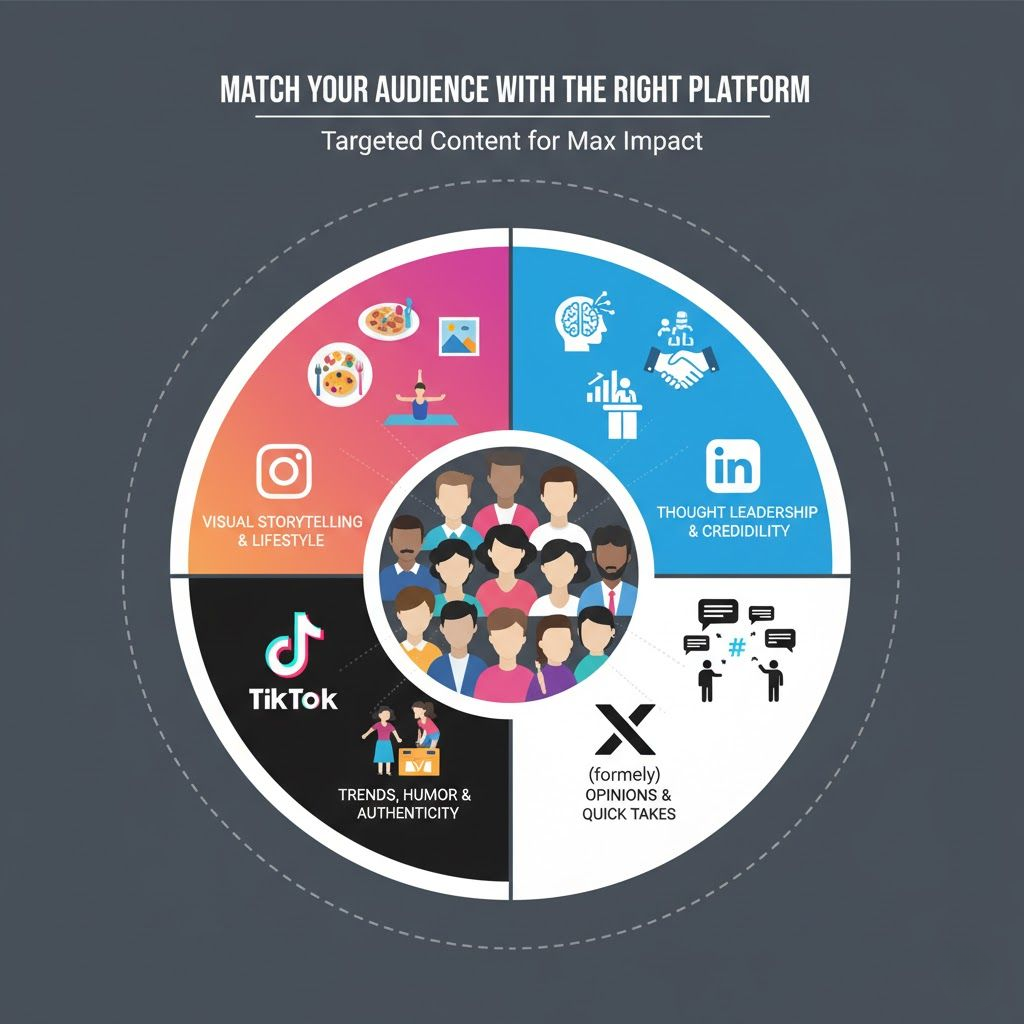
So when you focus on creating content, make sure to match your audience with the right platform. Your grouped buyer personas will actually tell you where you should spend your focus.
You focus on the platform where your audience spends time, not where you feel you should.
Pro Tip: You can use tools like SparkToro or Metricool to understand where the audience spends time.
The tool is great to learn which platform, podcasts or hashtags (ultimately saving you a lot of precious runs of trial and error).
Define What “Conversion” Means for Each Audience
Not every follower will buy right away — and that’s okay.
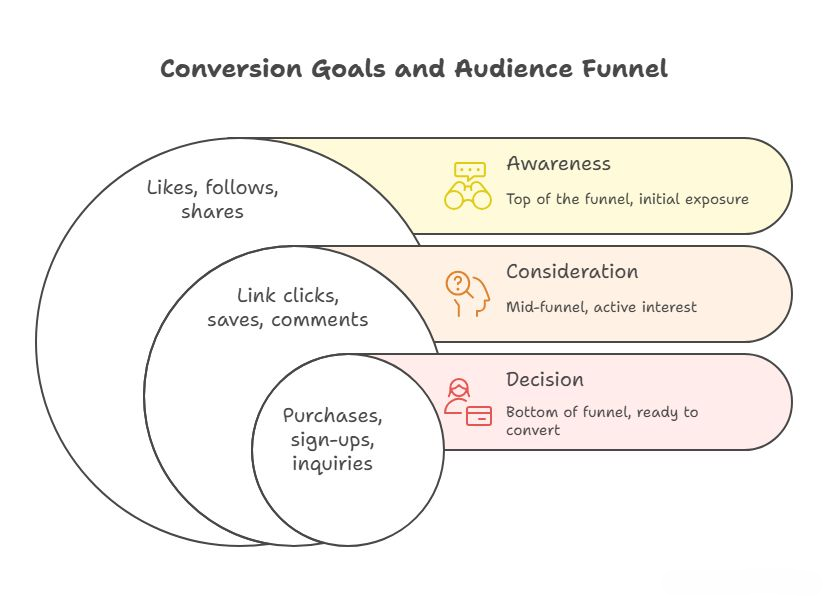
Your conversion goals should match where the audience is in the funnel:
- Awareness: Likes, follows, shares.
- Consideration: Link clicks, saves, comments.
- Decision: Purchases, sign-ups, inquiries.
Knowing your conversion goals will allow you to track real success, and not follow vanity metrics. Because 1,000 followers who act are worth more than 10,000 who just scroll.
Step 3: Build Your Content Pillars (Your Core Messaging System)
Now that we know who you’re talking to, let’s move to the next step which is “Building Your Content Pillars” and that’s pretty much the backbone of your entire SMM strategy.
You want to keep your content strategy consistent without burning out. And your content pillars play a significant role; you can think of them as the core themes your brand stands on.
Choose the topics your audience will associate with.
Otherwise, you will end up doing more harm than good.
One day you’re posting memes, the next day a quote, and then — boom — a hard-sell post that confuses everyone. Content pillars bring focus, rhythm, and predictability to your storytelling.
What Are Content Pillars?
The best way I can explain content pillars is through a simple example of a house.
And your content pillars are the beams that hold it up. You remove one and your entire house starts wobbling. Every pillar represents content that dictates your brand’s mission to your audience in a way that it addresses their needs. For example, if you’re a digital marketing consultant, your pillars might fall into the following categories:
- Education: Tips, tutorials, and breakdowns.
- Credibility: Case studies, testimonials, client wins.
- Community: Relatable content, behind-the-scenes, and Q&As.
- Trends: Latest updates or your take on what’s happening in the industry.
This way, you can keep your strategy tight. Overall, you will also know which category a post fits into, and how your audience can learn what to expect from your end.
How to Identify Your Core Pillars?
Not sure what your core content pillars are? Well, you can identify them by answering three questions:
- What does my audience care about the most? (Look back at Step 2)
- What do I want to be known for?
- What topics can I talk about endlessly without running out of ideas?
The answers you write will tell you what your content pillars can shape into.
You can use ChatGPT here; as discussed, you already have your audience personas and niche clear, just feed them to your prompt engine and ask:
“Based on these audience personas and my niche [insert brief], suggest 4–5 content pillars that align with brand goals and customer pain points.”
Refine these pillars using your own intuitions & let AI give you the best direction.
Add Depth with Subtopics in Every Pillar
Every pillar you choose will have multiple subtopics to scale your content.
For example, if you’re a fitness coaching brand; you can break down concepts & teach your audience something new if you’re planning to cover the “Education” pillar.
- How different workouts impact muscle growth
- Nutrition myths debunked
- Beginner’s guide to calorie tracking
- Mini tutorials: “3 moves to improve your posture”
Such content will build your authority and show you actually know your stuff.
If you are more bent on the “Social” pillar, you can mostly rely on UGC content.
Here, you can let others (your client) do the convincing for you.
- These can be client transformation stories.
- Or it can be testimonials and before/after progress shots.
- Your client can send screenshots of feedback which you can put up.
- Or you can simply feature “Client of the Month.”
User-generated content mostly builds proof which is relatively more valuable than promises.
Similarly, there are other pillars as well that you can capitalize on.
| Pillar | Core Goal | Example Post Ideas |
| Education | Build authority | “Why protein timing matters more than total intake” |
| Social Proof | Build trust | “How Zara lost 10kg with our 8-week challenge” |
| Lifestyle | Build connection | “Morning routine before my 6AM class 💪” |
| Motivation | Build engagement | “Discipline isn’t about feeling ready — it’s about showing up” |
| Product Focus | Drive conversions | “New 4-week HIIT program starts Monday — link in bio!” |
Step 4: Create a Posting Plan That Drives Consistency
By now, you’ve researched your digital landscape (you know the playground) and you’ve identified your audience (you know who you’re speaking to) and you have built your content pillars (you know what to talk about). Now, the real challenge comes when you have to post the content regularly.
The truth most creators and brands often struggle with:
It’s not the lack of creativity that kills momentum — it’s the lack of structure.
You can have the best ideas in the world, but if they are scattered, unplanned, and posted on impulse, you’ll burn out before your content even starts gaining attraction.
That’s where a posting plan steps in, because it’s not just a calendar, it’s a continued system.
Start With Realistic Frequency — Not “Post Every Day” Pressure
Posting daily sounds amazing in theory, but if it burns you out, it’s not sustainable.
You’re better off posting 3 quality times a week consistently than posting 7 times one week and disappearing the next. So, how do you decide what frequency you need to set?
Ask:
- How many solid, value-driven pieces can I create per week without sacrificing quality?
- What platforms am I focusing on? (e.g., 3 Instagram posts + 2 TikToks + 1 LinkedIn article weekly)
- Can I repurpose one post across formats instead of reinventing it every time?
You can use ChatGPT to plan your posting schedule.
Just feed a short system prompt:
“Create a realistic 4-week posting schedule for a fitness coach who posts 3 times a week on Instagram, repurposes content for TikTok, and writes 1 newsletter per week.”
You will automatically get a framework that fits your bandwidth.
Follow a Simple Weekly Content Framework
Your posting schedule can work like your Spotify playlist.
Every day, you can choose your own ‘theme.’
This way, your feed remains balanced and reduces the mental load of deciding what to post next.
So let’s say you’re a tech startup, a SaaS company launching a productivity app, something that speaks to founders, creators & remote teams.
Your posting schedule can look somewhat like:
| Day | Pillar Focus | Example Post |
| Monday | Education | “3 time-blocking methods that actually boost focus (and how our app supports them)” |
| Wednesday | Social Proof | “How Zara, a freelance designer, saved 10 hours a week using [App Name]” |
| Friday | Lifestyle / Behind-the-Scenes | “Our team’s Friday sync: how we manage hybrid work chaos with async tools” |
| Sunday | Product Focus | “Sneak peek: our new AI meeting summarizer drops next week 👀” |
Use Batching to Save Time & Money
This is the step where many individuals often go wrong.
They create strong visuals, write incredible captions and yet post everything on the same day.
It’s like preparing a decent meal for everyone right when they are already at the table.
Instead, a better strategy is to optimize and batch your workflow
- If you researched and came up with an idea on Monday.
- Then design, record or write your post on Tuesday.
- Upload and schedule them for publishing on a scheduling tool on Wednesday.
The rest of the week, spend time replying to comments, entertaining DMs & tracking engagement.
You will see that your creativity flows better when you separate content creation from publishing.
Repurpose Your Content Across Platforms
If you want to multiply impact without multiplying your overall effort, you don’t need new content to be posted on every platform; you just need new formats of the same idea.
For example: Let’s say you post a carousel on Instagram titled “3 Mistakes Killing Your Progress in Your Marital Life” you can easily repurpose this into:
- A TikTok/YouTube Short: You talk through each mistake, 30 seconds each.
- A Tweet thread: Summarizing those mistakes in snappy one-liners.
- A LinkedIn post: Turning it into a story-driven post about client experience.
Just use the same message, but in different formats.
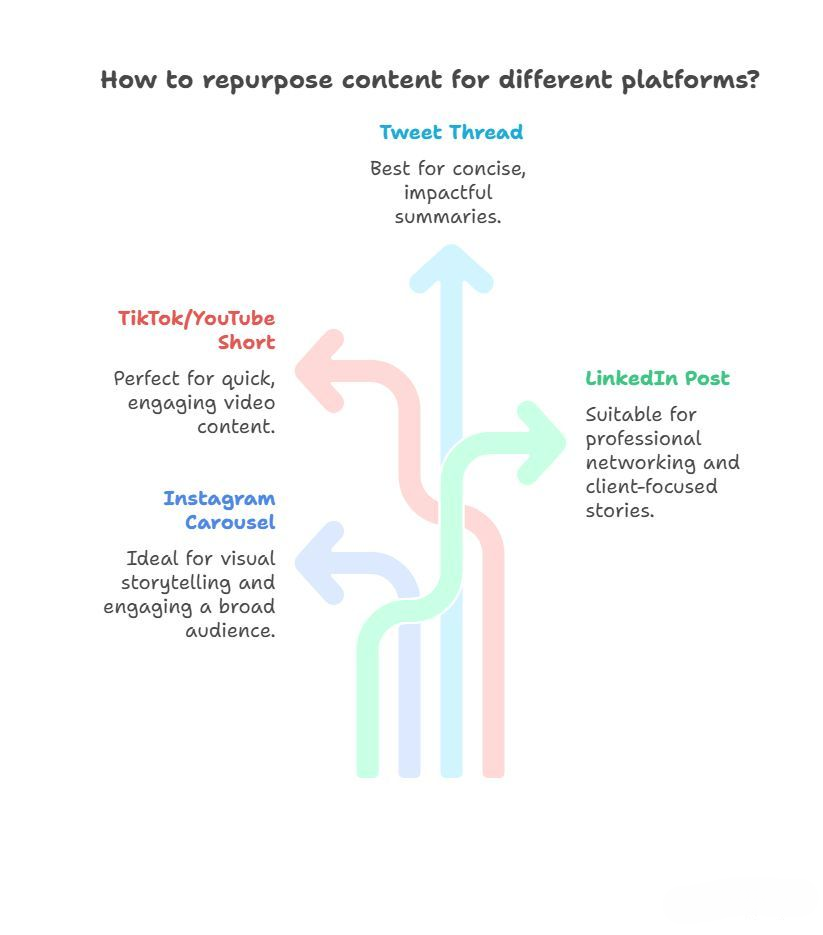
It will help you attain wider reach, and the best part, you don’t have to put any extra effort.
You can ask ChatGPT to turn your Instagram post into one that’s more befitting for your LinkedIn audience… by simply asking.
“Turning this Instagram carousel caption into a LinkedIn post sounding a bit more professional.”
Build an Engagement Routine
Posting social media posts is just one part of the play.
The real growth happens when you engage.
Set aside days purely for engagement.
Have an engagement schedule of up to 15-30 minutes daily.
You can start by:
- Replying to comments thoughtfully.
- Engage with social posts from followers & niche creators.
- Ask relevant questions in your stories.
It signals the algorithm that you’re not just pushing content, you’re actually building relationships. And this is pretty much what social media banks on, genuinity instead of promotions.
Step 5: Track, Measure, and Optimize with Clear KPIs
It appears you’re done with the heavy lifting.
And now, it’s finally time to measure what actually works.
Because let’s be real, if you aren’t tracking your performance, you’re not strategizing properly.
You’re putting most of your effort in guessing or playing wild cards.
This is just not how social media works.
To track and measure, think of analytics as your feedback loop. Every post you send out, every comment you make and every click you do tells a story. It speaks what your audience values, what sparks their emotions, and what quietly falls flat.
Your job as a strategist is to listen to that story & adjust your next move accordingly.
Define What “Success” Looks Like
So before you chase numbers, decide which numbers really do matter.
Not every metric equates to impact.
Here’s how to break it:
| Goal | Primary KPIs | What It Means |
| Brand Awareness | Reach, Impressions, Follower Growth | People are discovering you. |
| Engagement | Likes, Comments, Shares, Saves | People are resonating with your message. |
| Traffic & Conversions | Link Clicks, Website Visits, Sign-Ups | People are taking action beyond social. |
| Loyalty & Retention | Story Replies, Repeat Comments, Community Growth | People are sticking around and identifying with your brand. |
Don’t put your entire faith in vanity metrics (like how many followers you have made).
Focus more on intent metrics, the ones that signal genuine connection or conversion potential.
Set Aside a Day to Read Your Analytics
Keep a single day from your week (maybe Friday) since it’s a lucky day to review your analytics.
Check:
- What content got the most engagement?
- What time or day did my posts perform best?
- What format (carousel, reel, post) drove the most saves or clicks?
- Did any posts lead to sign-ups, DMs, or website traffic?
Log your findings in Google Sheet tracker. Eventually, you will see a pattern emerging.
Double Down on What Works – Ditch What Doesn’t
Do some of your posts really work? Well, if you see a trend reappearing every now and then, systemize it. It’s what you can bank on, a method you can replicate every week.
As the wise social guru once said:
“Remember, your best strategy is hidden inside your best data.”
Conclusion – Turning Strategy into a Winning Social Presence
So there you have it, the entire social media marketing strategy that screams!
Yes, it has happened before for people, and it’s bound to turn into fruition for you too. You started this journey trying to figure out why your social media wasn’t converting.
Now, you have the full map, from researching pillars to post scheduling & optimization.
That’s not just content strategy — that’s brand mastery.
Keep your structure tight, your creativity wild, and your insights alive.
Because the brands that win aren’t just the ones that post — they are the ones willing to listen, learn and evolve.
At Rank Hive, our social media marketing helps brands see that silver lining.
Wanna chat? We are available.


