


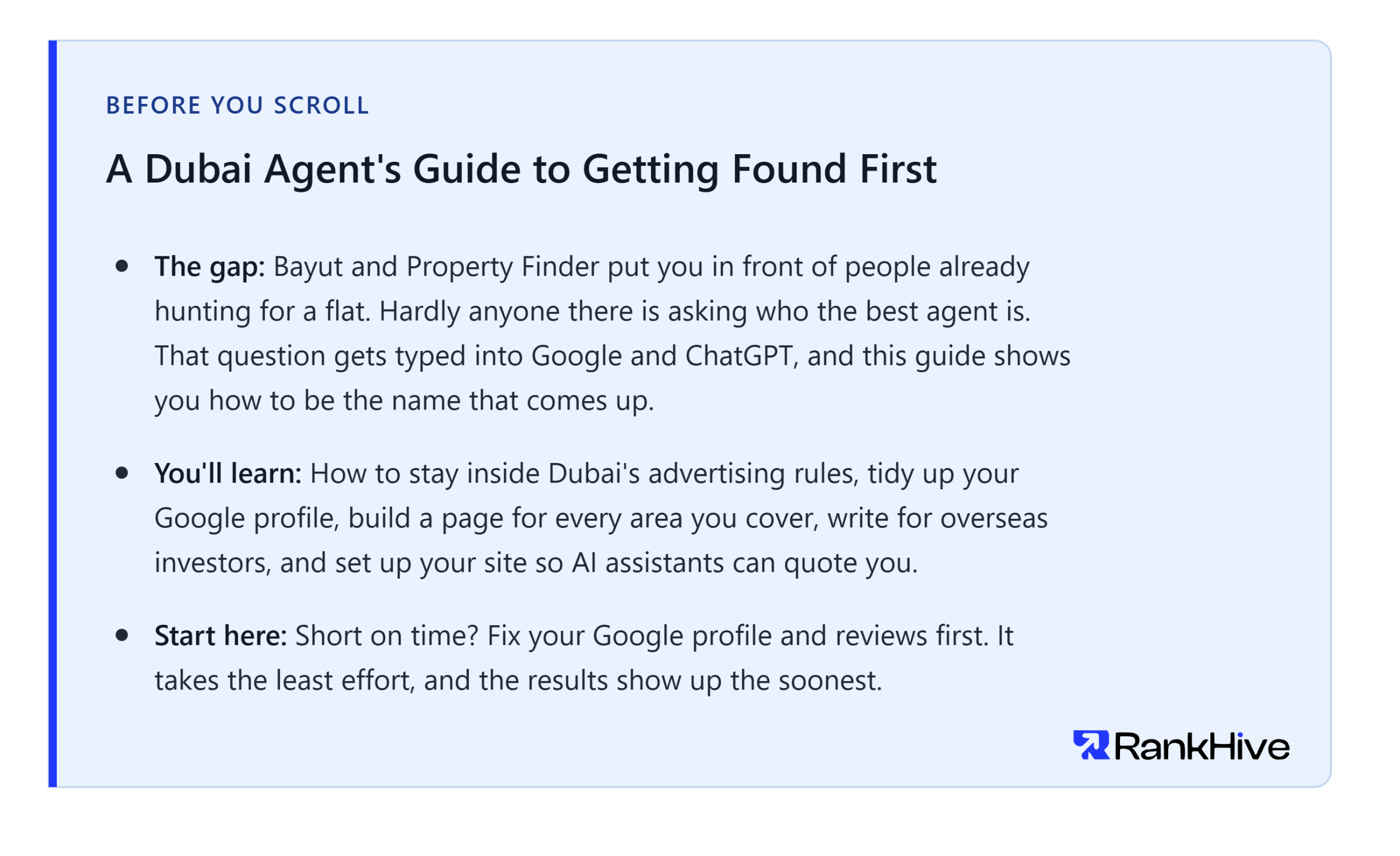
Searching for a property in Dubai seems like one challenging task.
Upon typing in “ 2 bedroom apartment in Dubai,” you’re most likely to get thousands of listings. Be it Bayut or Property Finder, the market is crowded.
As a real estate agent, it is tough to compete to get your listing at the top. To achieve it, a SEO for real estate agents Dubai requires more than adding property-related keywords to a website.
It requires understanding local search behaviour, targeting the right communities, building professional credibility, and making it easy for potential clients to get in touch.
Why SEO Matters for Real Estate Agents in Dubai?
Dubai’s property market attracts local residents, international buyers, tenants and investors. These audiences doesn’t just searching for the same terms. Someone looking to rent an apartment in Jumeirah Village Circle has different requirements from an overseas investor researching off-plan development.
This creates opportunities for agents who understand their target audience and build content around specific needs.
Here is why organic search deserves a place in a real estate marketing strategy.
1. Reach Potential Clients When They Are Actively Searching
Instead of generic keywords, you need to research the what your potential clients are searching for.
People use Google at different stages of their property journey. Some are comparing communities, while others are ready to contact an agent for property right away.
A well-structured website can target these different searches by linking relevant pages.
Instead of targeting every page for Dubai real estate, the agent reaches people interested in a specific area or property. This narrows down the process and keep leads organized.
2. Build an Independent Source of Property Leads
Property portals need to provide a large access to the potential clients. But it also need to compete with several other platforms to get found.
An independent website gives agents more control over their branding, content and enquiry process. They can showcase their experience, publish community guides and direct visitors towards their own contact channel.
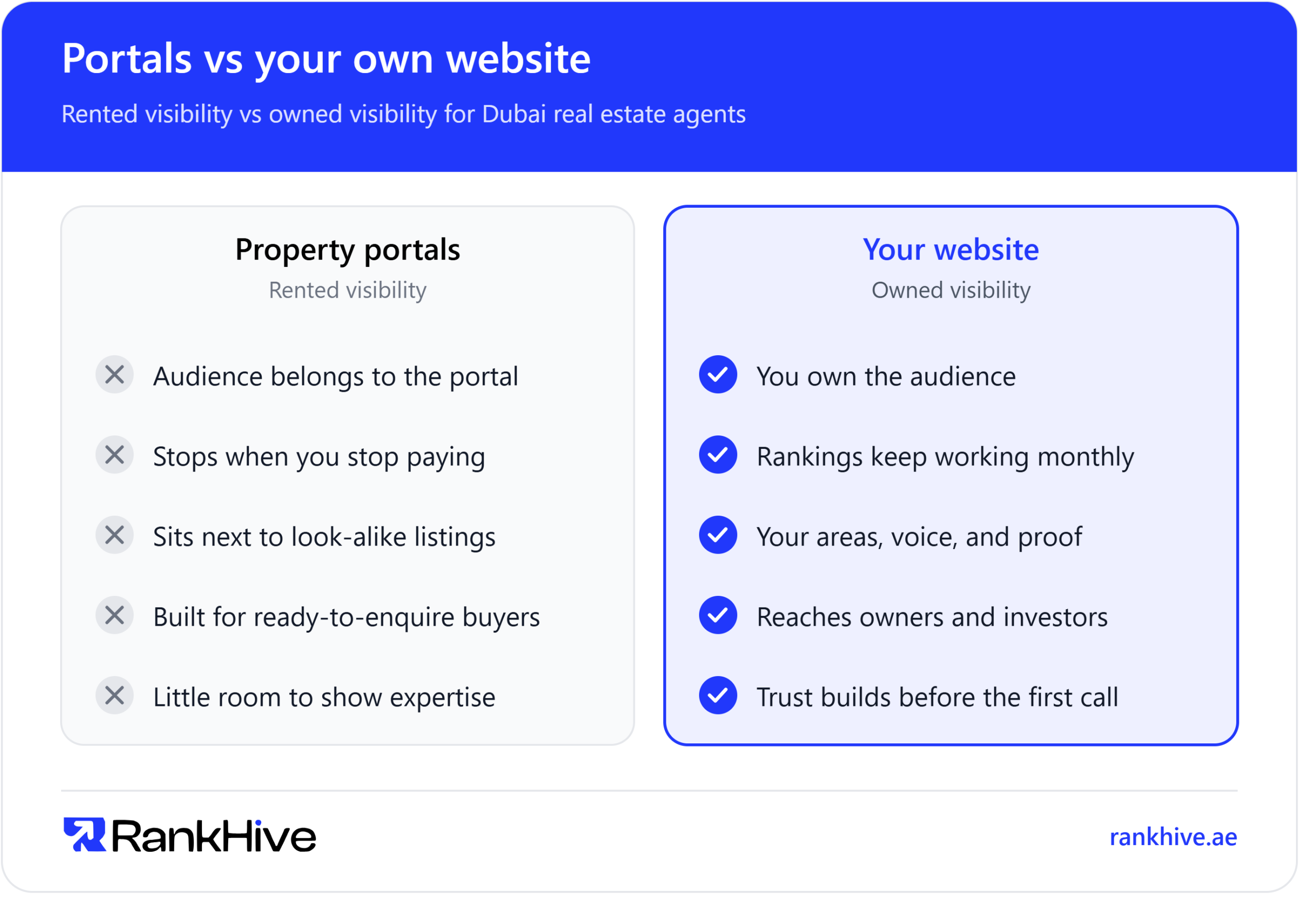
This doesn’t mean abandoning property portals. Rather, property agent SEO use easy way to attract potential clients without depending entirely on third-party platforms.
3. Establish Your Reputation as a Property Expert
A buyer might compare several agents before deciding whom to contact. A professional website with detailed community information, genuine client testimonials every factor matters.
Establishing a real estate agency crediblity makes the real difference. For property agent SEO it’s important to get real client reviews to close more leads.
4. Attract More Relevant Enquiries
Real estate website SEO is only useful when it connects with a real audience.
Someone searching for luxury villas in Palm Jumeirah has a different requirement from someone researching affordable apartments for rent. Targeting these searches with relevant pages helps agents connect visitors with the properties and services they are looking for.
Over time, this can create a more consistent source of relevant inquiries.
Understand What Property Buyers and Sellers Search for in Dubai
Before choosing keywords or creating landing pages, agents need to understand how potential clients search.
Not every visitor starts with a property listing. Some begin by researching neighborhoods, comparing prices, or looking for advice before buying a property.
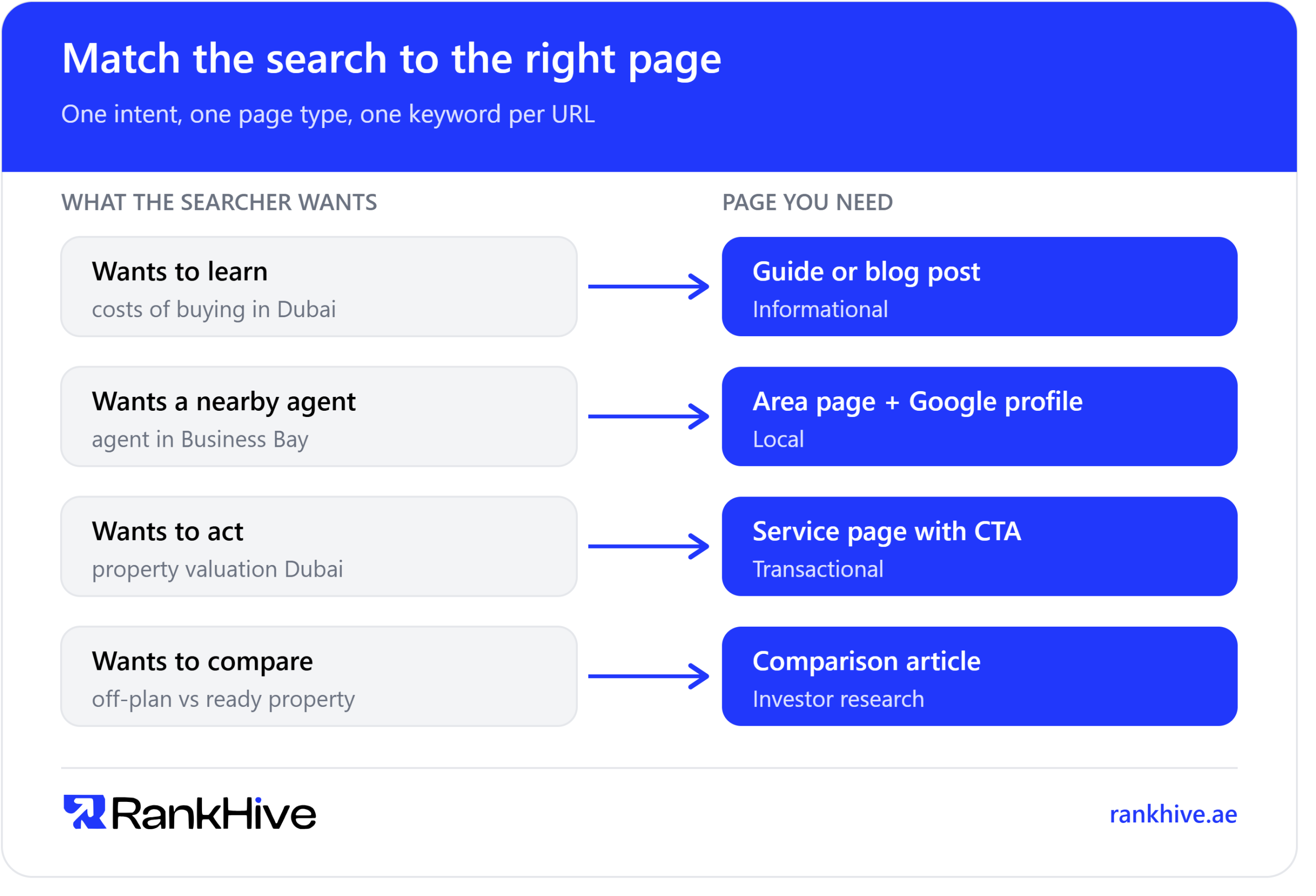
These searches generally fall into four categories.
| Search intent | Example searches | Suitable page |
| Property-specific | Apartments for sale in Dubai Marina | Property listing page |
| Location-based | Real estate agent in Business Bay | Agent or location page |
| Service-related | Luxury property consultant in Dubai | Service landing page |
| Research-oriented | Is JVC a good area for investment? | Community or investment guide |
Understanding search intent helps property agent SEO decide what information a page should provide.
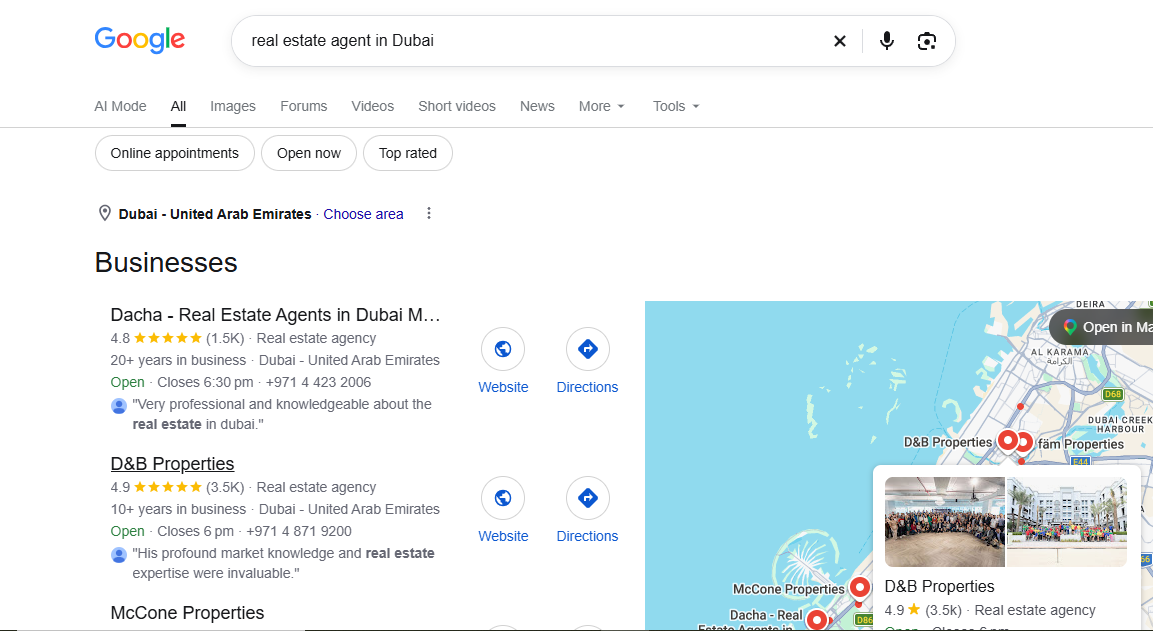
For instance, someone searching for real estate agent in Dubai expects to see several agent details and reviews, prices and viewing options.
Similarly, someone searching for Dubai Hills Estate gets useful information about the community, not a page filled with unrelated listings.
The goal is to match each search with the most relevant information.
Read more: The Complete Guide to SEO in Dubai for the AI-Search Era
How to Build an SEO Strategy for Real Estate Agents in Dubai
A successful property SEO strategy helps align everything.
From keyword research to website structure, this enables local visibility, making your brand stand out from the crowd. Each element supports a different part of the search journey.
1. Find the Right Real Estate SEO Keywords
Keyword research helps agents understand which terms potential clients use when searching for properties and professional services.
However, targeting high-volume phrases such as “properties in Dubai” isn’t always the best starting point. These searches are broad and often dominated by established property portals and large agencies.
A more focused approach is to identify keywords based on:
- Location: Dubai Marina, Downtown Dubai, Business Bay, JVC and Dubai Hills Estate.
- Property type: Apartments, villas, townhouses, penthouses and commercial properties.
- Transaction type: Buying, selling, renting and off-plan investments.
- Audience: First-time buyers, overseas investors, tenants and luxury property buyers.
- Professional services: Property consultants, real estate agents and investment advisors.
Consider how these keyword variations can lead to different website pages.
| Broad keyword | More targeted keyword | Search intent |
| Properties in Dubai | Apartments for sale in Dubai Marina | Transactional |
| Dubai real estate agent | Real estate agent in Business Bay | Commercial |
| Villas for sale | 4-bedroom villas in Dubai Hills Estate | Transactional |
| Dubai property investment | Is JVC a good area for property investment? | Informational |
| Luxury properties | Luxury property consultant in Dubai | Commercial |
Long-tail keywords are particularly useful for agents who specialise in specific communities or property categories. Although individual searches may attract fewer visitors, they can connect agents with people who have clearer requirements.
Tools such as Google Keyword Planner, Google Search Console, and competitor research platforms can help identify keyword opportunities. Review the actual search results before assigning keywords to pages, as similar phrases may have different search intent.
Looking for a more structured SEO strategy? Connect with our team for professional local SEO services in Dubai.
2. Create Community-Specific Landing Pages
Dubai’s property market is made up of communities with different property types, price ranges, amenities and buyer profiles.
An agent working in Dubai Marina may have different selling points from someone specialising in Arabian Ranches or Palm Jumeirah.
This makes community-specific landing pages a valuable part of a real estate website.
Rather than creating one generic page for properties in Dubai, build dedicated pages around the areas you genuinely serve.
Potential examples include:
- Apartments for sale in Dubai Marina.
- Villas for rent in Arabian Ranches.
- Off-plan properties in Business Bay.
- Luxury apartments in Downtown Dubai.
- Family homes in Dubai Hills Estate.
A useful community page should offer more than a list of available properties.
Include information such as:
- Community overview: Explain the area’s residential character, property types, and general appeal.
- Available properties: Display relevant listings with accurate descriptions and updated availability.
- Local amenities: Discuss nearby schools, shopping centers, healthcare facilities, and leisure options where relevant.
- Transport and accessibility: Explain major road connections and available public transport.
- Market information: Include relevant property prices or market trends, supported by reliable and dated sources.
- Buyer considerations: Discuss factors such as service charges, property types and suitability for different requirements.
- Enquiry options: Make it easy to request information or arrange a viewing.
3. Optimize Your Google Business Profile
When someone searches for a real estate agent in a particular area, Google may display local business results alongside traditional website listings.
A properly maintained Google Business Profile can help eligible real estate businesses appear in these local results.
Start with the following:
- Claim and verify your eligible business profile.
- Select accurate primary and secondary business categories.
- Add consistent business contact information.
- Keep opening hours and business details updated.
- Include genuine photographs of your office and professional activities.
- Encourage clients to leave honest reviews.
- Respond to reviews professionally.
- Share relevant business updates where appropriate.
Reviews can also help potential clients understand what working with an agent is like. Encourage genuine feedback after completed transactions or professional interactions, without offering incentives for positive ratings.
Remember that individual agents should follow Google’s eligibility guidelines. A virtual office or an address where the business does not genuinely operate should not be used to create a misleading listing.
Local SEO also extends beyond Google Business Profile. Your website should clearly identify the communities you serve and provide useful information about your services.
If local visibility is a priority, Contact our SEO team to get location-focused search strategy.
4. Building a Personal Brand Through Website
A property listing tells visitors what you are selling. Your professional profile explains why they should consider working with you.
This distinction matters in a competitive market where potential clients can find multiple agents offering similar properties.
Create a dedicated agent profile that includes:
- Professional background and relevant experience.
- Communities and property categories you specialise in.
- Verified professional credentials.
- Relevant transaction experience or case studies.
- Genuine client testimonials.
- Professional contact information.
- Links to your community guides and property listings.
5. Optimize Property Listings for Search Engines
Property listings often make up a significant part of a real estate website. However, simply uploading photographs and copying a developer’s description won’t give each page a strong search presence.
Every listing should provide useful information that helps visitors assess whether the property matches their requirements.
Focus on the following elements:
- Write unique property descriptions. Explain the property’s actual features, layout, location and relevant selling points. Avoid copying identical descriptions across multiple listings.
- Use descriptive page titles. Include the property type and location naturally. For example, “3-Bedroom Apartment for Sale in Dubai Marina” is more informative than “Luxury Property 01.”
- Include accurate property details. Display the number of bedrooms, bathrooms, property size, asking price and relevant features.
- Use descriptive images. Add clear property photographs and meaningful alt text that describes what each image shows.
- Improve navigation. Connect listings with relevant community pages and related property categories.
- Make enquiries easy. Include visible options to request further details, arrange a viewing or speak with the agent.
There is also an important consideration when a property is sold or rented.
Don’t automatically delete every unavailable listing. Some pages may continue to attract visitors searching for that particular property or building. Where appropriate, update the page status and direct visitors towards similar available properties.
If a page no longer serves a useful purpose, assess whether it should be redirected to a genuinely relevant alternative or removed from the index.
Managing listing URLs carefully helps prevent unnecessary broken pages and confusing search experiences.
6. Publish Helpful Real Estate Content
Property listings primarily attract people looking for available homes. Informational content can reach potential clients much earlier in their decision-making process.
An investor researching Dubai’s residential communities, for example, may not be ready to contact an agent immediately. However, a useful investment guide can introduce the agent’s expertise before that person starts comparing properties.
Consider developing content around the following topics:
| Content category | Suggested topic |
| Community guides | Living in Dubai Marina: What Buyers Should Know |
| Investment advice | Is JVC a Good Area for Property Investment? |
| Buying guidance | What Documents Do You Need to Buy Property in Dubai? |
| Market insights | Dubai Property Market Trends and Price Movements |
| Off-plan properties | What to Check Before Investing in an Off-Plan Property |
| Renting advice | What Tenants Should Know Before Renting in Dubai |
The quality of this content matters more than the number of articles published.
Analyze current market information, explain unfamiliar property terms and answer questions that potential clients genuinely ask. Where you discuss transaction figures, rental yields or property prices, cite reliable sources and specify the relevant reporting period.
Avoid publishing generic articles that repeat information already available across dozens of property websites.
Create a useful content strategy to connect blog posts with relevant community pages and listings through contextual internal links.
7. Strengthen Your Website’s Technical SEO
Even useful content can struggle to perform if visitors and search engines have difficulty accessing the website.
Technical SEO addresses the website’s structure, accessibility and performance.
Real estate websites should pay particular attention to the following areas:
- Mobile usability: Ensure property pages, photographs, filters and enquiry forms work properly on smartphones.
- Page speed: Compress large property images, reduce unnecessary scripts and monitor loading performance.
- HTTPS security: Protect website connections and visitor information.
- Crawlability: Make sure important pages can be accessed by search engine crawlers.
- XML sitemap: Help search engines discover important website URLs.
- Internal linking: Connect community pages, listings, agent profiles and relevant articles.
- Canonical tags: Identify preferred versions of pages where similar URLs create duplication issues.
- Structured data: Use appropriate schema markup to describe supported business and page information.
Property websites can develop duplicate content problems when filters, sorting options and multiple URL variations create similar pages.
Get a free technical audit for your website to identify issues and prioritise fixes by our expert SEO team.
8. Build Local Authority Through Backlinks and Online Mentions
Search engines use multiple signals to understand the relevance and credibility of a website. Relevant links and consistent business information can contribute to an agent’s online presence.
Rather than collecting links from unrelated directories, focus on sources that make sense for the property industry.
Potential opportunities include:
- Contributing property insights to established UAE real estate publications.
- Participating in industry interviews and expert discussions.
- Building relationships with relevant local businesses.
- Publishing original market research that other websites may reference.
- Maintaining accurate professional profiles and business listings.
- Contributing useful information to property-related communities.
For instance, an agent who publishes an original report comparing residential communities may earn references from local publications or other industry websites.
The emphasis should be on relevance and genuine editorial value, not the number of backlinks collected.
Avoid paid link schemes and bulk submissions to low-quality directories. These tactics can create more problems than value.
9. Prepare Your Real Estate Website for AI Search
Property buyers increasingly use conversational search tools to research neighbourhoods, compare residential options and ask questions about the buying process.
Instead of searching only for “apartments in Dubai,” someone might ask an AI assistant:
“Which Dubai neighbourhoods are suitable for families looking for three-bedroom apartments?”
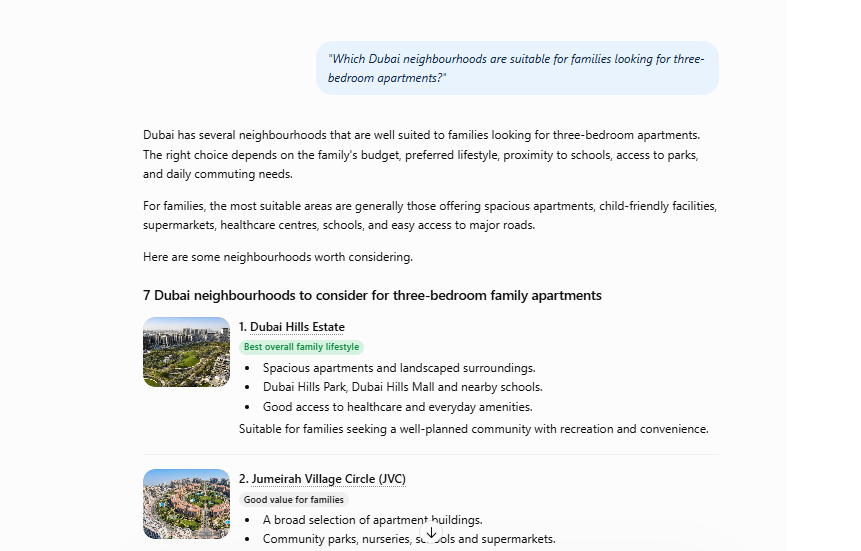
This creates another reason to publish detailed, accurate and well-organised property information.
Agents can prepare their websites for AI-driven discovery by:
- Answering specific property-related questions clearly.
- Publishing detailed community and neighbourhood guides.
- Including verifiable information and links to reliable sources.
- Demonstrating genuine local property knowledge.
- Maintaining consistent agent and business information.
- Using descriptive headings and logically structured content.
- Updating outdated information when market conditions change.
Nonetheless, there is no guaranteed way to secure a mention in ChatGPT, Gemini or Google’s AI Overviews. But publishing useful and trustworthy information gives both traditional search engines and AI-powered systems a clear roadmap.
Read more: GEO vs SEO: What UAE Businesses Need to Know
These approaches focus on making brand information easier to understand, retrieve and reference across emerging search experiences.
How to Turn Real Estate Website Traffic into Qualified Leads
Getting visitors to your website is only part of the job. If potential clients cannot find your contact information or understand what to do next, even relevant organic traffic may fail to produce enquiries.
Your website should make the next step clear.
Make WhatsApp and Call Options Easy to Find
Many property enquiries require a quick conversation. Add visible WhatsApp and telephone options to relevant pages, particularly property listings and community landing pages.
Make sure these options work properly on mobile devices. A visitor interested in a particular apartment should be able to contact the responsible agent without searching through several pages.
Create Property-Specific Enquiry Forms
A generic contact form may not collect enough information to help agents understand what a visitor needs.
Consider including fields for:
- Preferred community or location.
- Property type.
- Buying or renting requirements.
- Budget range.
- Preferred viewing date.
Keep the form short. Asking for too much information can discourage potential clients from submitting an enquiry.
Use Clear Calls to Action
Every important landing page should guide visitors towards a relevant action.
Examples include:
- Book a Property Viewing.
- Speak to a Dubai Property Consultant.
- Request Property Details.
- Explore Available Apartments.
- Discuss Your Investment Requirements.
The CTA should match the page. A community guide might encourage readers to speak with a local specialist, while a property listing should make viewing requests the main action.
Track Enquiries Beyond Website Visits
Google Analytics 4 and Google Search Console can help agents understand how people discover and interact with their websites.
However, tracking should extend beyond traffic and keyword rankings.
Monitor:
| Metric | What it tells you |
| Organic clicks | How many visitors arrive through search |
| Search impressions | How often pages appear in search results |
| Keyword performance | Which searches bring visitors |
| WhatsApp clicks | How many visitors initiate contact |
| Phone enquiries | How often visitors use call options |
| Form submissions | How many people submit property enquiries |
| Qualified leads | How many enquiries match your target audience |
| Viewing requests | How many potential clients progress towards a viewing |
Connecting website enquiries with a CRM can also help agents understand which pages generate serious prospects rather than general questions.
The goal isn’t simply to increase website traffic. It’s to attract people who are more likely to become clients.
A Practical 90-Day SEO Roadmap for Real Estate Agents
Building a search presence takes consistent work. Agents who are unsure where to begin can divide their initial SEO activities into three stages.
| Period | Priority activities |
| Days 1–30 | Website audit, keyword research, competitor analysis, technical fixes and Google Business Profile review |
| Days 31–60 | Community landing pages, agent profiles, listing improvements, content development and internal linking |
| Days 61–90 | Local authority building, content updates, AI-search readiness, conversion tracking and performance analysis |
During the first month, focus on understanding the website’s existing problems and identifying realistic keyword opportunities.
The second month should focus on improving the pages that matter most to the business. This may include community landing pages, property listings and professional profiles.
In the third month, review performance data, identify content gaps and improve the website’s ability to turn visitors into enquiries.
FAQs
1. Should a real estate agent have a personal website or use an agency website?
Both options can work, depending on the agent’s business arrangement. An individual website offers greater control over personal branding and content, while an agency website can provide an established platform with listings, resources and existing search visibility. Agents should check their brokerage’s policies before creating independent business websites.
2. Is Arabic SEO necessary for real estate agents in Dubai?
It depends on the audience an agent wants to reach. English-language content may serve many international buyers and residents, while Arabic pages can help connect with Arabic-speaking audiences. If both languages are important, create properly translated and locally relevant pages rather than relying on automatic translations. Use appropriate language targeting and separate URLs where needed.
3. Can social media profiles help with real estate SEO?
Social media profiles can support brand discovery, professional credibility and referral traffic. However, social engagement should not be treated as a direct Google ranking factor. Agents should use social platforms to share useful property information and direct interested audiences towards relevant website pages. See how Instagram marketing for real estate can complement a wider digital marketing strategy.
Building a Strong Presence for Your Real Estate Business
Property buyers and investors have plenty of options when searching for professional assistance in Dubai. Real estate agents need more than an online listing to stand out. They need a website that demonstrates local knowledge, answers relevant questions and makes it easy for potential clients to get in touch.
A focused SEO strategy can help achieve this through community-specific landing pages, accurate property listings, personal branding, local search optimization and useful content.
RankHive helps businesses strengthen their search presence through SEO, content strategy, technical website optimization and AI-search services.
Contact RankHive to discuss an SEO strategy built around your business goals and target audience.


