


AI doesn’t just automate your bids — it protects your budget.
Staying ahead in marketing means making the smart choice.
And when it comes to setting up a budget for your PPC ad campaign, you need to adapt to the evolving trends and tools.
Every dollar in your ad budget is competing in an auction.
In that blink, Google’s machine learning evaluates over 70 million signals to decide what your bid should be. No manual power can match that. Predictive bidding is the powerful engine for your budget.
What used to require constant manual monitoring, spreadsheet modeling, and educated guesswork can now be handled in real time by algorithms.
The result? Perfect budget plan, less wastage of capital, and compound efficiency that helps in the long run.
What is Predictive Bidding?
Predictive bidding is an AI-powered bidding that is commonly used for platforms like Google Ads. The machine learning model helps predict the right budget for your marketing campaign. It automatically sets the bid for that specific auction. This helps reduce the manual work and avoid flat bidding to every keyword or ad group.
Predictive bidding sets a unique, context-sensitive bid every single time your ad is eligible to appear.
The word “predictive” is key. This system doesn’t predict what has already happened but what is about to happen. That prediction is based on a rich mix of real-time signals, like:
- who this person is
- what device they’re on
- where they are
- what time it is
- how they’ve behaved before
All these factors help determine the predictive bidding even before the auction clears. Over 80% of advertisers have moved from manual to automated bidding, and the shift is accelerating.
How Does Predictive Bidding Work?
The moment the user begins to search on Google, the auction begins. It takes 100 milliseconds to run an auction. Here’s how this smart machine learning model actually works:
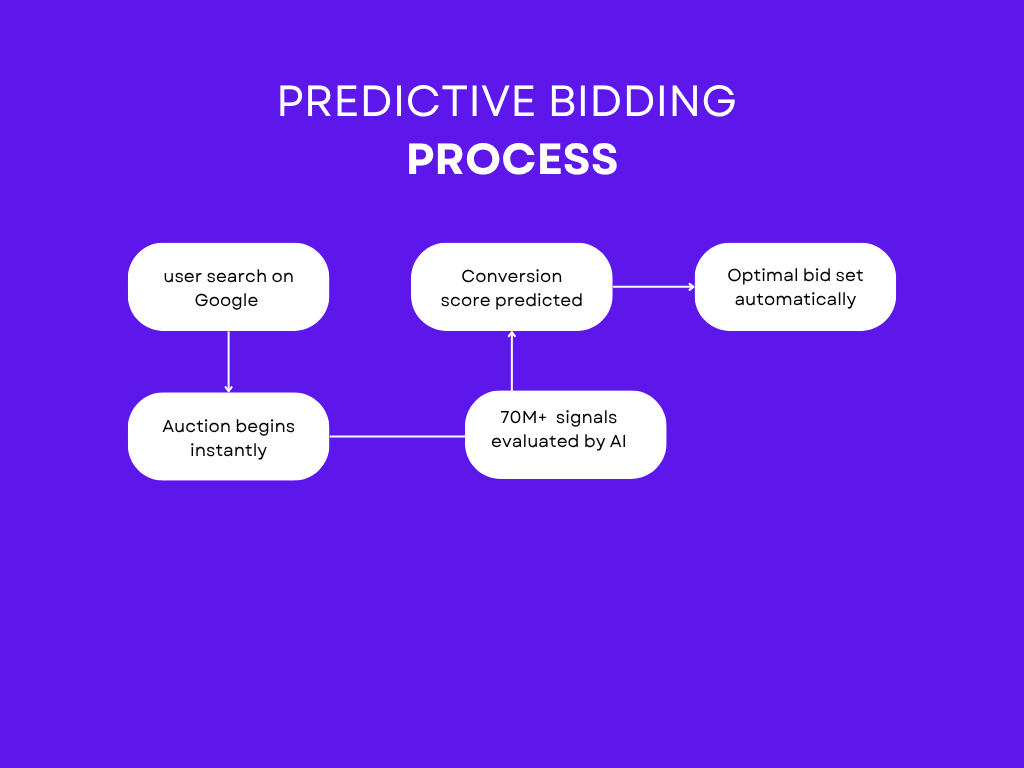
Think of this process as: two people searching for “running shoes” at the same time. One is on a mobile phone in a shopping district on a Friday afternoon; the other is on a desktop at 2 AM using a browser they rarely use.
Google’s model predicts different conversion probabilities for each. It then predicts the bids accordingly. The result is concentrated on the user who is more likely to buy.
Let’s take a look at how the auction signal actually gets triggered.
The signal stack:
- Device type and OS: mobile, desktop, tablet, and every operating system that signals different user behaviors.
- The physical location and search intent: where the user is based and what the search is actually intended for.
- Time of the day and day of the week: Conversations vary based on the day and time of day. To know the best time to post to get the real traffic, you need to know the right time when your audience is most active.
- Query context and match type: the wording of a search is important, not just matching the keyword.
- Browser and user suggestions: subtle user behavior that is tied to the browsing environment.
The Four Core Strategies for Predictive Bidding
Choosing the right predictive bidding strategy is what makes your campaign effective. Each campaign should have a different objective. Here are the top four strategies you need to build a smart bidding campaign.
Lead Gen Focus
You set a target cost per acquisition. Google AI predicts which user is most likely to convert and adjusts the bid so that it stays close to the budget. You spend more on high-intent signals and less on low-intent ones.
Best for: lead generation, fixed margin products
Revenue focus
You set a target return on ad spend. The system prioritizes auction predictions to generate high-value conversions, making it ideal for e-commerce with a variable process.
Best for: ecommerce, businesses with varying conversion values.
Volume focus
Google spends the entire budget to generate the maximum number of conversions. Useful for building conversion data or when the volume is the priority over the cost of the budget.
Best for: brand campaign, brand awareness campaign.
Value focus
Similar to volume focus, but optimized for total conversion rather than conversion count. The AI chases the highest value purchases, not just the most purchases, making it a natural fit along with target ROAS.
Best for: ecommerce with tiered products and subscription business models.
How to Set Up Predictive Bidding (Step-by-step Process)
-
Audit your conversion tracking
Smart bidding is as important as the conversion data it learns. Before doing anything else, you need to convert tracking to the right action, such as purchases or calls, that drives more conversions.
-
Build your conversion baseline
If your website has less than 30 conversions per month, optimize with maximize optimize (no CPA target) to build data volume first. Opting for target CPA directly leads to poor performance and erratic bidding.
-
Set a realistic target
The target CPA and target ROAS should be based on the historical performance of your campaign. Google Ads will suggest a budget based on your set target CPA. A CPA that is lower than 40% of the target doesn’t make an impact.
-
Give the learning phase its time
After you launch a campaign, it’s important to give it some time to analyze. Changing the campaign settings will impact the performance. Make sure the campaign is 2-4 weeks old to make the changes. During this window, making significant changes can impact the conversions.
-
Layer in audience signal
Predictive bidding performs better with more signals. You can add your first-party customer list, website visitors, and CRM data to analyze your audience. This gives more context to the algorithm on who the high-value users are and helps improve the bidding over time.
-
Use the performance planner before scaling
Before you increase the budget, open the Google Ads performance planner to analyze it. The predictive model helps stimulate how different budgets affect conversions, CPA, and ROAS.
How to Use Predictive Bidding for a Controlled Budget?
Predictive bidding is often known as a performance tool; it’s an impact that controls your budget. Here’s how predictive bidding helps control the campaign budget.
The fundamental mechanism of predictive bidding is budget protection. Bidding less on users who are unlikely to convert, the system reduces waste at the auction level.
A campaign manual CPC is distributed evenly across high-intent and low-intent clicks.
The same budget under Smart Bidding can help get high-probability conversions, making it easier to get more results. Such automation helps predict the accurate budget for your campaign. AI and GEO searches are making bidding more controlled and budget-friendly.
How to Safeguard Smart Bidding?
Even when the predictive bidding is running, you still need to have proactive budget control. There are some smart strategies that need to be implemented for smart bidding.
- Maximum CPC limits: Set a maximum CPC limit for your budget. This helps prevent the bidding algorithm from bidding excessively on a single high value that can distort the whole campaign.
- Daily budget cap at the campaign level: Even if the algorithm works fine, the daily cap level at the campaign level can help prevent spending disproportionately.
- Conversion value rules: For Target ROAS campaigns, set minimum conversion value thresholds to prevent the algorithm from chasing very low-value transactions at full bid intensity.
- Portfolio bid strategy: For advertisers running multiple campaigns with shared goals, portfolio strategies pool conversion data across campaigns, giving the algorithm more signal to work with and enabling smarter cross-campaign budget allocation.
- Spend alerts: Set automated rules to pause campaigns or alert you if daily spend exceeds 5x normal. Major overspend events, common on value-based strategies, can be caught before they drain your monthly budget in a single day.
Tools for Powerful Predictive Bidding
Google Smart Bidding is powered by the right tool. Using a broader ecosystem of bidding tools offers more specific and accurate bids for your campaign.
Let’s consider some of the most powerful predictive bidding tools.
- Google Smart Bidding
The most default and useful bidding tool for your campaign has to be Google Smart Bidding. This tool is easy to integrate without any additional cost. Google’s smart bidding tool works across search, shopping, display, and video ads. This tool helps predict conversions even without any prior advertising history.
- Optmyzr
This third-party platform helps optimize the bidding for brands managing multiple accounts. A third-party platform that layers rule-based optimization and custom scripts on top of Smart Bidding.
Particularly strong for agencies managing multiple accounts. Allows granular target adjustments, budget pacing rules, and cross-account coordination that platform-native tools don’t support.
- Skai
Previously known as Kenshoo, this enterprise-grade tool is a bidding engine that uses predictive models. This tool helps with conversion probability work across Google Shopping, Amazon, and social platforms simultaneously.
The portfolio optimization capability shifts spend dynamically between channels based on real-time performance signals, a significant advantage for large retailers running a multi-channel platform.
- Google Performance Planner
Not a bidding tool, but an essential planning companion. The Performance Planner uses your account’s predictive models to simulate how different budget and target combinations would have performed.
Use this tool before any major budget change or strategy shift. This tool provides simulation-based evidence for decisions that would otherwise be based on guesswork.
- Search Ads 360
This is Google’s own enterprise bid management platform, and it can be integrated with Google Ads accounts.
Search Ads 360 builds portfolio bid strategies that span multiple accounts. This conversion data is across dozens or hundreds of accounts to give the algorithm a much larger learning dataset.
Designed for large advertisers and agencies that need to bid across many accounts with shared conversion goals. For an accurate bidding budget, it’s important to get expert assistance. Get the best PPC service in Dubai for an accurate campaign budget.
Looking Ahead!
Predictive bidding is a dynamic shift in digital advertising. What used to require manual effort and monitoring can now be done via an automation tool. Bidding is now handled with a real-time AI algorithm that processes signals hard to predict manually.
But making predictive bidding an autopilot tool that handles everything can sabotage your ad campaign. AI is powerful but not autonomous. Predictive bidding needs clean data to set a realistic bid. This is where an expert strategist comes in for accurate bidding.
So, go ahead and make the predictive bidding accurate, and get conversions under the budget.


