


Likes are great for visibility, but they don’t pay the bills. Here’s how to build a Facebook strategy that turns engagement into real business growth.
A strong Facebook marketing strategy is what aligns with business goals, audience targeting, content, and paid campaigns to turn engagement into measurable leads and sales.
It typically follows nine stages: setting a clear goal, defining your audience, building a full-funnel content plan, pairing organic content with paid ads, optimizing ad creative, building a high-converting landing page, retargeting lost visitors, and tracking revenue-based metrics.
It’s easy to get excited when a Facebook post gets hundreds of likes. But if those interactions aren’t bringing in leads, sales, or inquiries, are they really helping your business grow?
This is where many businesses go wrong. They measure success by metrics instead of focusing on the actions that create revenue. A post with thousands of reactions may look impressive, but a campaign that generates ten qualified customers is far more valuable for business.
With a proper Facebook marketing guide you’ll be able to create a conversion-focused strategy.
Key Takeaways
- Focus on business goals instead of chasing likes and followers.
- Build content for every stage of the customer journey.
- Combine organic content with paid Facebook advertising for better results.
- Use audience data and retargeting to improve conversions.
- Track revenue-driven metrics instead of vanity metrics
- Let AI and Meta’s automation improve campaign performance, but always keep your strategy customer-focused.
Why Facebook Still Matters in 2026
Even when there are plenty of marketing platforms available, marketers still believe Facebook has the potential to generate revenue for businesses. Facebook allows businesses to generate better leads and sales.
Despite newer social media platforms entering the market, Facebook remains one of the largest digital advertising platforms in the world. With more than 3 billion monthly active users, businesses have access to audiences across nearly every age group and industry.
What makes Facebook particularly valuable isn’t just its size; it’s the ecosystem.
Instead of being a standalone social platform, Facebook connects with:
- Messenger
- Meta Ads Manager
- Facebook Marketplace
- Facebook Groups
This allows businesses to reach customers across multiple touchpoints while managing campaigns from a single platform.
Why Businesses Still Choose Facebook
Facebook marketing for business requires strong results because it offers:
- Advanced audience targeting
- Cost-effective advertising options
- High-quality lead generation tools
- Multiple content formats
- Powerful retargeting capabilities
- AI-powered campaign optimization
Unlike platforms that mainly focus on entertainment, with a Facebook marketing strategy UAE it is easy to excel in user discovery, product comparison, read reviews, join communities, and make purchasing decisions.
For B2B companies, service providers, healthcare businesses, educational institutions, and local businesses, Facebook remains one of the highest-performing marketing channels available.
Likes vs. Conversions: Understanding the Difference
One of the biggest mistakes businesses make is celebrating engagement without asking whether it contributes to business growth.
A strong social media marketing strategy requires a presence that is felt. However, conversion is what actually creates a real difference.
Consider these two scenarios:
Which one is actually successful?
The answer is obvious. Yet many businesses continue optimizing their content for engagement rather than actually lead generation.
Vanity Metrics vs. Business Metrics
| Vanity Metrics | Business Metrics |
| Likes | Leads Generated |
| Followers | Sales |
| Comments | Conversion Rate |
| Shares | Revenue |
| Reach | Return on Ad Spend (ROAS) |
| Video Views | Customer Lifetime Value |
| Impressions | Cost Per Acquisition |
Vanity metrics aren’t completely useless. They help indicate whether people notice your content. However, they should never be your primary measure of success.
Instead, ask questions like:
- Did this campaign generate leads?
- How many purchases came from Facebook?
- What was the return on investment?
- Did website traffic increase?
- Are visitors converting after clicking the ad?
These insights provide a much clearer picture of your marketing performance.
Step 1: Start With One Clear Business Goal
Before creating a single Facebook post, define what success looks like. Without a goal, you’ll end up posting random content and hope something will actually work for you.
Ask yourself:
What do I actually want Facebook to achieve?
Your answer might be:
- Generate qualified leads
- Increase online sales
- Book consultations
- Drive website traffic
- Grow email subscribers
- Increase app downloads
- Promote an event
- Build brand awareness
Every piece of content, advertisement, and campaign should support one primary objective that is to generate revenue.
Use SMART Goals
Instead of saying:
“I want more followers.”
Create a measurable objective like:
Generate 150 qualified leads through Facebook Lead Ads within the next 60 days while maintaining a cost per lead below $15.
SMART goals are:
- Specific
- Measurable
- Achievable
- Relevant
- Time-bound
When your goals are clearly defined, it becomes much easier to measure success and optimize your campaigns.
Match Facebook Objectives With Business Goals
| Business Goal | Recommended Facebook Campaign |
| Generate leads | Lead Generation Campaign |
| Increase sales | Sales Campaign |
| Website traffic | Traffic Campaign |
| Brand awareness | Awareness Campaign |
| App installs | App Promotion Campaign |
| Event registrations | Engagement Campaign |
Choosing the right campaign objective allows Meta’s algorithm to optimize your ads for the actions that matter most.
Step 2: Know Exactly Who You’re Targeting
One of the biggest reasons a Facebook campaign fails isn’t due to poor content but poor targeting. Even the most creative ad won’t convert if it is showing to the wrong audience.
Only social media experts know how much time to spend to understand their target audience and create tailored content.
Start by building an in-depth customer persona.
Ask questions like
- Who are they?
- What problems are they trying to solve?
- What motivates them?
- Which brands do they already follow?
- What objections might they have before buying?
- Which devices do they use?
- What type of content do they consume?
The better you understand your audience, the more relevant your brand message becomes. That is when you need a solid Facebook marketing strategy UAE to compete with competitors.
Read more: How to Grow Organic Social Media Reach Without Ads?
Go Beyond Basic Demographics
Instead of only relying on basic demographics, dig deeper to understand your audience better. Narrow down your audience using insights such as:
- Interests
- Online behavior
- Purchase intent
- Occupation
- Location
- Income level
- Previous interactions with your brand
The more specific your targeting, the higher your chances of reaching people who are actually interested in what you offer.
Use Facebook’s Powerful Audience Types
Facebook is a platform with a mixed audience type. You need to understand which audience to target to create the influence. Some of the common audience types consist of:
- Core Audiences
Reach users based on demographics, interests, behaviors, and location. - Custom Audiences
Reconnect with people who have already interacted with your business, such as website visitors, past customers, video viewers, or email subscribers. - Lookalike Audiences
Find new users who share similar characteristics with your best existing customers. This is one of the most effective ways to scale campaigns without sacrificing the quality.
Don’t Ignore First-Party Data
As privacy regulations evolve and third-party cookies become less reliable, customer data becomes more valuable than ever.
Use data collected from:
- CRM systems
- Email subscribers
- Website visitors
- Previous customers
- Loyalty programs
- Lead forms
This data helps Meta deliver ads to people who are more likely to convert while improving campaign accuracy over time.
Step 3: Build a Full-Funnel Facebook Marketing Strategy
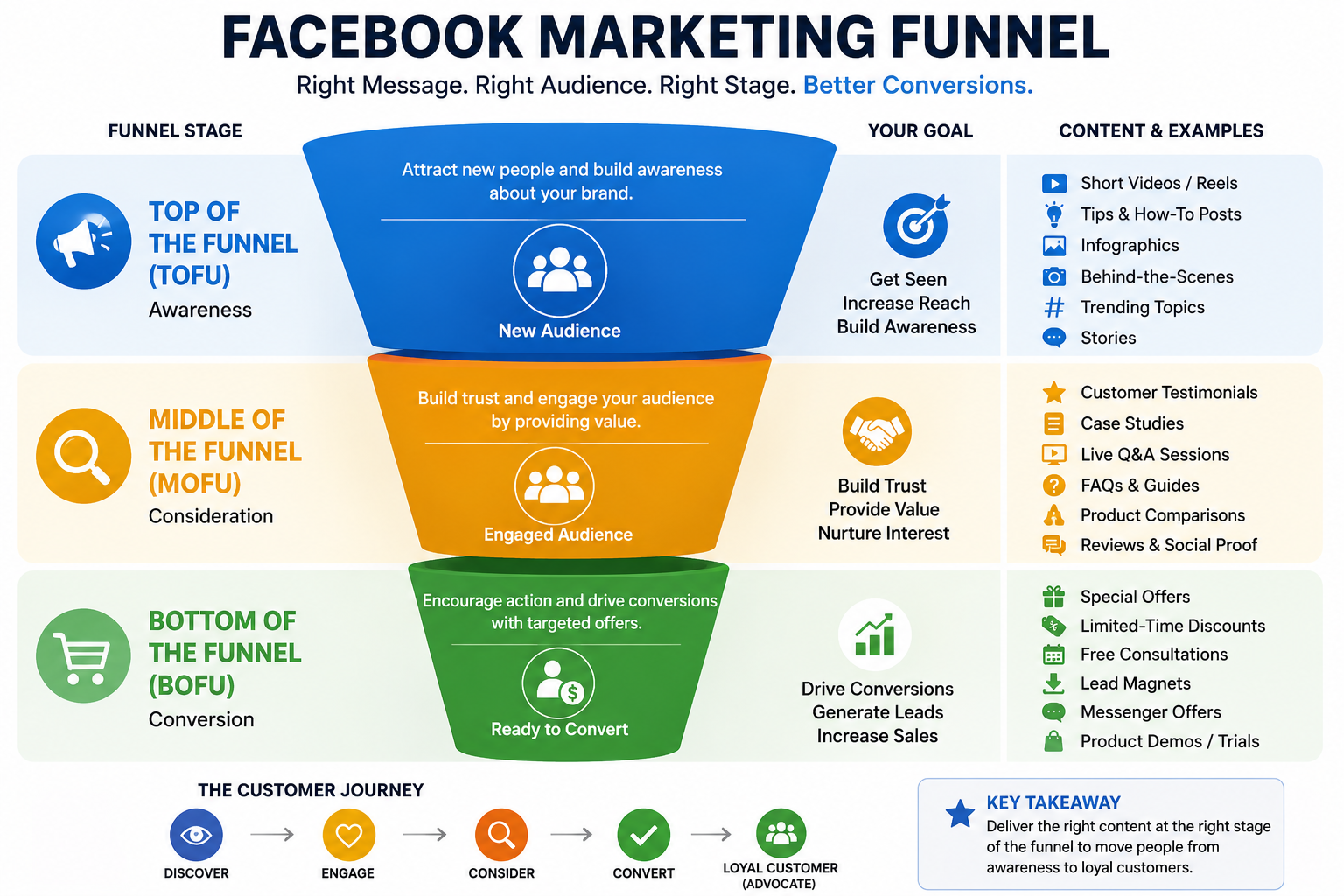
Many businesses expect a single Facebook post or ad to generate instant sales. In reality, most people don’t buy the first time they just discover a brand.
They need time to learn about your business, compare options, and build trust before making a decision.
That’s why the most successful businesses don’t just post content; they opt for social media marketing services build a marketing funnel.
A solid Facebook marketing strategy analyzes the customer journey to turn awareness into conversions.
Top of the Funnel (TOFU): Build Awareness
At this stage, your audience may not even know your business exists. Your goal isn’t to sell; it’s to capture attention and provide value.
Focus on educational and engaging content such as:
- Short-form videos and Reels
- Industry tips and quick how-to posts
- Infographics
- Behind-the-scenes content
- Trending topics
- Stories that highlight your brand personality
Keep the messaging informative rather than promotional. The more value you provide, the more likely people are to remember your brand.
Middle of the Funnel (MOFU): Build Trust
Once people are familiar with your business, they begin evaluating whether you’re the right solution. This is where trust-building content becomes essential.
Share content like:
- Customer success stories
- Testimonials and reviews
- Case studies
- Product demonstrations
- Facebook Live Q&A sessions
- FAQs
- Comparison posts
- Educational webinars
This stage answers the questions potential customers are already asking and reduces hesitation before making a purchase.
Bottom of the Funnel (BOFU): Drive Conversions
Now your audience knows who you are and trusts your business. It’s time to encourage action.
Use high-converting content such as:
- Free consultations
- Limited-time offers
- Product demos
- Free trials
- Lead magnets
- Exclusive discounts
- Messenger conversations
- Appointment booking campaigns
Every post or ad should include one clear call-to-action. Avoid overwhelming users with multiple choices.
Step 4: Create Content That Moves People Toward a Decision
Not all Facebook content serves the same purpose. Some posts attract attention, while others educate, build credibility, or encourage people to take action.
A balanced content strategy ensures you’re guiding potential customers through every stage of the buying journey instead of constantly selling to them.
Content Formats That Perform Well
Facebook offers a variety of content formats, each suited to different goals:
- Reels for increasing reach and visibility.
- Short videos to explain products or services.
- Carousels for showcasing multiple features or products.
- Stories for sharing quick updates and behind-the-scenes moments.
- Live videos to answer questions in real time and connect with your audience.
- Polls and quizzes to boost engagement and gather feedback.
- User-generated content to build authenticity.
- Customer testimonials to establish trust.
Mixing these formats keeps your audience engaged while helping Facebook’s algorithm distribute your content more effectively.
Follow the 70-20-10 Content Rule
You need to understand that Facebook is not a sales brochure. It is a platform that can create a strong presence. The constant promotional posts result in lower engagement and audience fatigue.
Instead, it’s important to follow a content rule that gives you an edge:
- 70% Educational Content: Educate your audience before you convert them. Share industry-related tips, guides, insights, and helpful resources.
- 20% Trust-Building Content: Share customer feedback and reviews to gain credibility. As your brand grows, you can share company culture, success stories, and social proof to gain visibility.
- 10% Promotional Content: Showcase offers, product launches, discounts, or direct calls to action.
This approach positions your brand as a helpful resource rather than just another advertiser.
Create a Monthly Content Calendar
Planning content in advance helps maintain consistency and prevents last-minute posting fatigue.
A simple weekly schedule for posting on Facebook looks like:
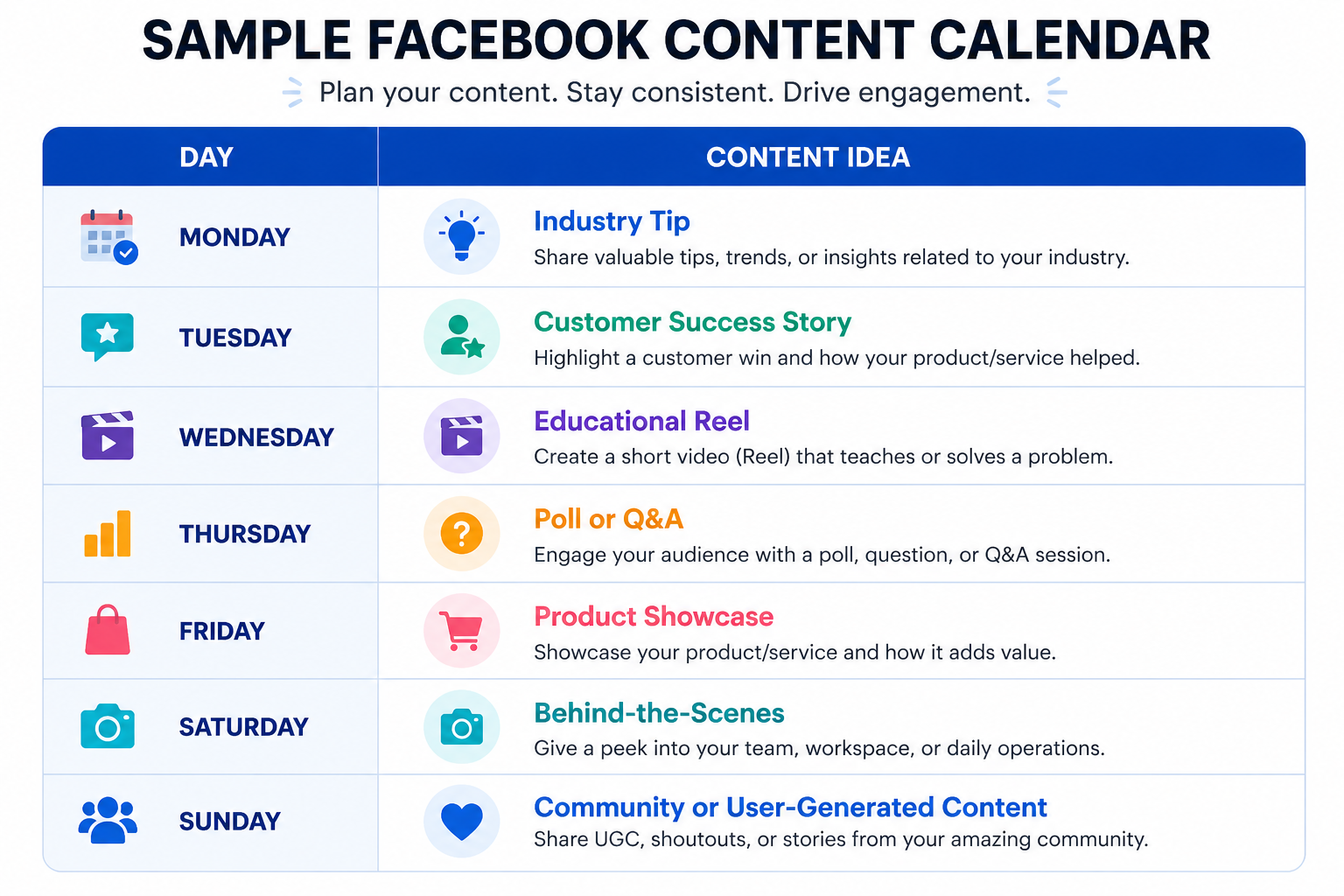
A content calendar also makes it easier to align posts with seasonal campaigns, product launches, and promotional events.
Step 5: Pair Organic Content With Paid Campaigns
Organic content is excellent for building trust and nurturing relationships, but relying on organic reach alone can limit your growth.
Facebook’s algorithm prioritizes meaningful interactions, meaning even high-quality posts may only reach a small portion of your audience.
That’s where Facebook advertising comes in.
Paid campaigns help amplify your best-performing content and place it in front of people who are most likely to convert.
Think of it this way:
- Organic content builds credibility.
- Paid advertising accelerates growth.
The two work best when used together.
Match Campaign Types to Your Goals
Choose campaign objectives based on what you want to achieve.
| Goal | Recommended Campaign |
| Brand Awareness | Awareness Campaign |
| Website Visits | Traffic Campaign |
| Lead Generation | Instant Forms |
| Online Sales | Sales Campaign |
| App Downloads | App Promotion |
| Event Signups | Engagement Campaign |
Avoid boosting every post. Instead, create campaigns inside Meta Ads Manager, where you have access to advanced targeting, testing, and reporting features.
Want to Set Up Marketing Campaign for Your Brand? Get in touch with our expert team today!
Step 6: Optimize Your Facebook Ads for Conversions
Running Facebook ads is easy. Creating Facebook marketing strategy UAE that caters both local and international audiences.
Every element of your campaign should encourage users to complete a specific action.
Write Benefit-Focused Ad Copy
Instead of listing features, explain how your product or service solves a problem.
People care more about outcomes than specifications.
Use High-Quality Visuals
Whether you’re using static images, videos, or carousels, your creative should capture attention within the first few seconds.
Match the Ad to the Landing Page
One of the biggest reasons campaigns fail is poor message consistency.
If your ad promotes a free consultation, your landing page should immediately reinforce that offer, not send users to a generic homepage.
Install Meta Pixel
Meta Pixel helps track user behavior after someone clicks your ad.
It allows you to monitor actions such as:
- Page views
- Purchases
- Form submissions
- Add-to-cart events
- Newsletter signups
This data helps improve targeting while making future campaigns more effective.
Test Everything
Never assume your first ad is the best.
Run A/B tests for:
- Headlines
- Images
- Videos
- Calls-to-action
- Audience segments
- Landing pages
Small improvements in click-through or conversion rates can significantly increase your return on investment over time.
Step 7: Build a High-Converting Landing Page
Even the best Facebook ad can’t compensate for a poor landing page.
If users click your ad only to land on a confusing or slow-loading page, they’re likely to leave without taking action.
A high-converting landing page should include:
- A compelling headline
- Clear value proposition
- One primary call-to-action
- Fast loading speed
- Mobile-friendly design
- Trust badges
- Customer testimonials
- Simple lead forms
- Minimal distractions
Remember, every extra click or unnecessary form field increases the chances of losing a potential customer.
Step 8: Use Retargeting to Recover Lost Customers
Most visitors won’t convert the first time they interact with your business. That doesn’t mean they’re not interested; it often means they need another reminder.
Retargeting helps bring these users back.
You can retarget:
- Website visitors
- People who watched your videos
- Users who engaged with your Facebook Page
- Shopping cart abandoners
- Existing email subscribers
- Previous customers
A simple retargeting sequence might look like this:
Facebook Ad → Website Visit → No Purchase → Retargeting Ad → Landing Page → Conversion
Retargeting campaigns often produce higher conversion rates because you’re reaching people who already know your brand.
Step 9: Track the Metrics That Actually Matter
If you’re still measuring success by likes and followers alone, you’re missing the bigger picture.
Instead, focus on metrics that directly reflect business growth.
Monitor:
- Conversion Rate
- Cost Per Lead (CPL)
- Cost Per Acquisition (CPA)
- Click-Through Rate (CTR)
- Return on Ad Spend (ROAS)
- Landing Page Conversion Rate
- Customer Lifetime Value (CLV)
- Revenue Generated
Review your analytics regularly and identify areas for improvement.
The most successful marketers treat every campaign as an opportunity to learn, test, and optimize.
Read more: How to build social media KPIs that actually matter
Common Facebook Marketing Mistakes That Hurt Conversions
Even experienced marketers can fall into habits that limit campaign performance.
Avoid these common mistakes:
- Posting without a clear objective
- Chasing likes instead of business results
- Ignoring audience research
- Sending ad traffic to the homepage
- Using weak or unclear calls-to-action
- Forgetting to install Meta Pixel
- Never retargeting interested visitors
- Using the same creative for months
- Neglecting A/B testing
- Failing to review campaign performance
Avoiding these pitfalls can make a significant difference in the effectiveness of your Facebook marketing strategy UAE.
AI Is Changing Facebook Marketing
Artificial intelligence is reshaping how businesses advertise on Facebook. Meta now offers AI-powered tools that simplify campaign management while improving performance.
Some of the most useful features include:
- Meta Advantage+ Campaigns for automated optimization.
- AI-powered audience expansion to discover high-potential customers.
- Predictive budget allocation for better ad spend efficiency.
- Automated placements across Facebook, Instagram, Messenger, and Audience Network.
- AI-generated creative suggestions to test different headlines and visuals.
While AI can improve efficiency, it shouldn’t replace strategy.
Businesses that combine automation with human creativity, customer insights, and compelling storytelling will continue to outperform those relying solely on algorithms.
Get a Free Facebook Marketing Guide in 2026!
A Simple Facebook Marketing Framework
Instead of treating Facebook as just another social platform, think of it as a complete customer acquisition system.
Business Goal
↓
Audience Research
↓
Content Planning
↓
Organic Posts
↓
Paid Campaigns
↓
Landing Page
↓
Retargeting
↓
Measure Results
↓
Optimize & Scale
When every stage works together, Facebook becomes more than a platform that is more than just gaining likes; it becomes a reliable channel for generating leads, nurturing relationships, and driving long-term business growth.
Bottom Line
A successful Facebook presence isn’t measured by the number of likes your posts receive.
It is measured by the number of leads it generates. When you set clear goals, understand your audience, and create content for every stage of the buyer’s journey, it creates an impact. You can build a system that consistently attracts, nurtures, and converts potential customers.
By following this Facebook marketing guide, you can create a framework that is more than a simple checklist. Review your performance regularly, test new ideas, refine your campaigns based on data, and adapt to changing customer behavior. Even small improvements in targeting, content, or ad performance can lead to significant gains over time.
FAQs
What is a Facebook marketing strategy?
A structured plan for using Facebook content, targeting, and ads to move people from awareness to purchase, rather than just posting for engagement.
How much should a business budget for Facebook ads in the UAE?
Budgets vary widely by industry and goal, but most SMBs in the UAE start testing with AED 500–2,000/month per campaign before scaling based on cost-per-lead performance.
How long does it take to see results from a Facebook marketing strategy?
Organic content typically needs 4–6 weeks to build traction; paid campaigns can generate leads within days but usually need 2–4 weeks of testing to optimize cost per acquisition.


