


You set up a campaign.
You define your audience, write compelling copy, and set the budget.
Yet when you launch the campaign, the results don’t match expectations. Why?
Well, you monitor inconsistency in clicks, low conversions, and performance that feels unpredictable.
In most cases, it is not creative or even the wrong audience targeting. It is the choice of ad format that results in failure.
Ads such as search, display, and video all come under the umbrella of digital advertising. But they all serve different purposes.
Choosing the wrong ad format can result in minor inefficiency that can impact return on investment.
Understanding when and why to use each format is what results in more effective yet structured growth.
Before we dig in, let’s consider some of the types of ads.
The 3 Ad Types You’re Choosing Between
Before making any strategic decisions, it is essential to clearly understand how each ad type functions and what role it plays in the broader sense.
-
Search Ads
Search ads appear on search engine results pages when users actively look for specific information, products, or services. Let’s consider an example,
When we searched for “best dental clinic in Dubai,” we can see a number of sponsored ads. These ads are triggered by keywords. It means they rely on user intent rather than passive exposure.
What makes search ads effective is the mindset of the user. Someone typing a query into a search engine is already problem-aware and looking for a solution. This creates a direct pathway for marketing experts.
They understand how to convert intent into conversions. This makes search ads the most effective format for performance-driven campaigns.
-
Display Ads
Display ads are the best way of visual advertising. It appears across websites, mobile apps, and digital platforms.
Unlike search ads, these ads do not rely on queries; instead it target users based on their interests, behaviors, or browsing history of the users. Let’s consider an example,
This Semrush display ad, offers better visibility without enforcing the consumer, rather it offers immediate action. Display ads present a brand in a user’s environment, gradually building familiarity and recognition with time.
-
Video Ads
Video ads are all over platforms such as YouTube and social media platforms such as Facebook, Instagram or Messenger. These visuals provide better storytelling, motion and sound.
Unlike static, meta ads allow brands to communicate more complex messages and emotional narratives within a short time period. Learn more about Meta ads and how they work.
This ad format is particularly effective for influencing perception, demonstrating value, and creating a memorable brand presence. While these video ads might not always drive instant conversions, they help shape audience perception and boost brand trust.
The Real Difference: Intent vs Attention vs Influence
Even before you choose an ad format, it’s important to understand the purpose. Are you launching a campaign for search intent? Or to grab attention, or to influence the audience?
Understanding the difference will give you clarity. The most effective way to differentiate these ad formats is by understanding the psychological state of the user intent.
Search ads work best when targeting user intent. When a user is actively looking for something, it means the brand’s role is to provide the most relevant and immediate solutions to the consumers.
This is often where conversions happen because the decision-making process is already underway.
Display ads focus on a short attention span. The target audience is not actively seeking a product, so the objective is to capture interest and maintain visibility.
Success here is measured less by immediate action and more by long-term brand recall and repeated exposure.
Video ads go one step further by influencing perception.
They allow brands to shape opinions, demonstrate value, and build emotional connections. Instead of simply seeing video ads, it offers experiences, making them particularly effective for building trust and differentiation.
Search vs. Display vs. Video ads: Which One is Right For You?
| Factor | Search Ads | Display Ads | Video Ads |
| User Intent | High | Low | Medium |
| Primary Goal | Conversions | Awareness | Engagement |
| Cost Model | Cost-per-click | Cost-per-impression | Cost-per-view |
| Strength | Immediate action | Broad reach | Storytelling |
| Funnel Role | Bottom | Top | Top to middle |
This comparison table helps identify your long term goals. These ads are designed for different stages of branding. Right branding comes from understanding what PPC is and how top brands leverage it.
For an effective and successful campaign, it’s important to choose the right ad format. Let’s take a look at which ad type you should choose for better conversions.
When to Use Search Ads
Search ads are most effective when there is a clear, existing demand for a product or service. When users are actively searching with an intent, the search campaigns can capture the demand with precision and convert it into measurable outcomes.
Use Search Ads When
Search ads should be prioritized when your objective is to drive immediate results such as leads, inquiries, or purchases. They are particularly effective for businesses operating in competitive markets where users are already comparing options and decision making.
You need to understand that an ad appearing at the right moment and displaying the right message can instantly result in a better conversion rate.
They are also well-suited for campaigns with limited budgets because they focus on high-intent traffic rather than broad exposure. This makes search ads more efficient, measurable, and easier to optimize with time.
Avoid Search Ads When
Search ads are less effective when the demand of the users isn’t searching for it.
If your users are unfamiliar with your product category that means they are not actively searching for it. Search campaigns will struggle to generate meaningful results.
In such cases, relying solely on search can lead to low volume and missed opportunities for growth.
When to Use Display Ads
Display advertising is designed to create visibility rather than capture immediate intent. It works best in scenarios where building awareness and maintaining presence are more important than driving instant action.
Use Display Ads When
Display ads are particularly effective for reaching new audiences at scale. They allow brands to stay visible across multiple touchpoints, reinforcing messaging and increasing familiarity over time. This makes them valuable for long sales cycles, where users require multiple interactions before making a decision.
They are also highly effective for retargeting. By reconnecting with users who have already visited your website or engaged with your brand, display ads help keep your brand at the top of users’ minds.
Avoid Display Ads When
Display campaigns can underperform when expectations are misaligned. If the goal is immediate conversions without prior audience exposure, results may appear weak. Without strong targeting and clear messaging, display ads might become a background noise or ad that users skip rather than offering better conversions.
When to Use Video Ads
Video advertising adds depth to digital campaigns by combining visual storytelling with emotional engagement. It is not just about visibility; it is about creating impact.
Use Video Ads When
Video ads are most effective when a brand needs to communicate more than just a headline or image. They are ideal for demonstrating products, explaining services, or introducing a brand narrative. This makes them especially valuable during product launches, rebranding efforts, or campaigns focused on differentiation.
They also perform well on platforms where users are already consuming content, allowing brands to integrate into the viewing experience rather than interrupt it. This increases engagement and improves message retention.
Avoid Video Ads When
Video ads require a higher level of creative investment. Without strong visuals, clear messaging, and an engaging opening, they can lose audience attention quickly. If resources are limited or the message is not clearly defined, simpler formats may deliver better results.
Mapping Ad Types to the Marketing Funnel
Understanding how each format fits into the marketing funnel provides clarity on when to use them.
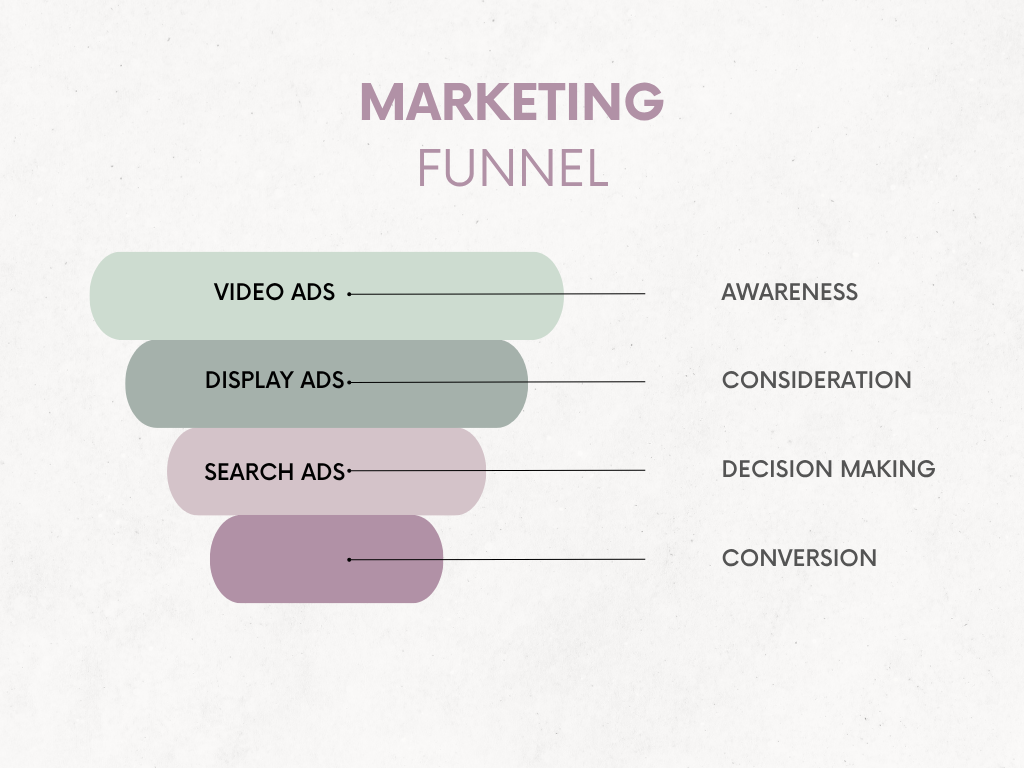
At the top of the funnel, the focus is on awareness. Display and video ads are particularly effective here because they introduce the brand to new audiences and spark initial interest.
In the middle of the funnel, the goal shifts to consideration. Video content can deepen understanding, while display retargeting reinforces messaging and keeps users engaged.
At the bottom of the funnel, where decisions are made, search ads become the primary driver. This is where intent is strongest, and the opportunity to convert is highest.
Budget and Resource Considerations
Choosing the right mix of ad formats is also influenced by available budget and internal capabilities.
For smaller budgets, focusing on search ads often delivers the most immediate return. The ability to target high-intent users ensures that spending is directed toward those most likely to convert.
With moderate budgets, combining search with display retargeting creates a balanced approach. This allows brands to capture demand while also nurturing users who are not yet ready to convert.
For larger budgets, a full-funnel strategy becomes viable. Video builds awareness, display reinforces presence, and search captures conversions. This integrated approach maximizes both reach and efficiency.
It is also important to consider resources that can help you set the right budget. Seek professional PPC services to come up with the right keyword strategy and compelling copy. At Rankhive, we believe that ads are more than just visual design or compelling text.
Our team of experts takes into consideration every step for an effective ad campaign. We build a strategy that delivers results.
Curating a Strategy That Delivers Consistent Results
An effective strategy is what makes branding consistent.
And no it doesn’t rely on a single format. Instead, it creates a structured journey across multiple touchpoints.
A typical high-performing strategy begins with video ads to introduce a brand that communicates its value. Display ads then retarget users who have shown interest, reinforcing the brand message and visibility.
Finally, search ads capture users when they are ready to take action.
This approach aligns with how users naturally move through the decision-making process, making campaigns more effective.
A Simple Decision Framework
To simplify the decision-making process, it is useful to evaluate campaigns through a structured lens.
Start by defining the primary objective. If the goal is immediate conversions, search ads are typically the most effective choice. If your brand is focusing on building awareness, display or video ads are a more appropriate choice.
Next, consider whether users are actively searching for your product or service. Understanding the demand favors search, while new or unfamiliar offerings benefit from display and video ads.
Creative ads build strong brand visibility. The visual or video assets are available, and expanding into display or video becomes more viable. Otherwise, search provides a more accessible starting point.
Finally, aligning the budget with the resources available is important. Smaller budgets require focus and efficiency, while larger budgets offer diversification and full-funnel execution.
Turning Strategy Into Results at Rankhive!
You need to understand that there is no single ad format that consistently performs. It’s important to understand that each type of ad serves a distinct purpose within the broader marketing strategy.
Our experts understand that search ads capture demand when users are ready to act. Whereas, display ads maintain visibility and build familiarity with your brand over time. Video ads shape perception and create deeper brand engagement.
The real advantage comes from understanding how these formats work together.
For a successful marketing campaign, it’s important to align with clear objectives, audience intent, and available resources. It is a system that drives not just traffic, but sustainable growth.


