


You post consistently. Your Facebook page looks active. You may even have a decent number of followers. Yet your posts barely reach anyone.
Sound familiar?
A drop in Facebook reach doesn’t always mean the platform has suddenly stopped working for your business. More often, it is a sign that your Facebook marketing strategy needs a closer look.
Facebook remains a major platform for businesses, but the way people discover and interact with content has changed. In 2026, successful Facebook marketing is less about simply filling your content calendar and more about creating content that earns attention, conversation, and action.
The frustrating part is that some of the mistakes hurting your reach are not obvious. You may be making them without realizing it.
Let’s uncover what you have been doing wrong and what you should do instead.
Why Is My Facebook Reach So Low?
Before changing your entire social media strategy, look at what your content is actually telling you.
Low Facebook reach can be linked to weak engagement, irrelevant content, audience fatigue, inconsistent publishing, poor content-format choices, or a failure to learn from your performance data. A single underperforming post isn’t necessarily a problem. A pattern across several weeks is worth investigating.
Think of your Facebook page as a conversation rather than a notice board.
If your audience has no reason to stop, read, watch, comment, or share, simply publishing more posts won’t solve the problem.
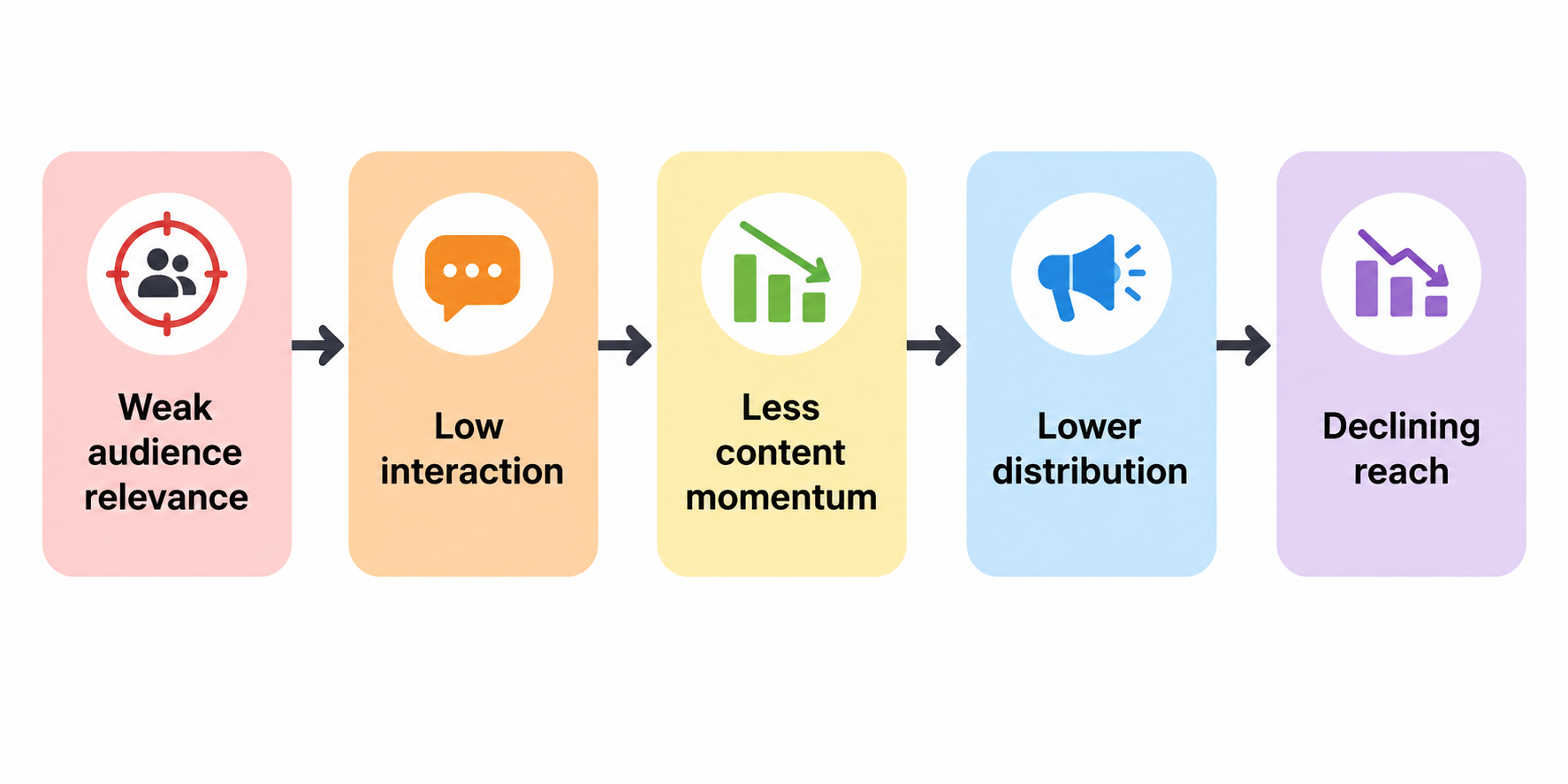
This is what actually happens when you make mistakes in Facebook marketing.
And what happens when you actually pay attention to Facebook marketing?
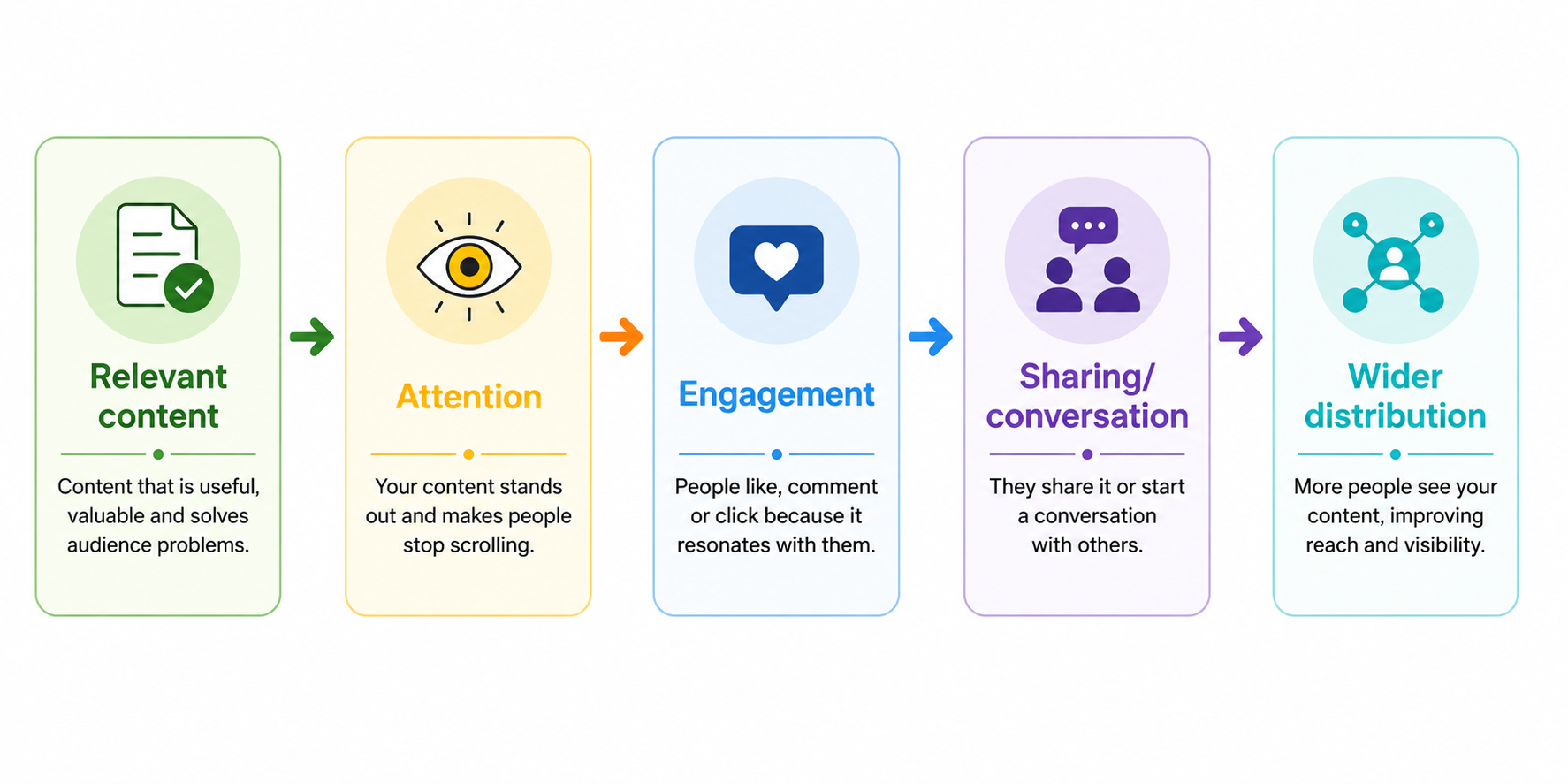
You see, creating relevant content for branding isn’t hard, but let’s dive into what you should be doing for effective Facebook marketing.
Mistake #1: Your Post Isn’t Audience Centric
Sharing content that is business centric rather than audience-centric won’t convert. To get better engagement and response, it is important to create a Facebook page that is all about your audience.
Analyze your Facebook page to see:
How many post are about your company?
“ We’re excited to announce…”
“Check out our latest service…”
“Meet our new team member…”
“Contact us today…”
There is nothing initially wrong with these posts. The problem starts when most of your content revolves around what you want to say instead of what your audience wants to know.
Your followers aren’t opening Facebook because they are waiting for your next sales announcement. They want useful information, interesting stories, entertainment, opinions, solutions, and conversation.
Why does this affect Facebook reach?
Content that doesn’t connect with the audience has little reason to generate interaction. If people consistently scroll past your posts, your content isn’t giving you useful signals it deserves.
What should you post instead?
Build your Facebook content strategy around your audience needs. For example, a digital marketing company could replace:
“We offer SEO services for businesses.”
with:
“Getting website traffic but almost no inquiries? These three SEO problems could be responsible.”
The second post starts with a problem that your audience is facing. The service can come later as a solution.
A useful rule is:
Talk about the customer’s problem before you talk about your solution.
This is one reason a structured approach to social media marketing can make such a difference. Whether you’re building content in-house or working with a digital marketing team such as Rankhive.
Mistake # 2: Every Post Sounds Like an Advertisement
This is one of the fastest ways to turn a Facebook page into a digital billboard. Imagine scrolling through your feed and seeing:
Buy now.
Book a consultation.
Get 20% off.
Contact us today.
Limited-time offer.
Again, promotional content has a place in Facebook marketing strategy. But if every post asks for a sale, your audience has little incentive to keep paying attention.
The better approach: Give before you ask
Instead of making every post conversion-focused, create content that builds familiarity and trust for your brand.
Try a mix of:
- Educational tips
- Industry insights
- Customer stories
- Behind-the-scenes content
- Quick how-to posts
- Questions and discussions
- Short videos
- Product demonstrations
- Case studies
- Occasional promotions
The exact ratio doesn’t have to be rigid. The important thing is that your page should provide value even when someone isn’t ready to buy.
A simple content journey
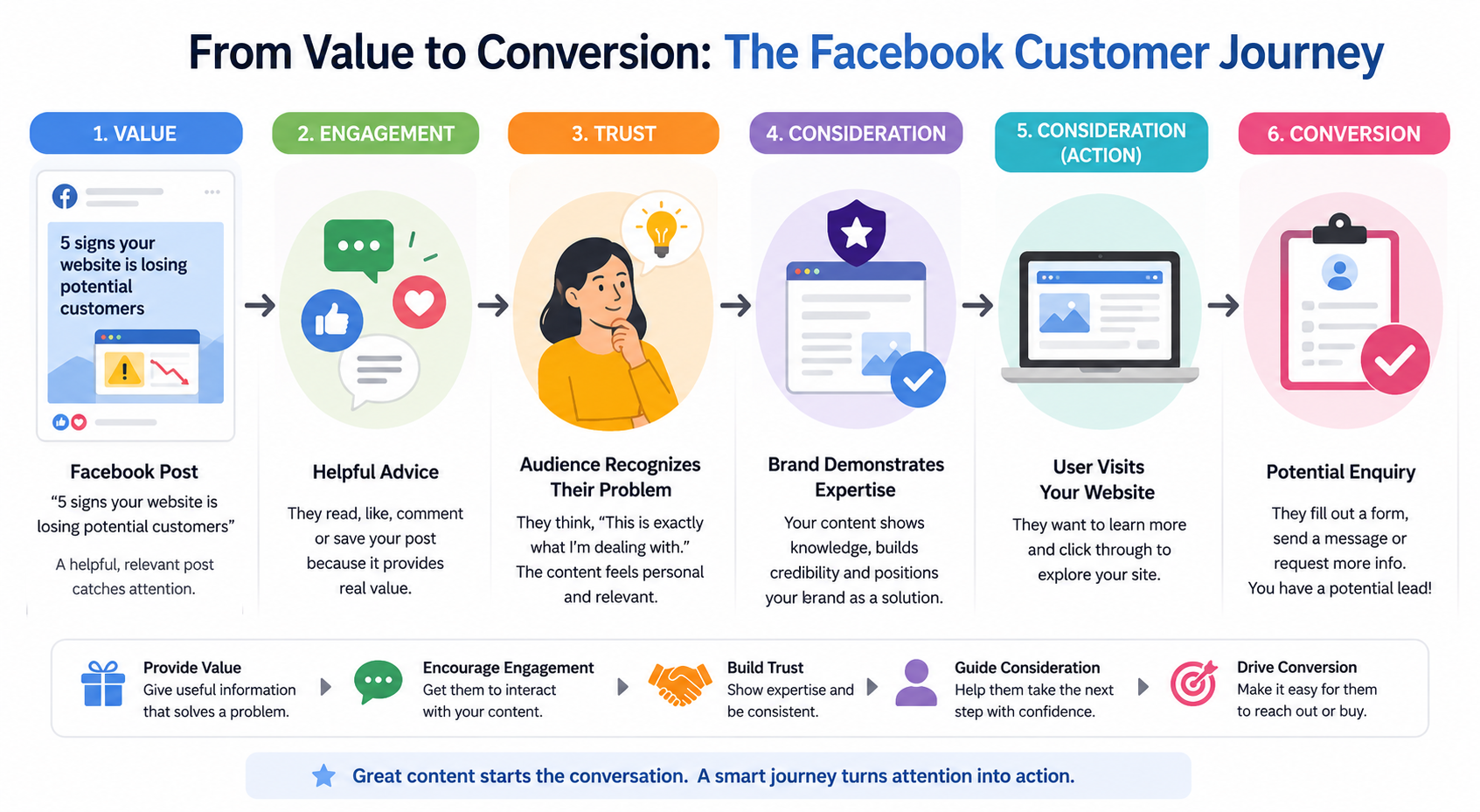
This is a much healthier customer journey than asking for a sale in every post.
Mistake #3: You’re Guessing What Your Audience Wants
You know your industry.
That doesn’t necessarily mean you know what your audience is actually looking for on Facebook.
This distinction matters.
A marketing manager might assume followers want detailed industry insights. The audience may actually respond better to practical tips. A software company may spend weeks creating product announcements while customers engage far more with troubleshooting videos.
The warning signs
You may be targeting the wrong audience if:
- Your posts receive impressions but almost no interaction
- Your followers don’t resemble your ideal customers
- Certain topics consistently outperform everything else
- You get views but very few meaningful actions
- Your audience rarely comments or shares your posts
Instead of relying on assumptions, use your Facebook analytics and content performance data to identify the right patterns.
Look at:
Topic → Format → Reach → Engagement → Clicks → Conversions
Then ask:
What do my best-performing posts have in common?
That answer should influence your next batch of content.
Don’t confuse reach with relevance
A post reaching 10,000 people isn’t automatically better than one reaching 2,000.
If the 2,000-person post generates qualified website visits, inquiries, shares, and meaningful conversations, it may be much more valuable.
Mistake #4: You’re Chasing Consistency Instead of Quality
Chasing never attracts what quality content can.
“Post every day.”
It’s advice you’ll hear everywhere in social media marketing expert.
But consistency doesn’t mean publishing something simply because your content calendar says Tuesday is “Facebook post day.”
A page full of filler content isn’t necessarily better than a page publishing fewer, more useful posts.
With a Facebook marketing guide, it’s important to structure content strategies and meaningful engagement rather than publishing random content.
The problem with filler content
Posts with no real value fail to make an impression:
- Generic motivational quotes
- Recycled stock images
- Repeated promotional graphics
- “Happy Monday!” posts with no real value
- Industry facts with no useful context
If your team is struggling to find something worth publishing, the answer isn’t necessarily to increase posting frequency.
It may be time to rethink the content strategy.
Use this strategy instead:
Create → Publish → Measure → Improve → Repeat
Start with a realistic schedule your team can maintain. Then focus on making every post with a purpose.
Ask:
- Is it educating?
- Is it solving a problem?
- Is it starting a conversation?
- Is it entertaining?
- Is it building trust?
- Is it moving someone further down the customer journey?
If the answer is none of these, the post probably needs another look.
Mistake #5: You’re Ignoring Post Engagement
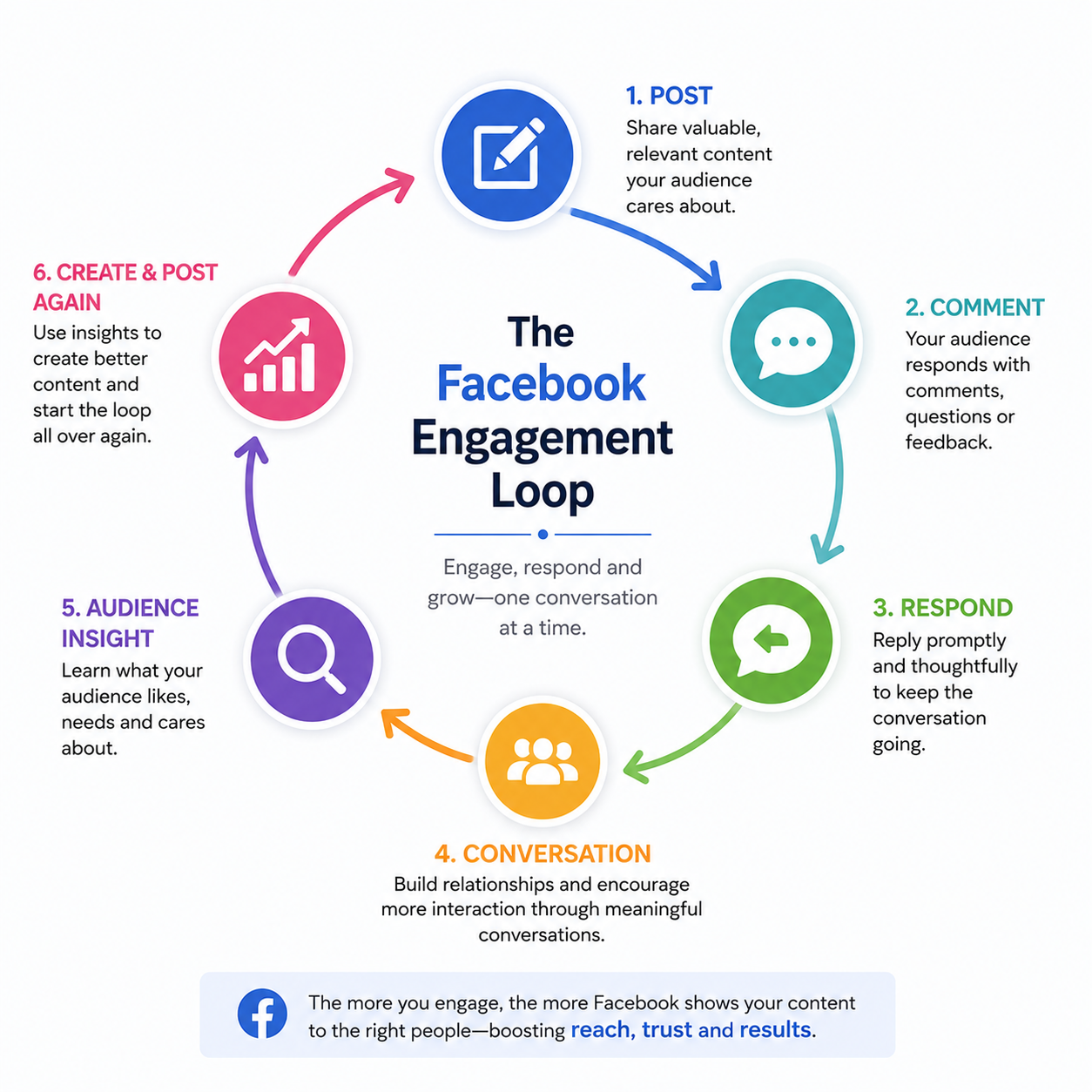
Right after publishing, your job isn’t done. Engaging with your audience is what makes it the real deal.
One of the most overlooked Facebook marketing mistakes is treating comments as notifications rather than opportunities.
Someone asks a question under your post.
You don’t respond.
Someone shares an experience.
Giving just a genric reaction like “Thanks!”means loosing an opportunity.
Someone disagrees with your opinion.
You ignore them; this is what happens when you miss a valuable opportunity on the table.
Why comments matter
Facebook is fundamentally a social platform. People don’t just consume content; they interact with it.
A thoughtful comment can become the start of a genuine conversation. That conversation can build trust with the original commenter and make the post more useful to everyone else reading it.
Turn comments into content
Suppose you publish:
“What’s the biggest challenge you face with Facebook advertising?”
Someone replies:
“I get clicks but no conversions.”
Don’t stop at:
“Thanks for sharing!”
Instead, answer the problem.
Then turn recurring questions into future posts, videos, carousels, or FAQs. Your audience is effectively giving you a free list of content ideas.
Follow along the post and engagement your audience is interacting with to get content ideas.
Mistake #6: You’re Repeating the Same Content Format
Imagine walking into a restaurant where every meal looks exactly the same.
Eventually you’ll end up leaving.
Your Facebook audience is also experiencing the same content everywhere.
Graphic + caption + link.
Then again.
And again.
And again.
Your Facebook content strategy should leave room for experimentation.
Formats worth testing
Depending on your business type and audience, you can try different formats like:
- Facebook Reels
- Short-form educational videos
- Carousels
- Customer stories
- Product demonstrations
- Behind-the-scenes posts
- Polls
- Questions
- Text-led posts
- User-generated content
- Live sessions
- Case studies
Video is particularly worth testing. Meta itself positions Reels as a major format for connecting with audience. It recommends vertical creative, clear messaging, and testing.
But don’t turn this into another checklist where you blindly publish every format.
The goal isn’t:
“Use everything.”
It’s:
“Test what works for your audience.”
A business may discover that short educational videos outperform static graphics. Another may find that customer stories connect well with the audience, increasing the engagement.
Your data should make that decision.
Mistake #7: You’re Focusing on Likes Rather than Metrics
Here’s a common scenario.
Your latest Facebook post gets 300 likes.
Everyone celebrates.
But it generates:
- 0 inquiries
- 4 website visits
- 2 shares
- No meaningful conversations
Was it successful?
Maybe.
But if your objective was generating leads, probably not.
Likes are easy to see, so marketers naturally become attached to them. But they don’t tell the whole story.
What should you measure?
| Metric | What It Tells You |
| Reach | How many unique people saw your content |
| Engagement rate | Whether people interacted with it |
| Shares | Whether people found it worth passing along |
| Comments | Whether it encouraged conversation |
| Link clicks | Whether it generated interest beyond Facebook |
| Video watch time | Whether people stayed to consume the content |
| Leads | Whether Facebook generated potential customers |
| Conversions | Whether that attention translated into business results |
As per the latest Facebook marketing guide in 2026, the demand is beyond vanity metrics and connecting social performance with meaningful actions such as clicks, leads, and conversions.
The question isn’t simply:
“How many people saw this?”
It’s:
“Did the right people see it, and what happened next?”
How to Fix Your Facebook Reach: A Simple 30-Day Reset
If you’ve recognized several of these mistakes in your own strategy, don’t overhaul everything overnight.
Use the next 30 days as a reset.
Week 1: Audit Your Content
Start with auditing your content. Review your last 20–30 posts to see what you’ve been sharing.
Create four groups:
Keep: Content that consistently performs well.
Improve: Good ideas with weak execution.
Stop: Content that repeatedly underperforms.
Test: New ideas and formats worth experimenting with.
Look for patterns rather than judging individual posts. If you’re following
Week 2: Build Your Content Pillars
Choose three to five topics your audience genuinely cares about.
For example, a B2B marketing company might use:
- Educational content
- Industry insights
- Customer problems
- Case studies
- Brand/community content
This gives your Facebook marketing strategy direction without making every post feel identical.
Week 3: Test Your Formats
Take your strongest topics and present them differently.
For example:
One topic → carousel → Reel → text post → discussion question
Now you have a clearer idea of whether the topic or the format is responsible for performance.
Week 4: Analyze and Refine
Don’t simply look at which post received the most likes.
Compare:
- Reach
- Engagement
- Shares
- Comments
- Clicks
- Video retention
- Leads
- Conversions
Then decide what deserves more attention next month.
This creates a much healthier cycle:
Publish → Analyze → Learn → Improve → Publish
Struggling with reach and engagement? Get in touch with our Facebook marketing expert for maximum leads!
The Bottom Line
Declining Facebook reach isn’t always something you can fix by posting more often.
Sometimes, the problem is much closer to home.
You’re talking too much about your business and keeping them guessing. Publishing generic content, ignoring conversations, repeating the same formats, or celebrating likes instead of business outcomes.
The solution isn’t to chase the algorithm.
It’s to understand your audience better.
Create content that earns attention. Give people a reason to participate. Test different formats. Pay attention to what works. Then use those insights to make your next post better.
That’s what turns Facebook from another item on your social media checklist into a channel that can actually contribute to your marketing goals.
FAQs
1. Why is my Facebook reach suddenly dropping?
Facebook reach can decline when content gets less engagement, becomes too promotional, targets the wrong audience, or stops offering enough value to encourage interaction.
2. What are the biggest Facebook marketing mistakes to avoid?
The most common mistakes include posting overly promotional content, ignoring your audience’s interests, publishing low-value content, using repetitive formats, ignoring comments, and focusing only on vanity metrics.
3. How can I increase my Facebook organic reach?
Create content around your audience’s problems and interests, encourage genuine conversations, test different formats, respond to comments, and use performance data to refine your Facebook content strategy.


